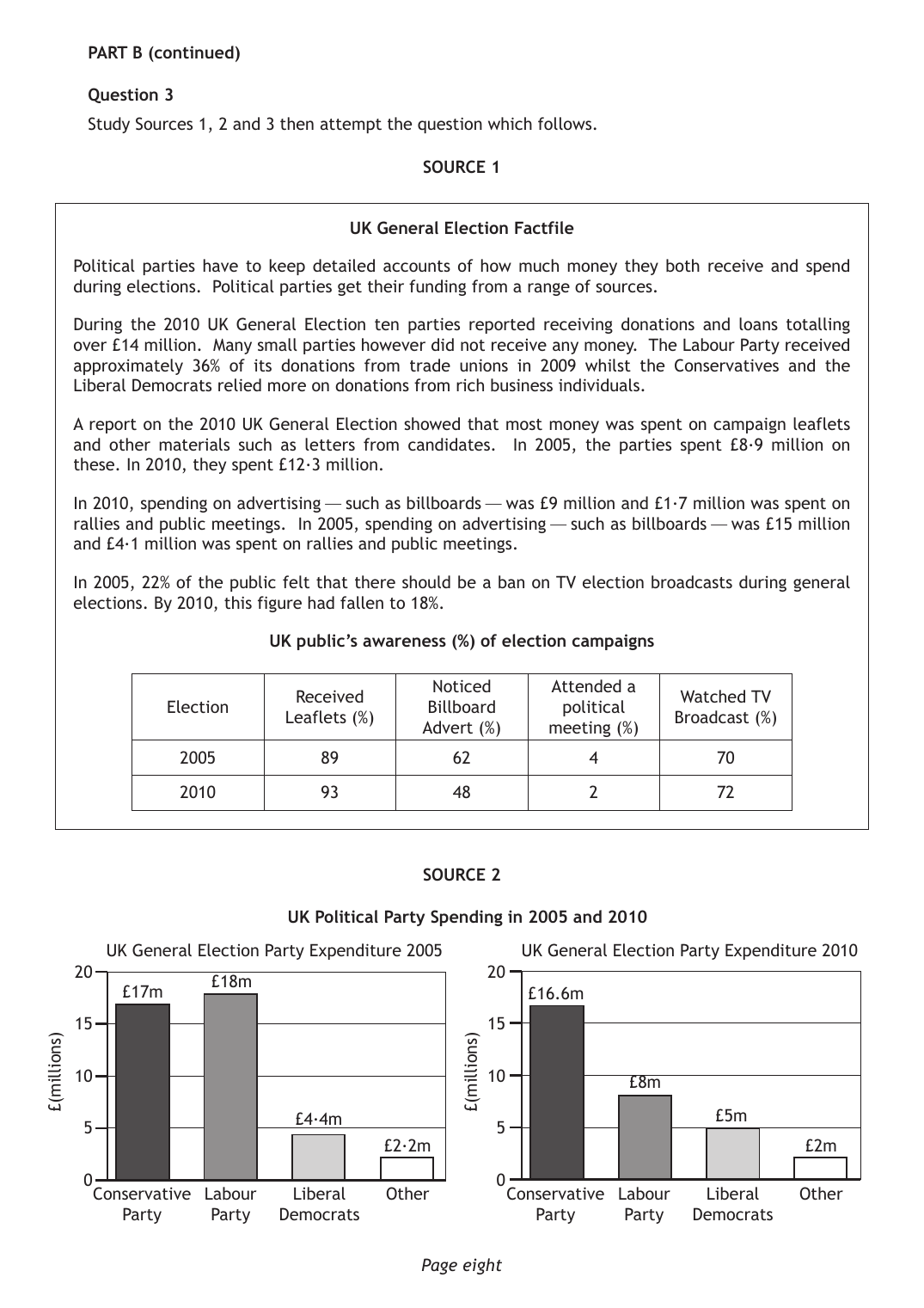
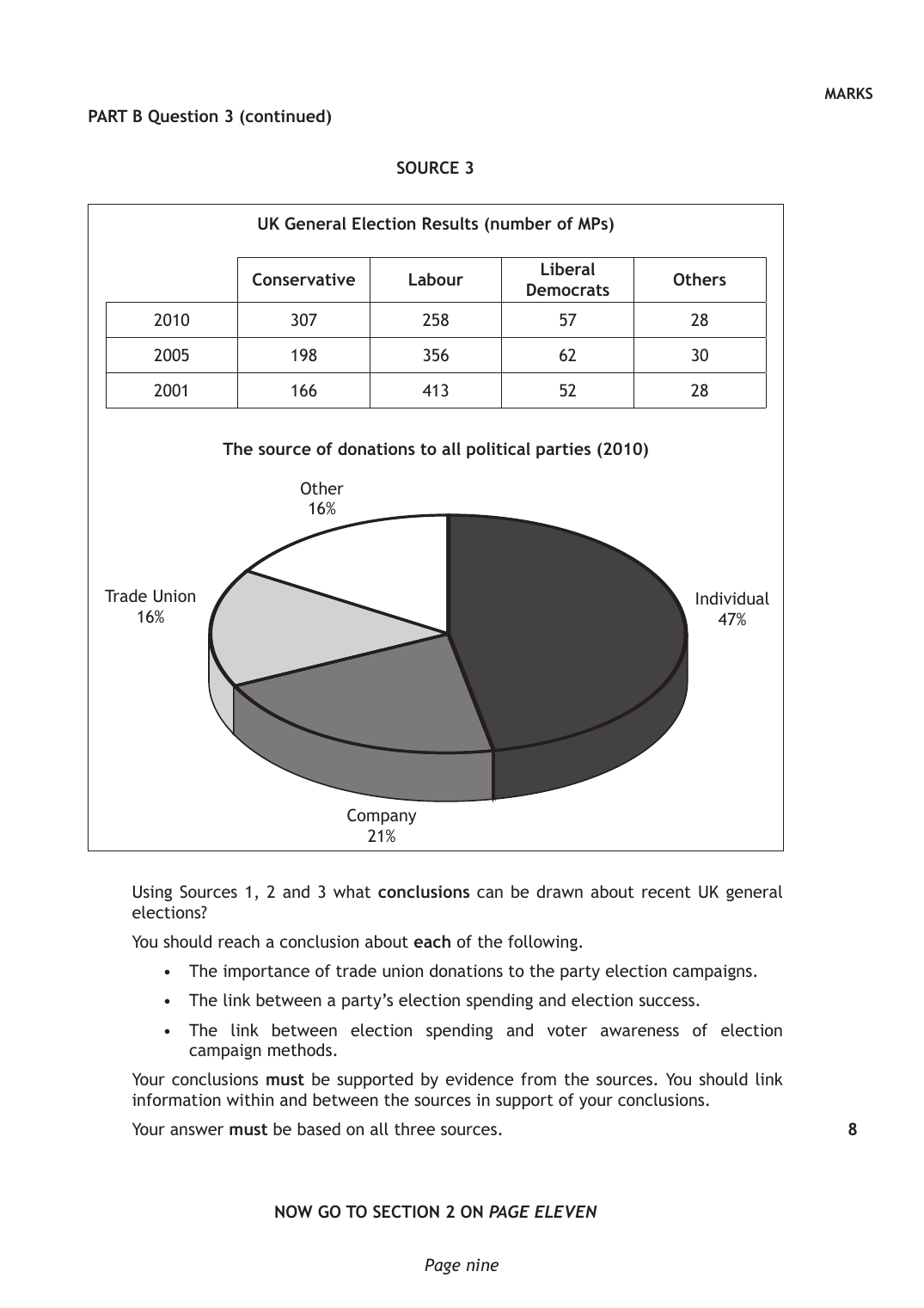
Study Sources 1, 2 and 3 and then answer the question which follows.
Using Sources 1, 2 and 3, what conclusions can be drawn about the 2024 UK General Election?
You should reach a conclusion about each of the following:
- the dominant political party in Scotland after the election
- the electoral performance of the Labour Party in 2024 compared to 2019
- the electoral performance of the Conservative Party in 2024 compared to 2019
- the proportionality of the results of the election.
Your conclusions must be supported by evidence from the sources. You should link information within and between the sources in support of your conclusions.
Your answer must be based on all three sources.
Sources (Source 1, Source 2, Source 3)
📝 Structure template — how to structure your answer
Conclusions · A source-based skills question
WFQ (words from the question)
- For EACH bullet point in the question, write the bullet point as a subheading, then:
- One conclusion that can be made about insert bullet point is insert valid conclusion.✓ 1 mark — valid conclusion
- Evidence to support this is shown in insert source which says/shows “insert evidence”.✓ 1 mark — evidence
- This clearly shows / strongly suggests insert valid conclusion — evaluative language earns the 3rd mark.✓ 1 mark — evaluative language
How it's marked
- Conclusion + one piece of evidence = 2 marks. That is all you need for two of the three marks.
- The 3rd mark does NOT come from a second piece of evidence linked to the same point — it comes from using evaluative terminology (e.g. “this clearly shows”, “the strongest evidence is”, “significantly”, “overwhelmingly”).
- Comparison bullets (e.g. the UK compared with another country): you must give evidence about BOTH sides — but two pieces of evidence together still earn only ONE evidence mark, not two. You can still earn the 3rd mark with evaluative language, exactly as normal.
- Up to 3 marks per bullet point; four conclusions (one per bullet point) are needed for full marks (10).
- Tip: turn each bullet point into a question (e.g. “What is…?”, “What are…?”, “Which…?”, “How…?”) — the answer you give is your conclusion.
- Conclusion + evidence = 2 marks. For the 3rd mark add evaluative language — a second quote linked to the same point does NOT earn it.
- For a comparison bullet you must back BOTH sides with evidence — but that is still only one evidence mark, not two. The 3rd mark still comes from evaluative language.
✓ Reveal marking scheme
These are possible/exemplar answers from the marking instructions — other valid points can also gain marks.
How marks are awarded
- The candidate is required to use a limited range of sources and draw valid conclusions from them, with supporting evidence.
- Candidates should draw conclusions using the bullet points in the question.
- For full marks, four developed conclusions must be given.
- For full marks, candidates must refer to all sources in their answer. Award a maximum of 6 marks if only two sources are used and a maximum of 4 marks if only one source is used.
The dominant political party in Scotland after the election
- Conclusion — The Labour Party were the dominant political party in Scotland after the general election. (1 mark — valid conclusion)
- Conclusion — The Labour Party were the dominant political party in Scotland after the general election. Evidence — In Source 1, it states ‘The voters’ verdict on the SNP was damning with many switching their support back to the Labour Party’ and in Source 2 it shows that the Labour Party secured 37 of the Scottish seats, a significant improvement of 36 on the previous election, proving that they were the most dominant party by a sizeable margin. (3 marks — valid conclusion evidence from two sources and evaluative terminology)
The electoral performance of the Labour Party in 2024 compared to 2019
- Conclusion — The Labour Party performed much better in the 2024 UK General Election compared to 2019. (1 mark — valid conclusion)
- Conclusion — The Labour Party performed much better in the 2024 UK General Election compared to 2019. Evidence — In Source 1, it states that ‘These polls correctly predicted that Labour would win by a landslide’ and in Source 3 it shows that the Labour Party won 412 seats. This was a significant increase of 211 seats compared to 2019. (3 marks — valid conclusion evidence from two sources and evaluative terminology)
The electoral performance of the Conservative Party in 2024 compared to 2019
- Conclusion — The Conservative Party performed extremely poorly in the 2024 UK General Election compared to 2019. (1 mark — valid conclusion)
- Conclusion — The Conservative Party performed extremely poorly in the 2024 UK General Election compared to 2019. Evidence — In Source 1 it states that ‘The Conservatives, on the other hand, failed to retain power, winning less than a quarter of the vote.’ (2 marks — valid conclusion with evidence from one source)
The proportionality of the results of the election
- Conclusion — The results produced by the 2024 UK General Election were unproportional. (1 mark — valid conclusion)
- Conclusion — The results produced by the 2024 UK General Election were unproportional. Evidence — In Source 1 it states ‘Under FPTP, the number of seats a party wins does not always match the percentage of votes they receive. This means the system is not fully proportional’ and in Source 3 it shows that the Labour Party won 33.7% of the votes, which is less than half, but they were awarded 62.2% of the seats which is nearly two thirds of those available. This shows that the percentage of votes and seats were not equal. (3 marks — valid conclusion evidence from two sources and evaluative terminology)