Revise Nat 5
← All Modern Studies

πŸ“Š Source-based skill Β· 10 marks

Decision making

Every decision making question, with its source material and marking scheme. Refine by year or section.

Filter
Year
Section
View

Showing 18 of 18 questions

Decision making10 marks2026Q14Social Issues in the United Kingdom

Study Sources 1, 2 and 3 and then answer the question which follows.

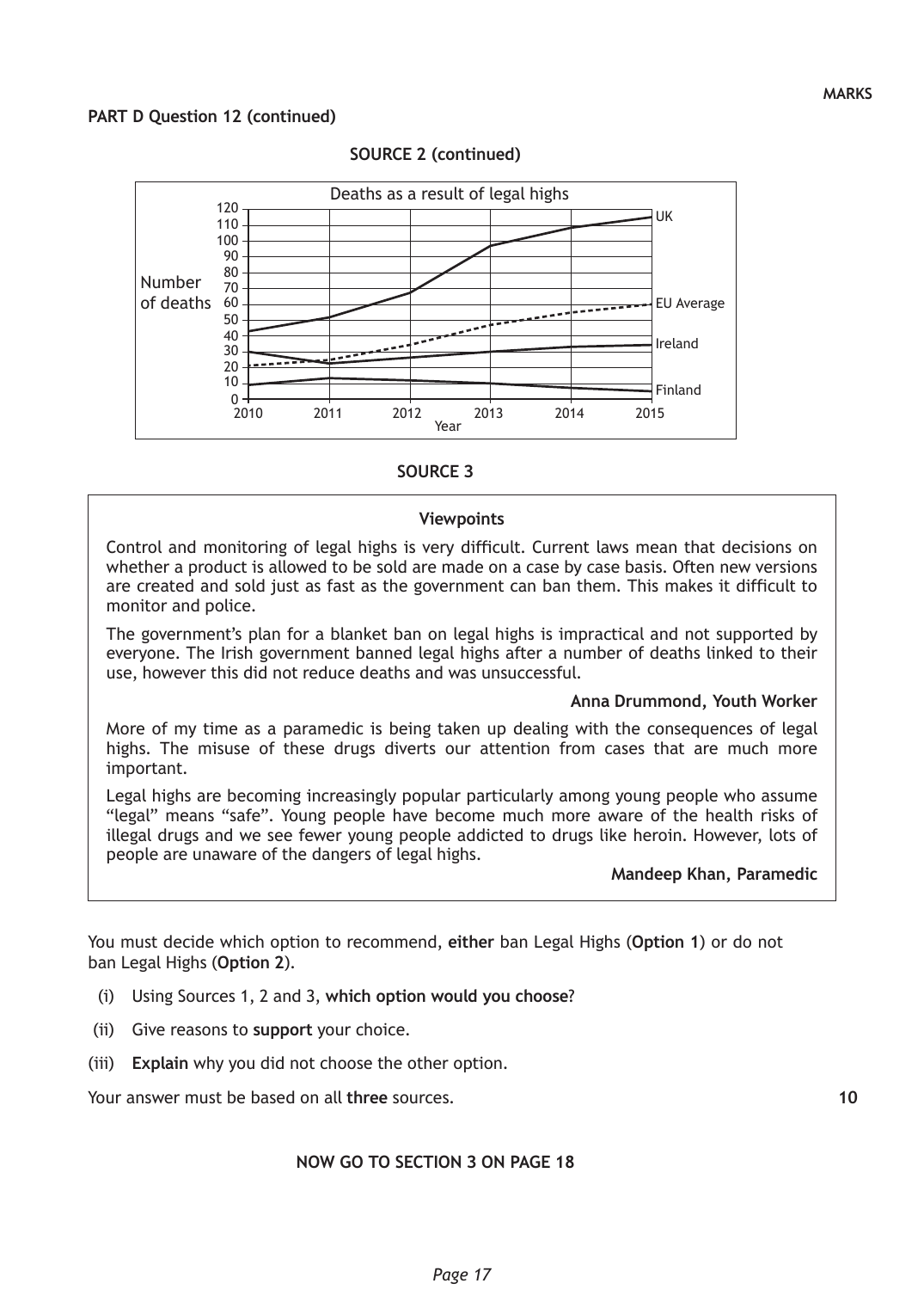
You are an adviser to the Scottish Government. You have been asked to make a recommendation on who should be appointed as the new drug commissioner to tackle the drug problem in Scotland.

Option 1

Appoint Ava Reid

Option 2

Appoint Graeme Mathieson

You must decide which option to recommend, either appoint Ava Reid (Option 1) or appoint Graeme Mathieson (Option 2).

(i) Using Sources 1, 2 and 3, which option would you choose?

(ii) Give reasons to support your choice.

(iii) Explain why you did not choose the other option.

Your answer must be based on all three sources.

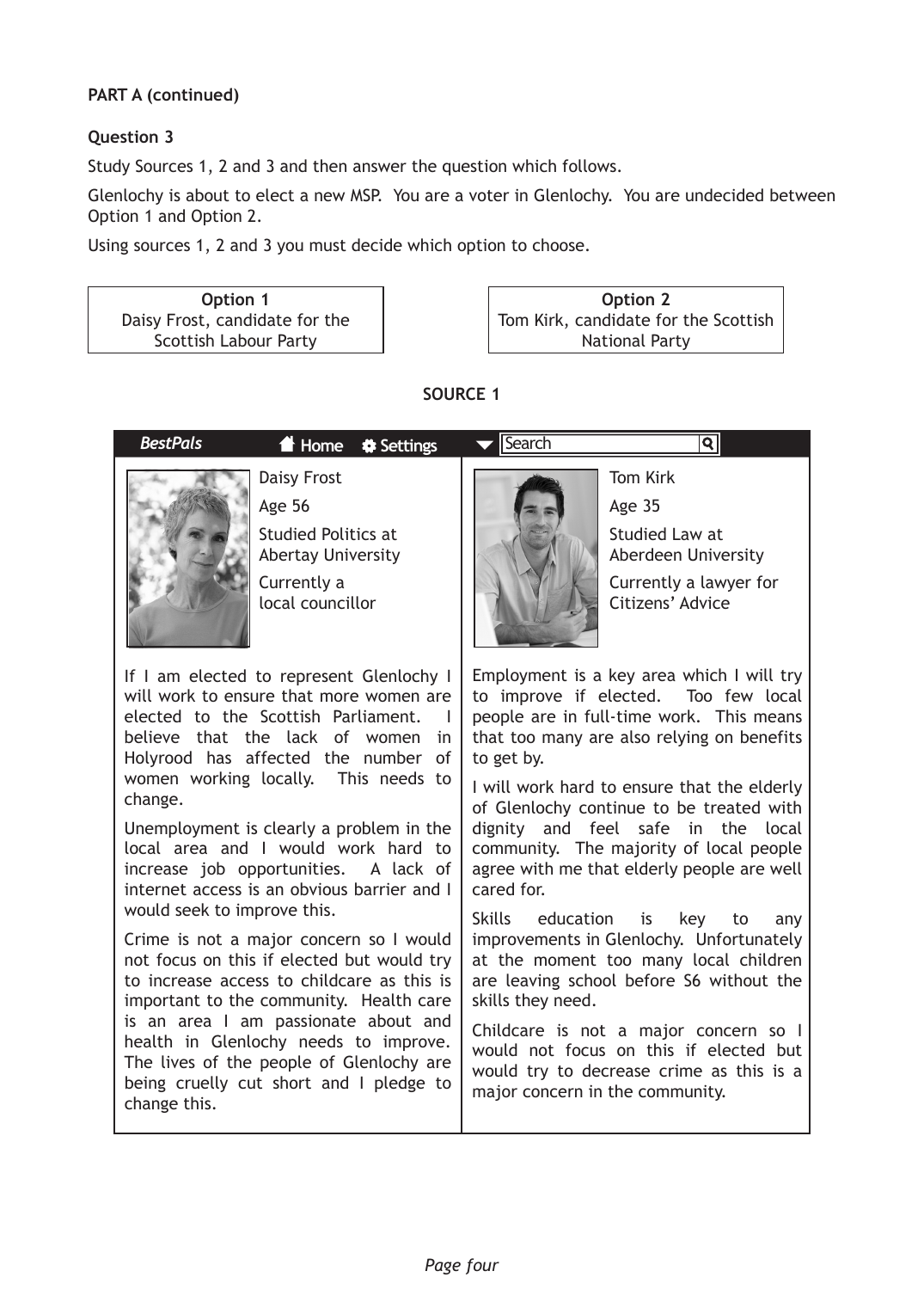
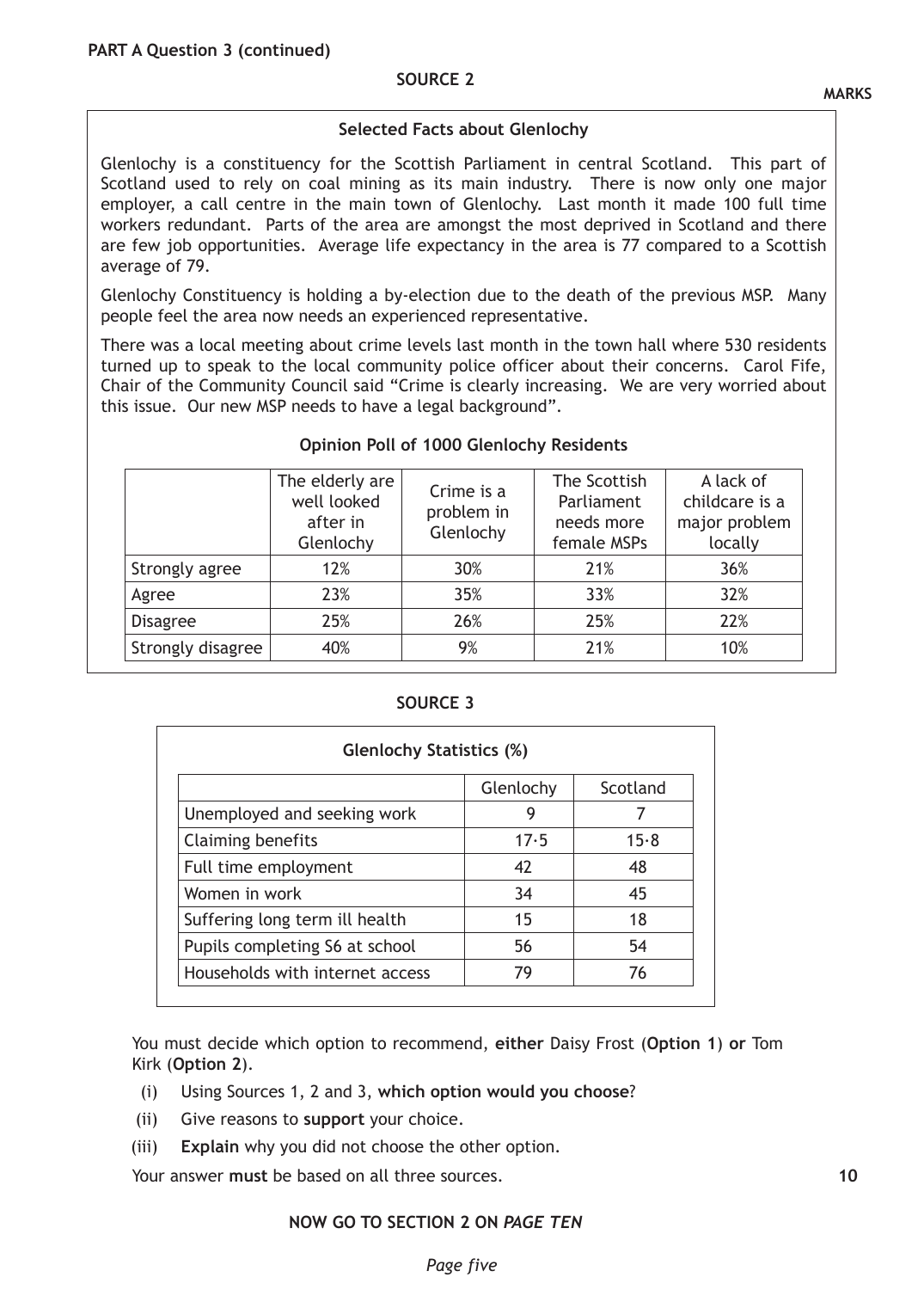
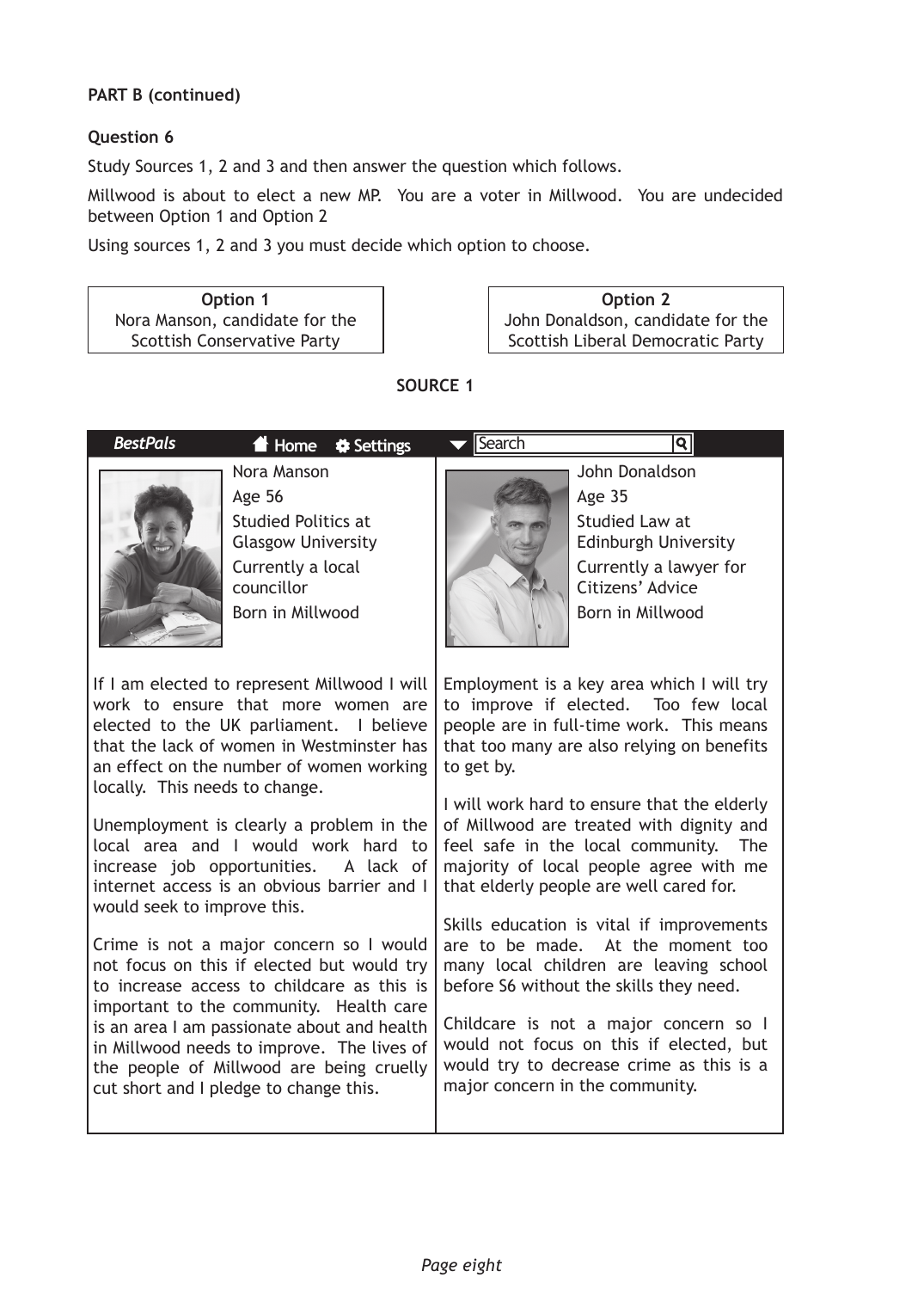
Sources (Source 1, Source 2, Source 3)
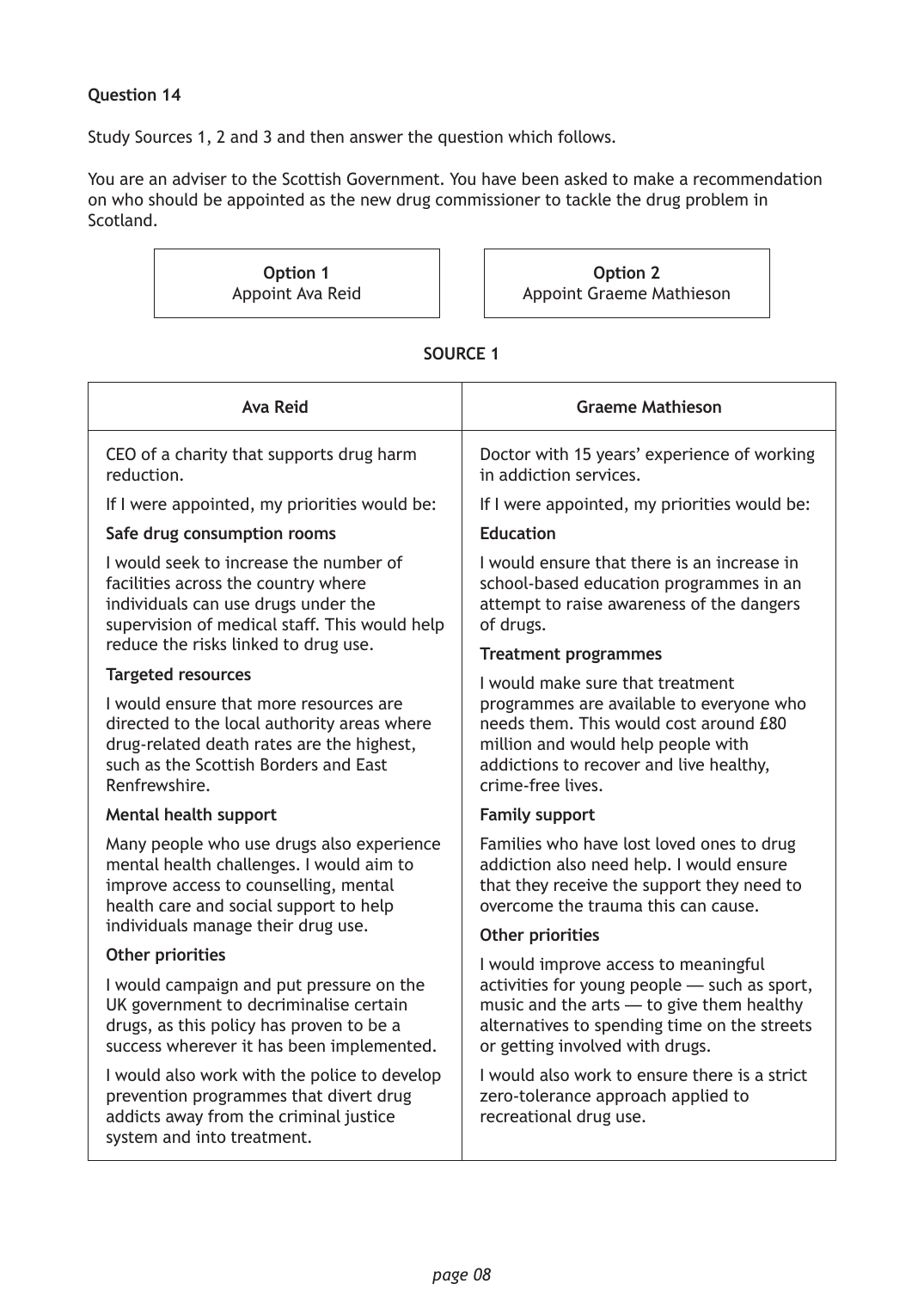
Source page 1 for this questionSource page 2 for this questionSource page 3 for this question
πŸ“ Structure template β€” how to structure your answer

Decision making Β· A source-based skills question

WFQ (words from the question)

  1. I chose insert option name.
  2. Evidence to support this is in insert source which says/shows β€œinsert evidence”.βœ“ 1 mark per piece of evidence (up to 8)
  3. This is further supported by evidence in insert source which says/shows β€œinsert evidence”. (Repeat until you have 8 pieces of evidence = 8 marks.)
  4. Rebuttal: I rejected insert option name because insert source says/shows β€œinsert evidence”.βœ“ needed for full marks

How it's marked

  • Up to 3 marks for a developed justification; credit highly where you link evidence between sources.
  • For full marks you must justify your decision AND explain why you rejected the other option.
  • Maximum 8 marks if you only deal with one option.
  • Aim for around 8 pieces of evidence to build up the marks.
  • Don’t forget the rebuttal β€” say why you rejected the other option.
βœ“ Reveal marking scheme
Max 10 marks

These are possible/exemplar answers from the marking instructions β€” other valid points can also gain marks.

How marks are awarded
  • The candidate is required to evaluate a limited range of sources, in order to justify a decision/recommendation.
  • The candidate must also explain why they have rejected the other option.
  • In order to achieve full marks candidates must say why they did not choose the other option. An answer which deals with only one option should be awarded a maximum of 8 marks.
  • For full marks, candidates must refer to all sources in their answer. Award a maximum of 6 marks if only two sources are used and a maximum of 4 marks if only one source is used.

Option 1 β€” Ava Reid

  1. I recommend Option 1 because in Source 1 it says that Ava would 'seek to increase the number of facilities across the country where individuals can use drugs under the supervision of medical staff. This would help reduce the risks linked to drug use.' (1 mark β€” evidence drawn from Source 1)
  2. I recommend Option 1 because in Source 1 it says that Ava would 'seek to increase the number of facilities across the country where individuals can use drugs under the supervision of medical staff. This would help reduce the risks linked to drug use.' This links to Source 3 where it states that 'Some people argue that a harm reduction approach would be a more effective method to tackle Scotland's drug problem. This could include creating more safer drug consumption rooms across the country.' (2 marks β€” two pieces of evidence drawn from Sources 1 and 3)

Credit reference to aspects of the following (Option 1):

  1. 'Many people who use drugs also experience mental health challenges. I would aim to improve access to counselling, mental health care and social support to help individuals manage their drug use.' (Source 1) which links to Source 3 which states that 'In addition, they believe there should be more support available for people who struggle with mental health issues.'
  2. 'I would also work with the police to develop prevention programmes that divert drug addicts away from the criminal justice system and into treatment.' (Source 1) which links to Source 3 which states 'This approach could involve the criminal justice system, with the aim of diverting drug users away from prison and giving them more support in the community.'

Reasons for rejecting the other option (Option 1 chosen):

  1. I could have picked Option 2 because in Source 1 Graeme states that 'I would make sure that treatment programmes are available to everyone who needs them. This would cost around Β£80 million and would help people with addictions to recover and live healthy, crime-free lives.' However, this is wrong as Source 3 states that 'It is estimated that to tackle this problem the government would need to fund treatment programmes costing around Β£900 million'. (2 marks β€” evidence linked from Sources 1 and 3)

Option 2 β€” Graeme Mathieson

  1. I recommend Option 2 because in Source 1 it says 'Families who have lost loved ones to drug addiction also need help. I would ensure that they receive the support they need to overcome the trauma this can cause.' (1 mark β€” evidence drawn from Source 1)
  2. I recommend Option 2 because in Source 1 it says 'Families who have lost loved ones to drug addiction also need help. I would ensure they receive the support they need to overcome the trauma this can cause.' This links to Source 2 which shows that more than half of those surveyed agree or strongly agree that there should be more support for families affected by drug addiction. (2 marks β€” evidence linked from Sources 1 and 2)

Credit reference to aspects of the following (Option 2):

  1. 'I would ensure that there is an increase in school-based education programmes in an attempt to raise awareness of the dangers of drugs.' (Source 1) which links to Source 3 which says that 'In recent years, while there has been a focus in educating young people on the dangers of drug use, many people believe that more still needs to be done in this area.'
  2. 'I would improve access to meaningful activities for young people β€” such as sport, music and the arts β€” to give them healthy alternatives to spending time on the streets or getting involved with drugs.' (Source 1), which links to Source 3 which says that 'Providing activities for young people in their communities is also seen as a crucial way to help them make better choices and stay away from drugs.'

Reasons for rejecting the other option (Option 2 chosen):

  1. I could have picked Option 1 because in Source 1 Ava says that she would 'ensure that more resources are directed to the local authority areas where drug-related death rates are the highest, such as the Scottish Borders and East Renfrewshire.' However, Source 2 highlights that drug-related death rates are lowest in the Scottish Borders and East Renfrewshire. (2 marks β€” evidence linked from Sources 1 and 2)
Source: 2026 N5 History Β· X849/75/11 Β· Q14Question paper (PDF, p.8) β†—Marking instructions (PDF, p.27) β†—
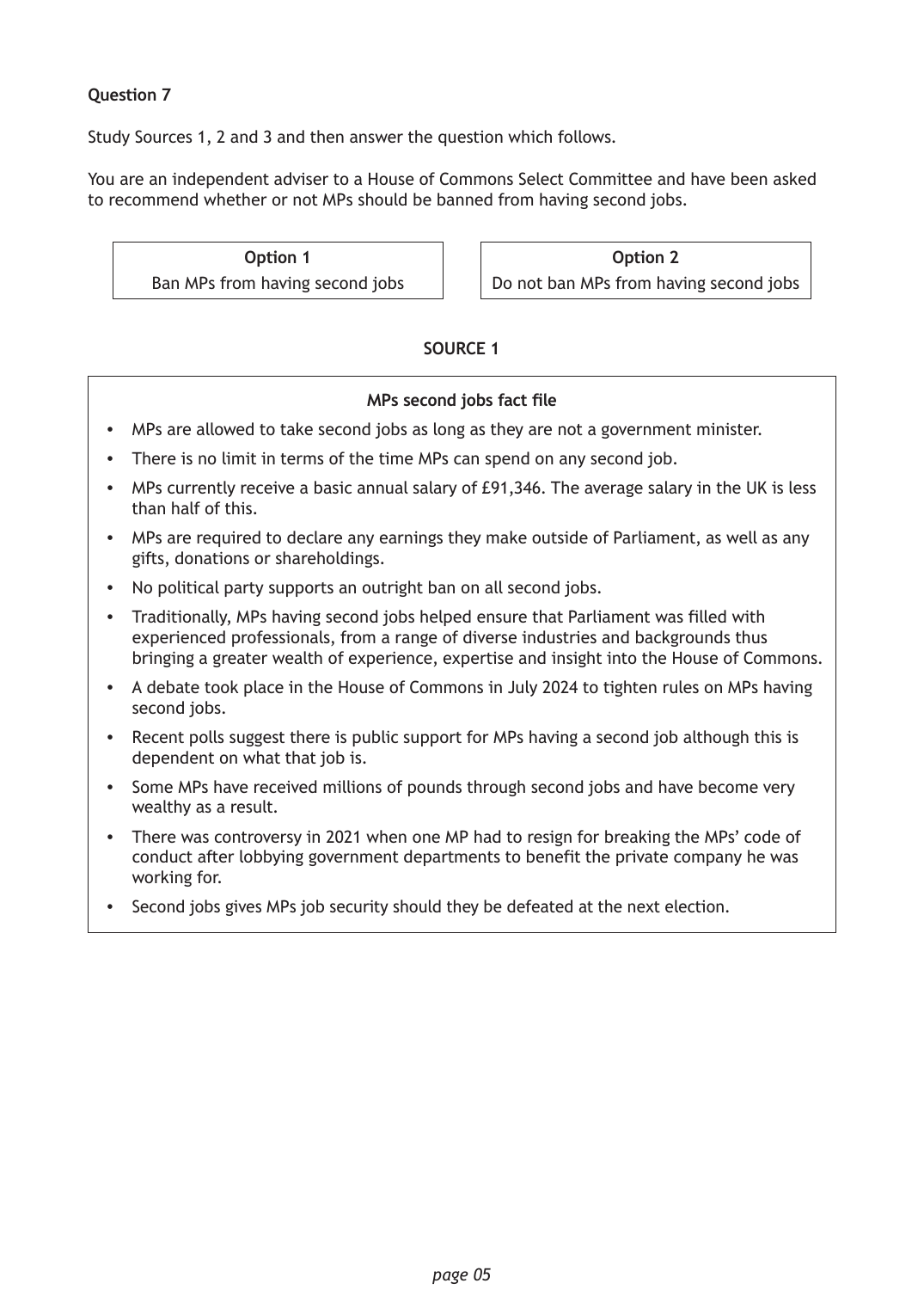
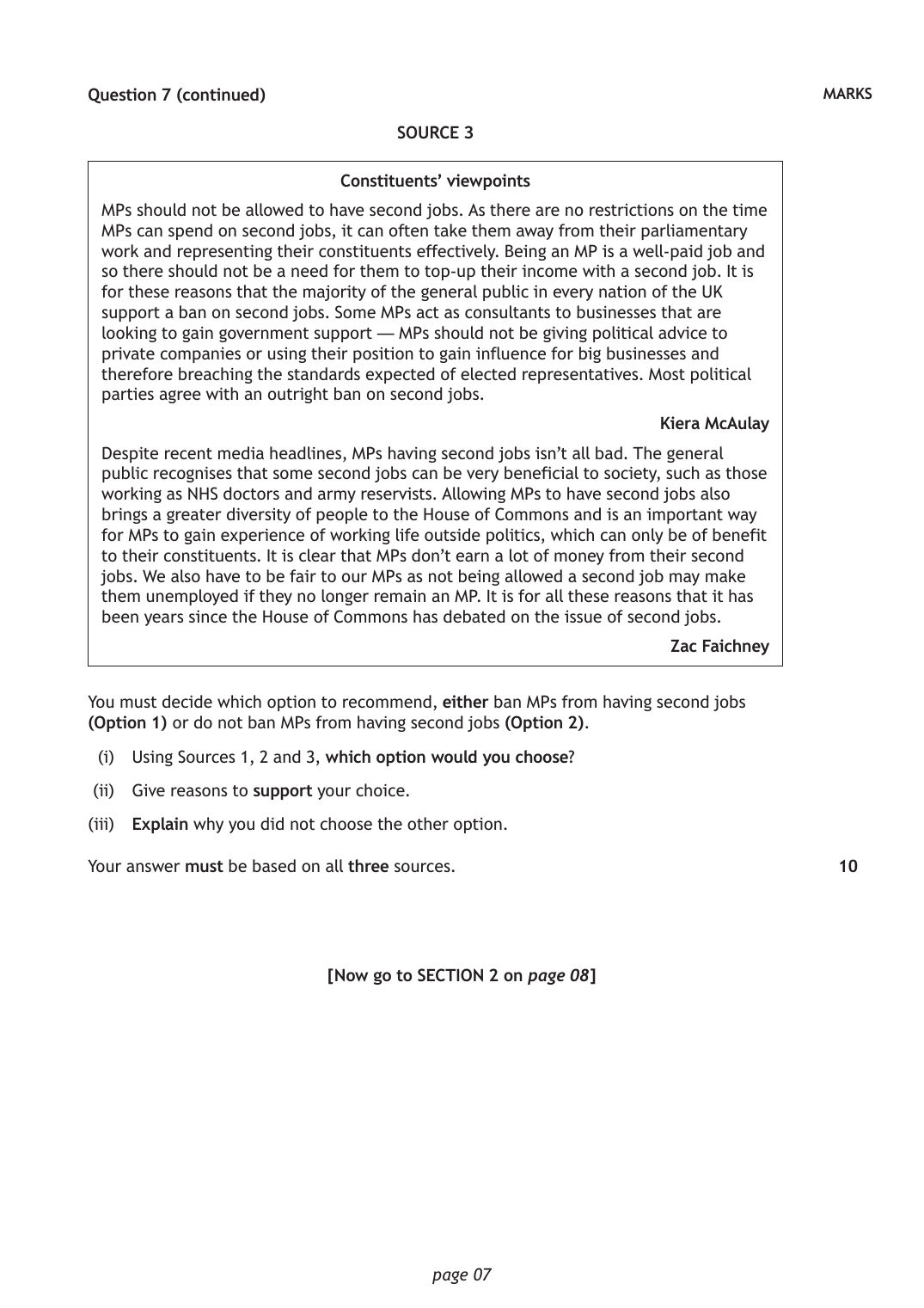
Decision making10 marks2025Q7Democracy in Scotland and the United Kingdom

Study Sources 1, 2 and 3 and then answer the question which follows.

You are an independent adviser to a House of Commons Select Committee and have been asked to recommend whether or not MPs should be banned from having second jobs.

Option 1

Ban MPs from having second jobs

Option 2

Do not ban MPs from having second jobs

You must decide which option to recommend, either ban MPs from having second jobs (Option 1) or do not ban MPs from having second jobs (Option 2).

(i) Using Sources 1, 2 and 3, which option would you choose?

(ii) Give reasons to support your choice.

(iii) Explain why you did not choose the other option.

Your answer must be based on all three sources.

Sources (Source 1, Source 2, Source 3)
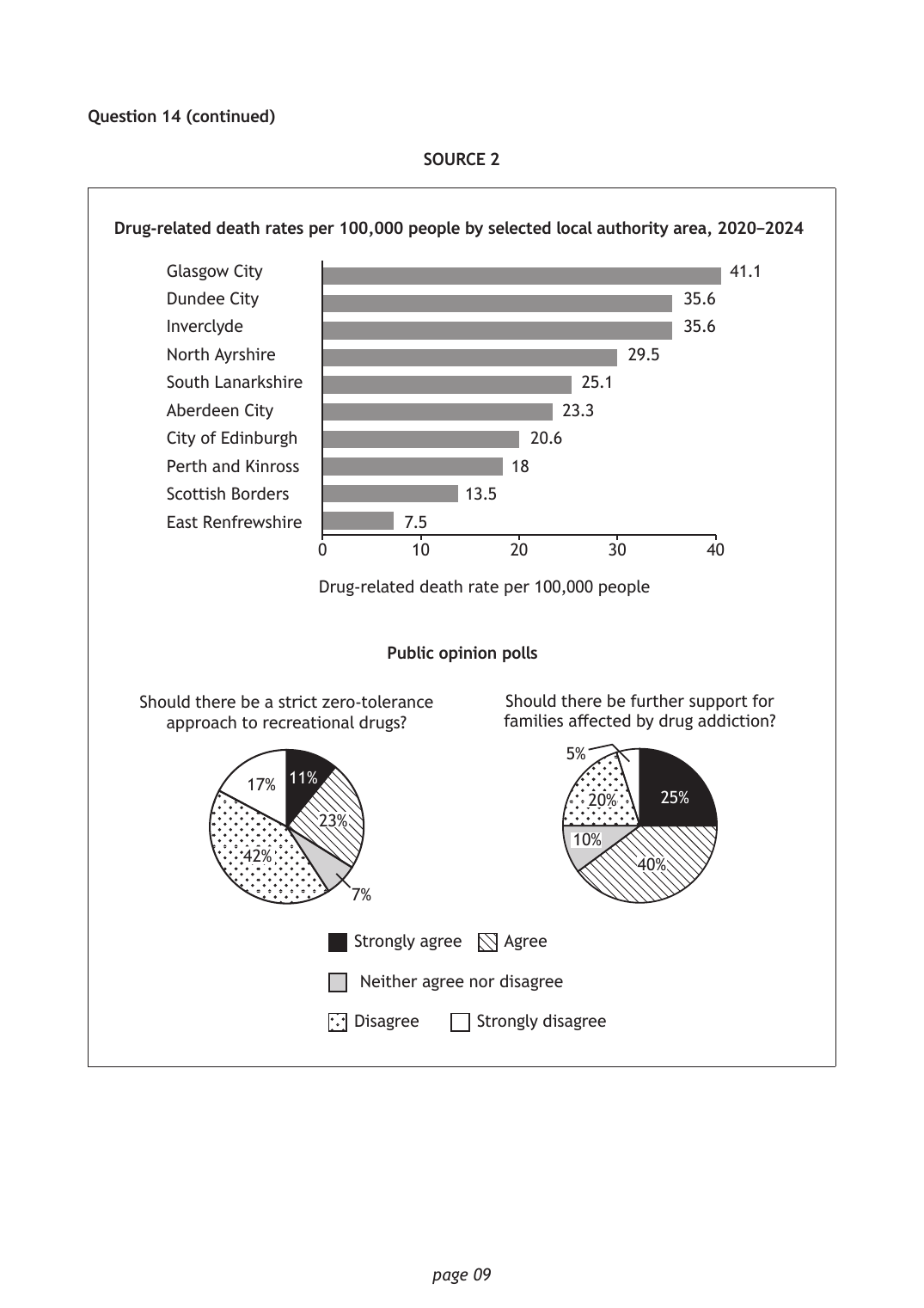
Source page 1 for this questionSource page 2 for this questionSource page 3 for this question
πŸ“ Structure template β€” how to structure your answer

Decision making Β· A source-based skills question

WFQ (words from the question)

  1. I chose insert option name.
  2. Evidence to support this is in insert source which says/shows β€œinsert evidence”.βœ“ 1 mark per piece of evidence (up to 8)
  3. This is further supported by evidence in insert source which says/shows β€œinsert evidence”. (Repeat until you have 8 pieces of evidence = 8 marks.)
  4. Rebuttal: I rejected insert option name because insert source says/shows β€œinsert evidence”.βœ“ needed for full marks

How it's marked

  • Up to 3 marks for a developed justification; credit highly where you link evidence between sources.
  • For full marks you must justify your decision AND explain why you rejected the other option.
  • Maximum 8 marks if you only deal with one option.
  • Aim for around 8 pieces of evidence to build up the marks.
  • Don’t forget the rebuttal β€” say why you rejected the other option.
βœ“ Reveal marking scheme
Max 10 marks

These are possible/exemplar answers from the marking instructions β€” other valid points can also gain marks.

How marks are awarded
  • The candidate is required to evaluate a limited range of sources, in order to justify a decision/recommendation.
  • The candidate must also explain why they have rejected the other option.
  • In order to achieve full marks candidates must say why they did not choose the other option. An answer which deals with only one option should be awarded a maximum of 8 marks.
  • For full marks, candidates must refer to all sources in their answer. Award a maximum of 6 marks if only two sources are used and a maximum of 4 marks if only one source is used.

Option 1: Ban MPs from having second jobs

  1. I recommend Option 1 because in Source 1 it says that 'MPs currently receive a basic annual salary of Β£91,346. The average salary in the UK is less than half of this.' (1 mark β€” evidence drawn from Source 1)
  2. I recommend Option 1 because in Source 1 it says that 'MPs currently receive a basic annual salary of Β£91,346. The average salary in the UK is less than half of this.' This can be linked to Source 3 where Kiera says that 'Being an MP is a well-paid job and so there should not be a need for them to top-up their income with a second job.' (2 marks β€” two pieces of evidence drawn from Sources 1 and 3)

Credit reference to aspects of the following:

  1. 'There is no limit in terms of the time MPs can spend on any second job.' (Source 1) which links with Source 3, 'As there are no restrictions on the time MPs can spend on second jobs, it can often take them away from their parliamentary work and representing their constituents effectively.'
  2. 'There was controversy in 2021 when one MP had to resign for breaking the MPs' code of conduct after lobbying government departments to benefit the private company he was working for.' (Source 1) which links with Source 3, 'Some MPs act as consultants to businesses that are looking to gain government support β€” MPs should not be giving political advice to private companies or using their position to gain influence for big businesses and therefore breaching the standards expected of elected representatives.'

Reasons for rejecting the other option:

  1. I could have picked Option 2 because in Source 3 Zac says, 'It is clear that MPs don't earn a lot of money from their second jobs.' However, this is wrong as in Source 1 it states that 'some MPs have received millions of pounds through second jobs and have become very wealthy as a result.' (2 marks β€” evidence linked from Sources 3 and 1)

Option 2: Do not ban MPs from having second jobs

  1. I recommend Option 2 because in Source 1 it says that 'Recent polls suggest there is public support for MPs having a second job although this is dependent on what that job is.' (1 mark β€” evidence drawn from Source 1)
  2. I recommend Option 2 because in Source 1 it says that 'Recent polls suggest there is public support for MPs having a second job although this is dependent on what that job is.' This links to Source 2 which shows that 54% of the public approve of MPs being NHS doctors and 50% approve of them being army reservists. (2 marks β€” two pieces of evidence drawn from Sources 1 and 2)

Credit reference to aspects of the following:

  1. 'Traditionally, MPs having second jobs helped ensure that Parliament was filled with experienced professionals, from a range of diverse industries and backgrounds thus bringing a greater wealth of experience, expertise and insight into the House of Commons.' (Source 1) which links with Source 3 – 'Allowing MPs to have second jobs also brings a greater diversity of people to the House of Commons and is an important way for MPs to gain experience of working life outside politics, which can only be of benefit to their constituents'
  2. Source 1 says that 'Second jobs gives MPs job security should they be defeated at the next election.' which links with Source 3 which says 'We also have to be fair to our MPs as not being allowed a second job may make them unemployed if they no longer remain an MP.'

Reasons for rejecting the other option:

  1. I could have picked Option 1 because in Source 3 Kiera says, 'the majority of the general public in every nation of the UK support a ban on second jobs.' However, she is wrong as Source 2 shows that the majority of the general public in England do not support a ban on second jobs. (2 marks β€” evidence linked from Sources 1 and 3)
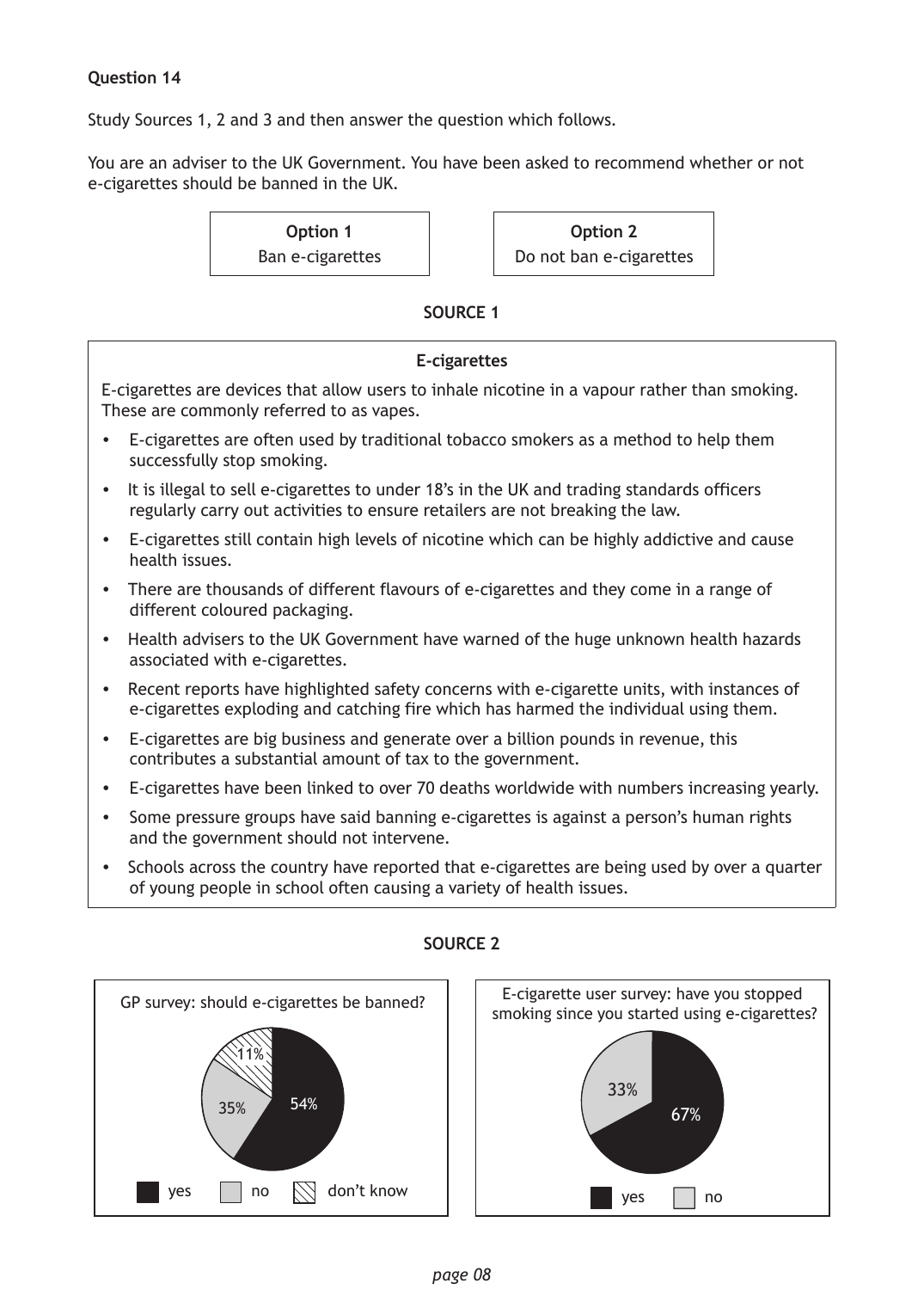
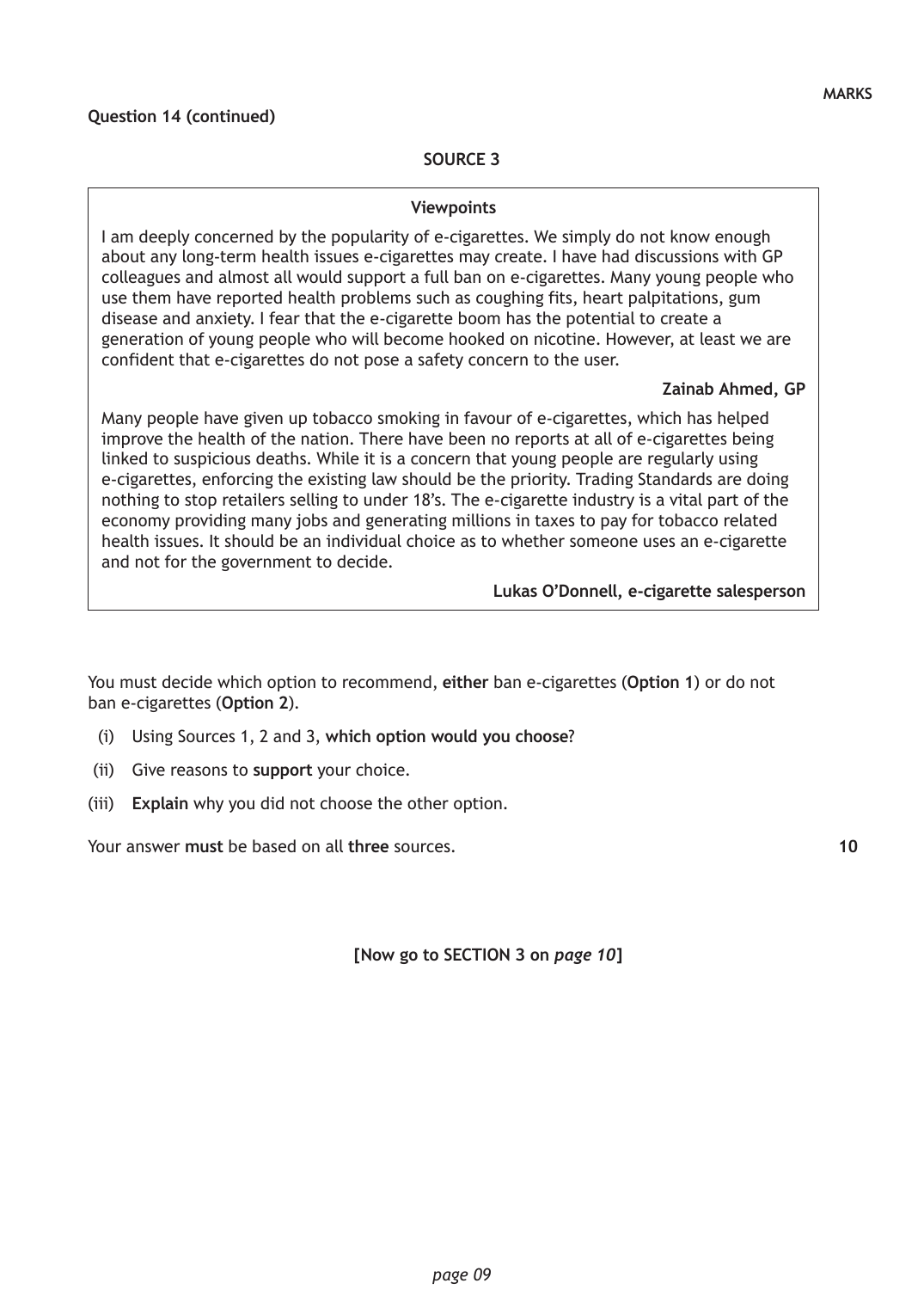
Decision making10 marks2024Q14Social Issues in the United Kingdom

Study Sources 1, 2 and 3 and then answer the question which follows.

You are an adviser to the UK Government. You have been asked to recommend whether or not e-cigarettes should be banned in the UK.

Option 1

Ban e-cigarettes

Option 2

Do not ban e-cigarettes

You must decide which option to recommend, either ban e-cigarettes (Option 1) or do not ban e-cigarettes (Option 2).

(i) Using Sources 1, 2 and 3, which option would you choose?

(ii) Give reasons to support your choice.

(iii) Explain why you did not choose the other option.

Your answer must be based on all three sources.

Sources (Source 1, Source 2, Source 3)
Source page 1 for this questionSource page 2 for this question
πŸ“ Structure template β€” how to structure your answer

Decision making Β· A source-based skills question

WFQ (words from the question)

  1. I chose insert option name.
  2. Evidence to support this is in insert source which says/shows β€œinsert evidence”.βœ“ 1 mark per piece of evidence (up to 8)
  3. This is further supported by evidence in insert source which says/shows β€œinsert evidence”. (Repeat until you have 8 pieces of evidence = 8 marks.)
  4. Rebuttal: I rejected insert option name because insert source says/shows β€œinsert evidence”.βœ“ needed for full marks

How it's marked

  • Up to 3 marks for a developed justification; credit highly where you link evidence between sources.
  • For full marks you must justify your decision AND explain why you rejected the other option.
  • Maximum 8 marks if you only deal with one option.
  • Aim for around 8 pieces of evidence to build up the marks.
  • Don’t forget the rebuttal β€” say why you rejected the other option.
βœ“ Reveal marking scheme
Max 10 marks

These are possible/exemplar answers from the marking instructions β€” other valid points can also gain marks.

How marks are awarded
  • The candidate is required to evaluate a limited range of sources, in order to justify a decision/recommendation.
  • The candidate must also explain why they have rejected the other option.
  • In order to achieve full marks candidates must say why they did not choose the other option. An answer which deals with only one option should be awarded a maximum of 8 marks.
  • For full marks, candidates must refer to all sources in their answer. Award a maximum of 6 marks if only two sources are used and a maximum of 4 marks if only one source is used.

Option 1: Ban e-cigarettes

  1. I recommend Option 1 because in Source 1 it says that health advisers to the UK government have warned of the huge unknown health hazards associated with e-cigarettes. (1 mark β€” evidence drawn from Source 1)
  2. I recommend Option 1 because in Source 1 it says that health advisers to the UK government have warned of the huge unknown health hazards associated with e-cigarettes. This can be linked to Source 3 that says 'we simply do not know enough about any long-term health issues e-cigarettes may create.' (2 marks β€” two pieces of evidence drawn from Sources 1 and 3)

Credit reference to aspects of the following (Option 1):

  1. 'E-cigarettes still contain high levels of nicotine which can be highly addictive' (Source 1) which links to Source 3 'I fear that the e-cigarette boom has the potential to create a generation of young people who will become hooked on nicotine.'
  2. Schools across the country have reported that e-cigarettes are being used by over a quarter of young people in school often causing a variety of health issues. (Source 1) which links to Source 3, 'Many young people who use them have reported health problems such as coughing fits, heart palpitations, gum disease and anxiety.'

Reasons for rejecting the other option (Option 1 chosen):

  1. I could have picked Option 2 because in Source 3 it says 'There have been no reports at all of e-cigarettes being linked to suspicious deaths. However, this is wrong as in Source 1 it states that 'e-cigarettes have been linked to over 70 deaths worldwide with numbers increasing yearly.' (2 marks β€” evidence linked from Sources 1 and 3)

Option 2: Do not ban e-cigarettes

  1. I recommend Option 2 because in Source 1 it says that e-cigarettes are often used by traditional tobacco smokers as a method to help them successfully stop smoking. (1 mark β€” evidence drawn from Source 1)
  2. I recommend Option 2 because in Source 1 it says that e-cigarettes are often used by traditional tobacco smokers as a method to help them successfully stop smoking, this can be backed up by Source 2 which shows that 67% have stopped smoking tobacco since they started using e-cigarettes. This is the majority of people who were surveyed. (3 marks β€” two pieces of evidence drawn from Sources 1 and 2 with evaluation)

Credit reference to aspects of the following (Option 2):

  1. E-cigarettes are big business and generate over a billion pounds in revenue, this contributes to a substantial amount of tax to the government (Source 1) which links to Source 3 'The e-cigarette industry is a vital part of the economy providing many jobs and generating millions in taxes to pay for tobacco related health issues.'
  2. Source 3 says 'It should be an individual choice as to whether someone uses an e-cigarette and not for the government to decide' which links to Source 1 'Some pressure groups have said banning e-cigarettes is against a person's human rights and the government should not intervene.'

Reasons for rejecting the other option (Option 2 chosen):

  1. I could have picked Option 1 because the GP in Source 3 states that 'I have had discussions with GP colleagues and almost all would support a full ban on e-cigarettes.' However, this is wrong as in Source 2 it shows that just over half of GPs support a full ban. This is not almost all as almost all suggests a strong majority. (3 marks β€” evidence drawn from two sources, with evaluative comment)
Source: 2024 N5 History Β· X849/75/11 Β· Q14Question paper (PDF, p.8) β†—Marking instructions (PDF, p.24) β†—
Decision making10 marks2023Q7Democracy in Scotland and the UK

Study Sources 1, 2 and 3 and then answer the question which follows.

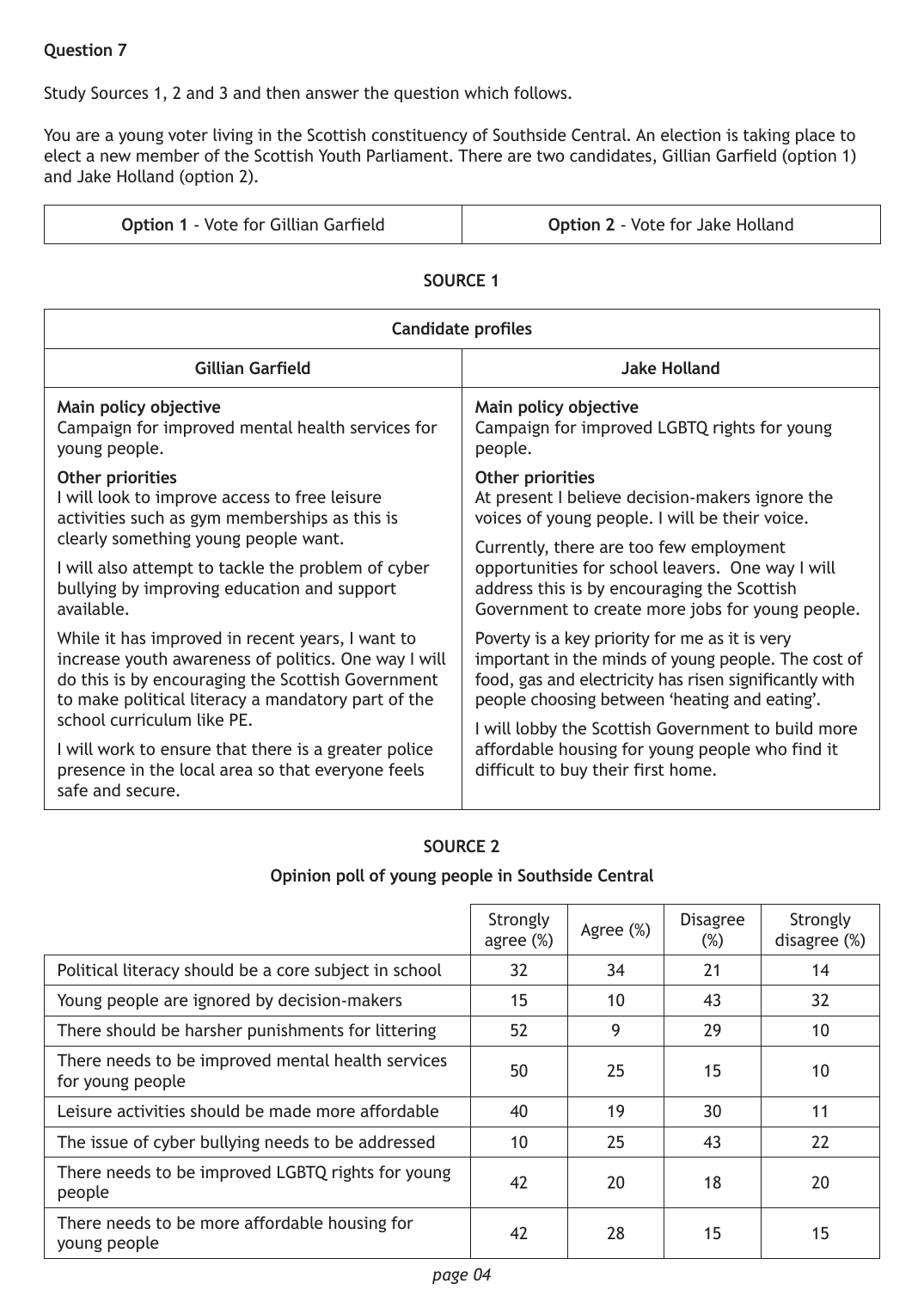
You are a young voter living in the Scottish constituency of Southside Central. An election is taking place to elect a new member of the Scottish Youth Parliament. There are two candidates, Gillian Garfield (option 1) and Jake Holland (option 2).

Option 1

Vote for Gillian Garfield

Option 2

Vote for Jake Holland

You must decide which option to recommend, either vote for Gillian Garfield (Option 1) or vote for Jake Holland (Option 2).

(i) Using Sources 1, 2 and 3, which option would you choose?

(ii) Give reasons to support your choice.

(iii) Explain why you did not choose the other option.

Your answer must be based on all three sources.

Sources (Source 1, Source 2, Source 3)

Source page 1 for this questionSource page 2 for this question
πŸ“ Structure template β€” how to structure your answer

Decision making Β· A source-based skills question

WFQ (words from the question)

  1. I chose insert option name.
  2. Evidence to support this is in insert source which says/shows β€œinsert evidence”.βœ“ 1 mark per piece of evidence (up to 8)
  3. This is further supported by evidence in insert source which says/shows β€œinsert evidence”. (Repeat until you have 8 pieces of evidence = 8 marks.)
  4. Rebuttal: I rejected insert option name because insert source says/shows β€œinsert evidence”.βœ“ needed for full marks

How it's marked

  • Up to 3 marks for a developed justification; credit highly where you link evidence between sources.
  • For full marks you must justify your decision AND explain why you rejected the other option.
  • Maximum 8 marks if you only deal with one option.
  • Aim for around 8 pieces of evidence to build up the marks.
  • Don’t forget the rebuttal β€” say why you rejected the other option.
βœ“ Reveal marking scheme
Max 10 marks

These are possible/exemplar answers from the marking instructions β€” other valid points can also gain marks.

How marks are awarded
  • The candidate is required to evaluate a limited range of sources, in order to justify a recommendation.
  • The candidate must also explain why they have rejected the other option.
  • In order to achieve full marks candidates must say why they did not choose the other option. An answer which deals with only one option should be awarded a maximum of 8 marks.
  • For full marks, candidates must refer to all sources in their answer. Award a maximum of 6 marks if only two sources are used and a maximum of 4 marks if only one source is used.

Option 1: Vote for Gillian Garfield

  1. I have chosen Option 1, because in Source 1 Gillian Garfield states that she would campaign for improved mental health services for young people. (1 marks β€” evidence drawn from Source 1)
  2. I have chosen Option 1, because in Source 1 Gillian Garfield states that she would campaign for improved mental health services for young people. This can be linked to Source 2 where it shows that 75% of those asked agree or strongly agree that mental health services for young people should be improved. (2 marks β€” evidence linked from Source 1 and Source 2)
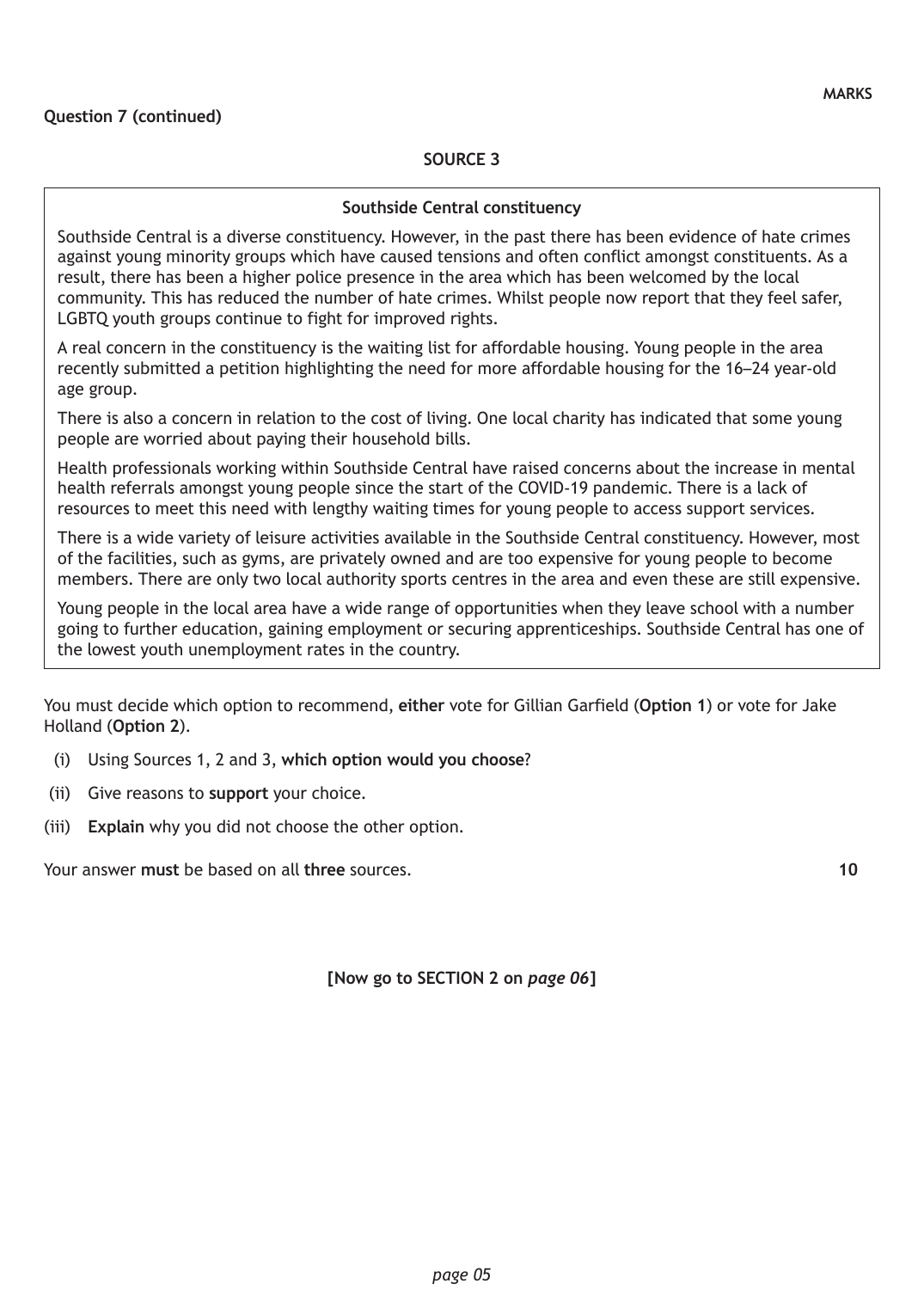
  3. I have chosen Option 1, because in Source 1 Gillian Garfield states that she would campaign for improved mental health services for young people. This can be linked to Source 2 where it shows that 75% of those asked agree or strongly agree that mental health services for young people should be improved. This can also be linked to Source 3 which states that since the COVID-19 pandemic there has been an increase in mental health referrals and a lack of resources to meet this need. (3 marks β€” evidence drawn from three sources)

Credit reference to aspects of the following:

  1. improved access to free leisure activities (Source 1) links to Source 2 where 19% agree and 40% strongly agree that leisure activities should be made more affordable, and Source 3, β€˜most of the facilities, such as gyms, are privately owned and are too expensive for young people to become members.’
  2. encouraging the Scottish Government to make political literacy a mandatory part of the school curriculum (Source 1) links to Source 2 where 66% either agree or strongly agree that political literacy should be a core subject in school.

Reasons for rejecting the other option:

  1. I could have picked Option 2, Jake Holland, because in Source 1 it states that he believes decision-makers ignore the voices of young people but he is wrong because Source 2 shows that three quarters of young voters disagree or strongly disagree that young people are ignored by decision-makers. (2 marks β€” evidence linked from Source 1 and Source 2)

Option 2: Vote for Jake Holland

  1. I have chosen Option 2, because in Source 1 it states that Jake will campaign for improved LGBTQ rights for young people. (1 marks β€” evidence linked from Source 1)
  2. I have chosen Option 2, because in Source 1 it states that Jake will campaign for improved LGBTQ rights for young people. This links to Source 2 where it says 62% of those asked agree or strongly agree for improved LGBTQ rights for young people. (2 marks β€” evidence linked from Sources 1 and 2)
  3. I have chosen Option 2, because in Source 1 it states that Jake will campaign for improved LGBTQ rights for young people. This links to Source 2 where it says 62% of those asked agree or strongly agree for improved LGBTQ rights. This is nearly two-thirds of the young people polled and a clear majority demonstrating strong support for improved LGBTQ rights for young people. (3 marks β€” evidence drawn from two sources, with evaluative comment)

Credit reference to aspects of the following:

  1. β€˜I will lobby the Scottish Government to build more affordable housing for young people’ (Source 1) links with Source 3 where it says that young people in the area recently submitted a petition highlighting the need for more affordable housing for the 16-24-year-old age group and Source 2 which shows that 70% either agree or strongly agree that there needs to be more affordable housing for young people
  2. poverty is a key priority (Source 1) links with Source 3 β€” β€˜There is also a concern in relation to the cost of living. One local charity has indicated that some young people are worried about paying their household bills.’

Reasons for rejecting the other option:

  1. I could have picked Option 1, Gillian Garfield, as she states β€˜I will work to ensure there is a greater police presence in the local area to ensure that everyone feels safe and secure’. However, Source 3 states β€˜there has been a higher police presence in the area which has been welcomed by the local community. This has reduced the number of hate crimes. Whilst people now report that they feel safer. . .’ (2 marks β€” evidence linked from Sources 1 and 3)
Decision making10 marks2022Q21International Issues

Study Sources 1, 2 and 3 and then answer the question which follows.

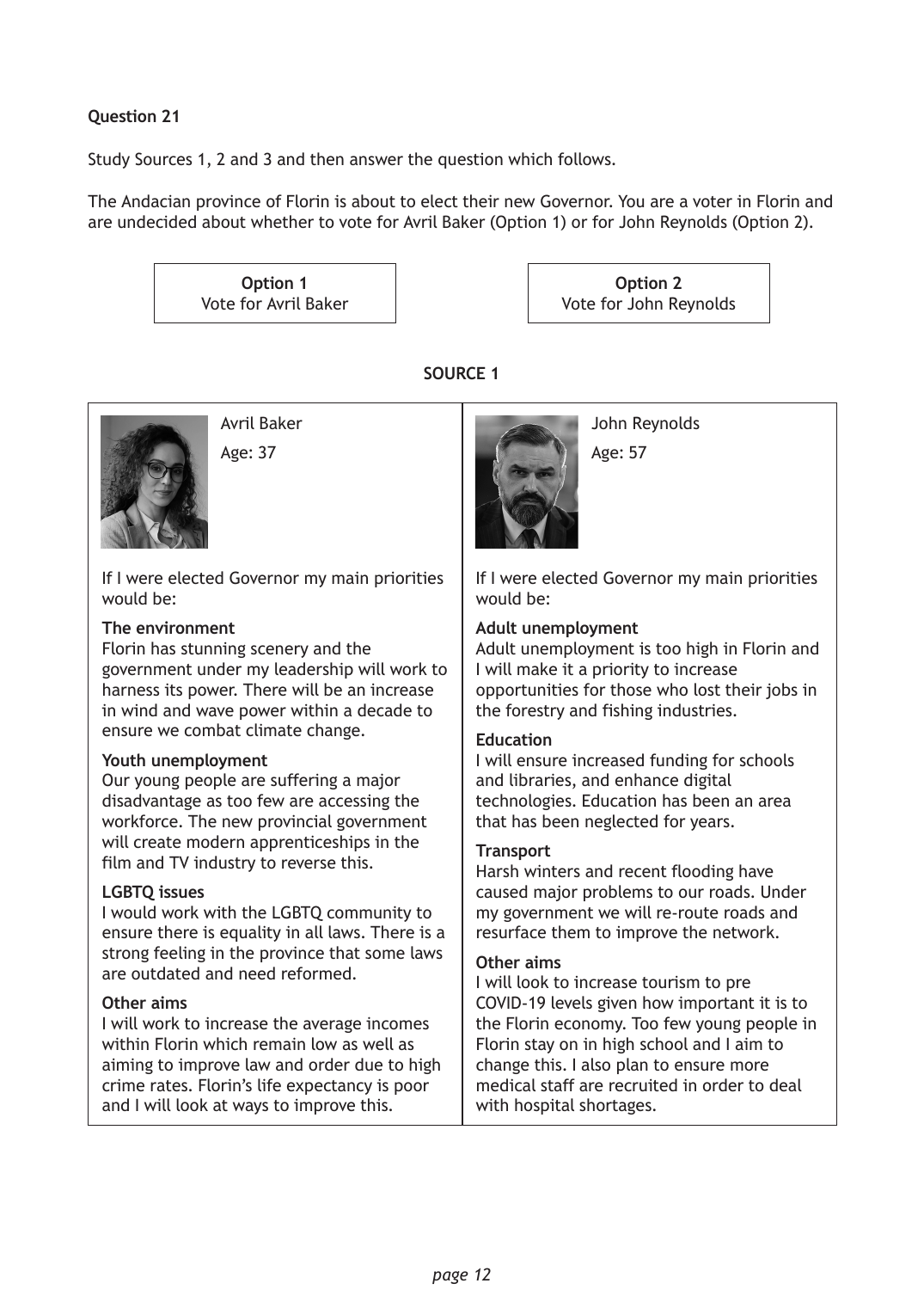
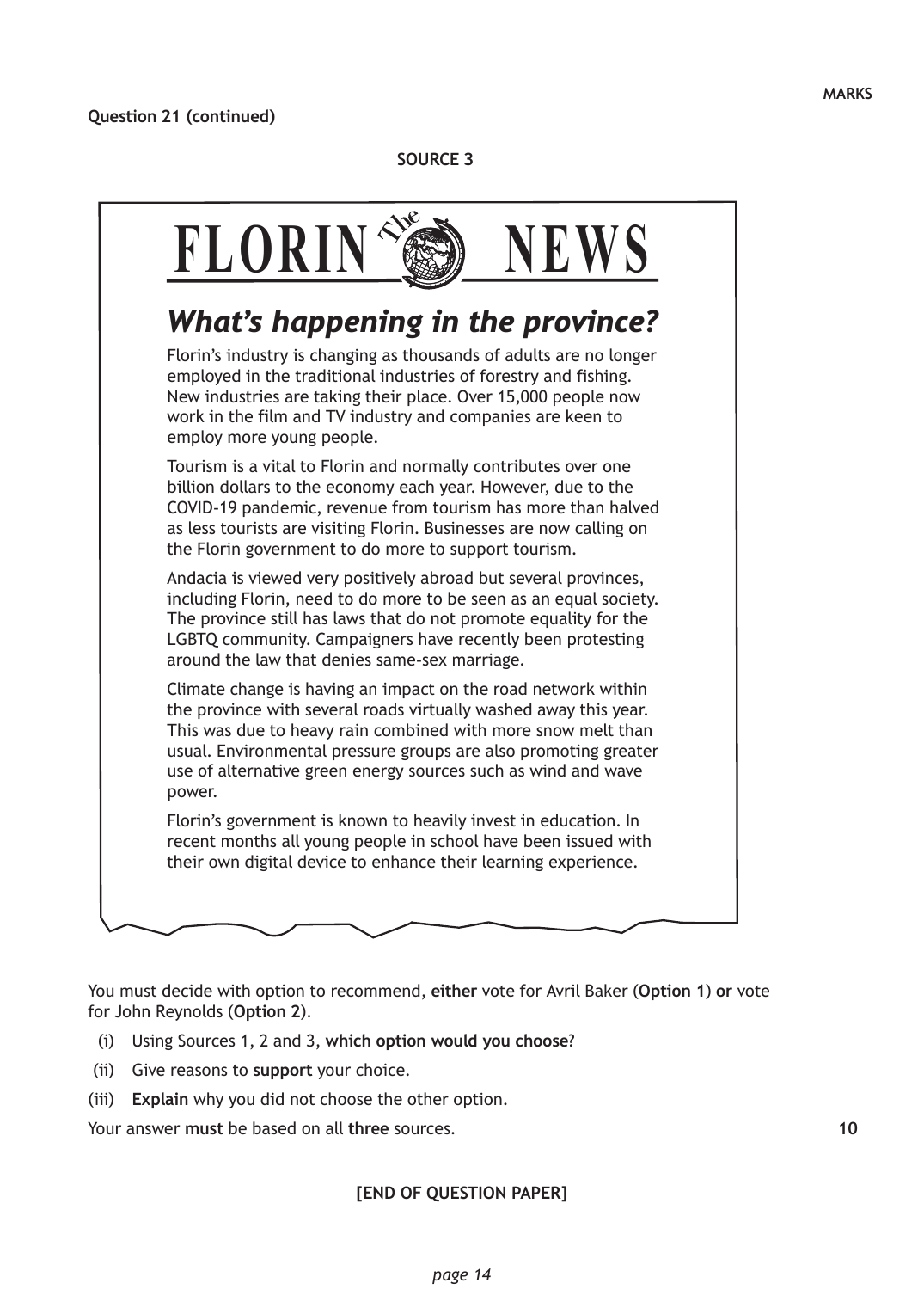
The Andacian province of Florin is about to elect their new Governor. You are a voter in Florin and are undecided about whether to vote for Avril Baker (Option 1) or for John Reynolds (Option 2).

Option 1

Vote for Avril Baker

Option 2

Vote for John Reynolds

You must decide which option to recommend, either vote for Avril Baker (Option 1) or vote for John Reynolds (Option 2).

(i) Using Sources 1, 2 and 3, which option would you choose?

(ii) Give reasons to support your choice.

(iii) Explain why you did not choose the other option.

Your answer must be based on all three sources.

Sources (Source 1, Source 2, Source 3)

Source page 1 for this questionSource page 2 for this questionSource page 3 for this question
πŸ“ Structure template β€” how to structure your answer

Decision making Β· A source-based skills question

WFQ (words from the question)

  1. I chose insert option name.
  2. Evidence to support this is in insert source which says/shows β€œinsert evidence”.βœ“ 1 mark per piece of evidence (up to 8)
  3. This is further supported by evidence in insert source which says/shows β€œinsert evidence”. (Repeat until you have 8 pieces of evidence = 8 marks.)
  4. Rebuttal: I rejected insert option name because insert source says/shows β€œinsert evidence”.βœ“ needed for full marks

How it's marked

  • Up to 3 marks for a developed justification; credit highly where you link evidence between sources.
  • For full marks you must justify your decision AND explain why you rejected the other option.
  • Maximum 8 marks if you only deal with one option.
  • Aim for around 8 pieces of evidence to build up the marks.
  • Don’t forget the rebuttal β€” say why you rejected the other option.
βœ“ Reveal marking scheme
Max 10 marks

These are possible/exemplar answers from the marking instructions β€” other valid points can also gain marks.

How marks are awarded
  • The candidate is required to evaluate a limited range of sources, in order to justify a decision/recommendation.
  • The candidate must also explain why they have rejected the other option.
  • In order to achieve full marks candidates must say why they did not choose the other option. An answer which deals with only one option should be awarded a maximum of 8 marks.
  • For full marks, candidates must refer to all sources in their answer. Award a maximum of 6 marks if only two sources are used and a maximum of 4 marks if only one source is used.

Option 1 β€” Vote for Avril Baker

  1. One reason to vote for Avril is that in Source 1 she says 'there will be an increase in wind and wave power within a decade to ensure we combat climate change'. (1 mark β€” evidence drawn from Source 1)
  2. One reason to vote for Avril is that in Source 1 she says 'there will be an increase in wind and wave power within a decade to ensure we combat climate change'. This is supported by Source 3 which states 'Environmental pressure groups are also promoting greater use of alternative green energy sources such as wind and wave power.' (2 marks β€” evidence linked from Source 1 and Source 3)
  3. create modern apprenticeships in the film and TV industry to reverse youth unemployment rates (Source 1) links with Source 3, as TV and film companies are keen to employ more young people
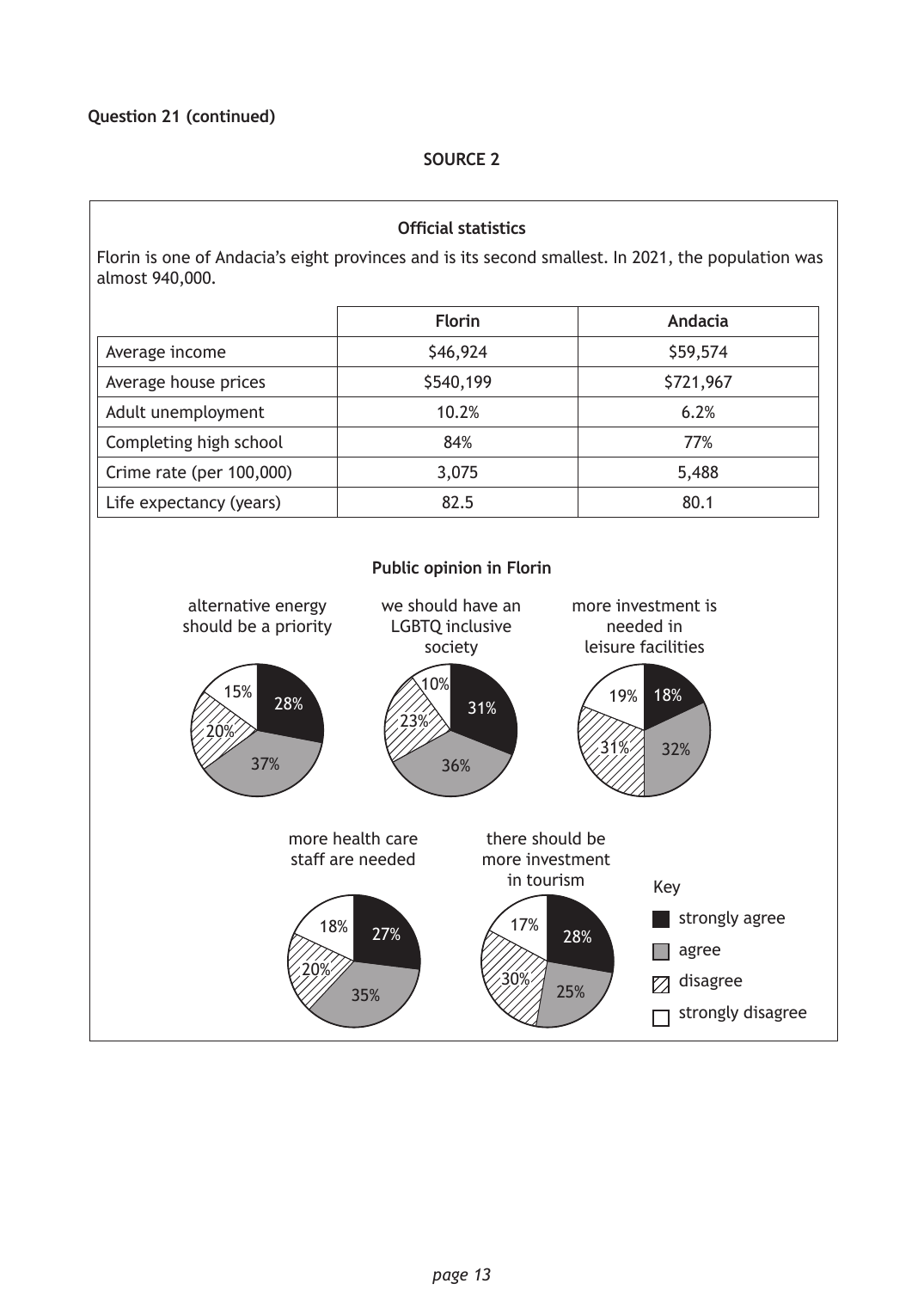
  4. 'I would work with the LGBTQ community to ensure there is equality in all laws. There is a strong feeling in the province that some laws are outdated and need reformed'. (Source 1) linking with Source 3 which says 'The province still has laws that do not promote equality for the LGBTQ community,' and also Source 2 where 67% agree Florin should have an LGBTQ inclusive society
  5. 'I will work to increase the average incomes within Florin which remain low' (Source 1), linking to Source 2 which shows the average income to be almost $13,000, less than Andacia.

Option 1 β€” Reasons for rejecting the other option

  1. I rejected John Reynolds as he says in Source 1 that too few young people stay on in high school compared to the rest of Andacia, but Source 2 shows that a higher proportion of young people stay on in high school in Florin β€” 84% compared to 77% overall in Andacia. Seven percent is a significant difference showing this is not an issue in Florin. (3 marks β€” evidence linked from Source 1 and Source 2 with an evaluative comment)

Option 2 β€” Vote for John Reynolds

  1. One reason to vote for John is that he says, 'Harsh winters and recent flooding have caused major problems to our roads…we will re-route roads and resurface them to improve the network'. (1 mark β€” evidence drawn from Source 1)
  2. One reason to vote for John is that he says, 'Harsh winters and recent flooding have caused major problems to our roads…we will re-route roads and resurface them to improve the network.' This is backed up by Source 3 which states 'Climate change is having an impact on the road network within the province with several roads virtually washed away this year.' (2 marks β€” evidence linked from Source 1 and Source 3)
  3. 'Adult unemployment is too high in Florin' (Source 1). This links to Source 2 which highlights that adult unemployment is 4% higher in Florin compared to Andacia and also Source 3 which says thousands of adults are no longer employed in traditional industries
  4. 'I also plan to ensure more medical staff are recruited in order to deal with hospital shortages.' (Source 1) which links to Source 2 as 62% of people agree with more healthcare staff being needed
  5. 'I will look to increase tourism to pre-COVID-19 levels given how important it is to the Florin economy.' (Source 1) which links with Source 3 which says that tourism levels have dropped and businesses are calling on the Florin government to do more to support tourism.

Option 2 β€” Reasons for rejecting the other option

  1. People may reject Avril as she says will aim to improve law and order due to high crime rates, but Source 2 shows that crime rates in Florin are actually over 2,000 fewer per 100,000 than the Andacian average which shows that this is significantly lower than Andacia. (3 marks β€” evidence linked from Source 1 and Source 2 with an evaluative comment)
Source: 2022 N5 History Β· X849/75/11 Β· Q21Question paper (PDF, p.12) β†—Marking instructions (PDF, p.39) β†—
Decision making10 marks2021Q7Democracy in Scotland and the UK

Study Sources 1, 2 and 3 and then answer the question which follows.

You are a UK government advisor. You have been asked to recommend whether or not the voting age should be lowered to 16 in UK general elections.

Option 1

Lower the voting age to 16

Option 2

Do not lower the voting age to 16

You must decide which option to recommend, either lower the voting age to 16 (Option 1) or do not lower the voting age to 16 (Option 2).

(i) Using Sources 1, 2 and 3, which option would you choose?

(ii) Give reasons to support your choice.

(iii) Explain why you did not choose the other option.

Your answer must be based on all three sources.

Sources (Source 1, Source 2, Source 3)

Source page 1 for this questionSource page 2 for this question
πŸ“ Structure template β€” how to structure your answer

Decision making Β· A source-based skills question

WFQ (words from the question)

  1. I chose insert option name.
  2. Evidence to support this is in insert source which says/shows β€œinsert evidence”.βœ“ 1 mark per piece of evidence (up to 8)
  3. This is further supported by evidence in insert source which says/shows β€œinsert evidence”. (Repeat until you have 8 pieces of evidence = 8 marks.)
  4. Rebuttal: I rejected insert option name because insert source says/shows β€œinsert evidence”.βœ“ needed for full marks

How it's marked

  • Up to 3 marks for a developed justification; credit highly where you link evidence between sources.
  • For full marks you must justify your decision AND explain why you rejected the other option.
  • Maximum 8 marks if you only deal with one option.
  • Aim for around 8 pieces of evidence to build up the marks.
  • Don’t forget the rebuttal β€” say why you rejected the other option.
βœ“ Reveal marking scheme
Max 10 marks

These are possible/exemplar answers from the marking instructions β€” other valid points can also gain marks.

How marks are awarded
  • The candidate is required to evaluate a limited range of sources, in order to justify a decision/recommendation.
  • The candidate must also explain why they have rejected the other option.
  • In order to achieve full marks candidates must say why they did not choose the other option. An answer which deals with only one option should be awarded a maximum of 8 marks.

Option 1 β€” Lower the voting age to 16.

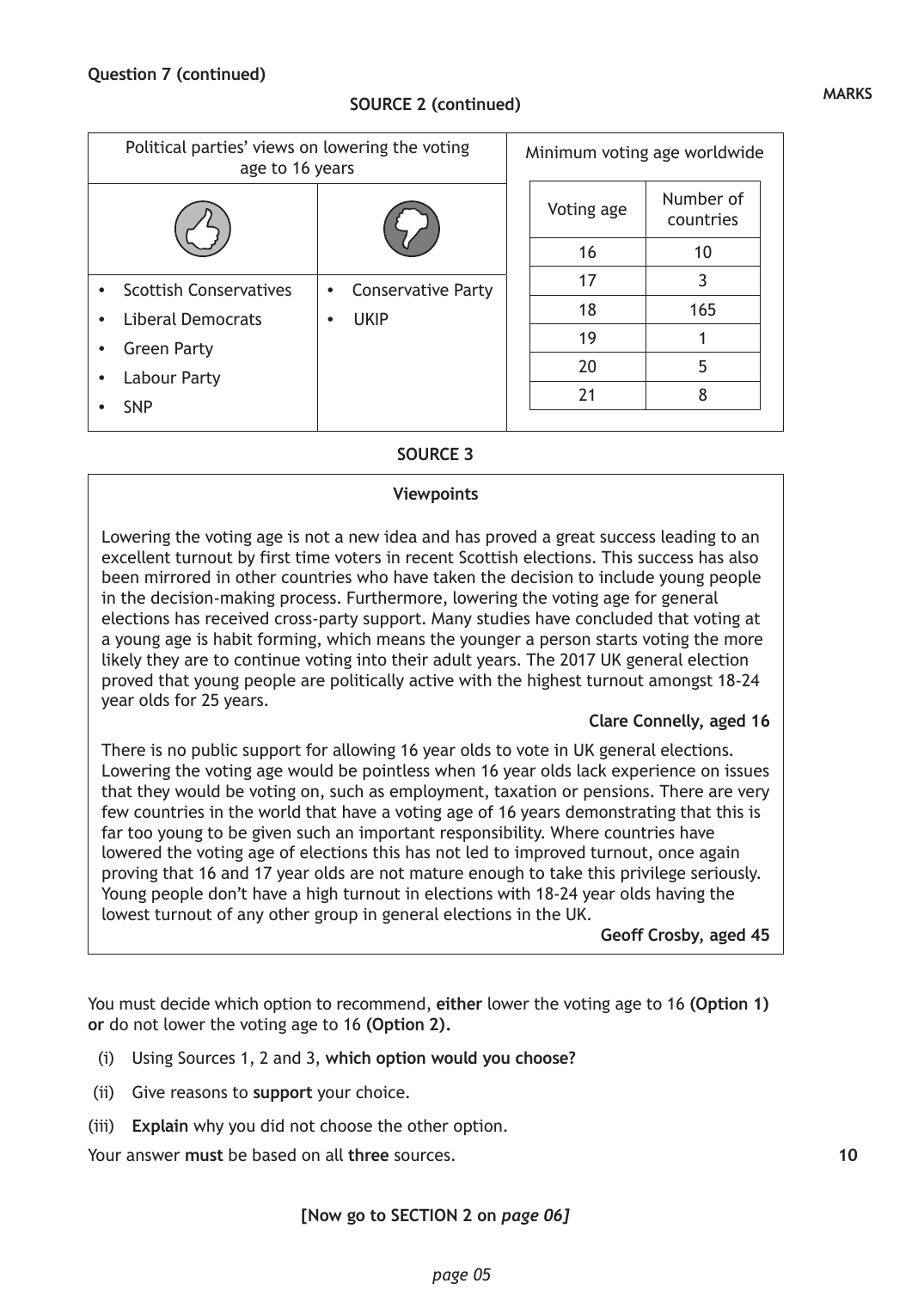
  1. The UK Government should lower the voting age to 16 years in UK general elections. Evidence to support this can be found in Source 3 where it states that lowering the voting age has proved a great success and led to excellent turnout by first time voters in recent Scottish elections. This is backed up by Source 1 where it states that 75% of 16 and 17 year olds who registered to vote, voted in the Scottish independence referendum. (2 marks β€” evidence linked from Source 1 and 3)

Credit reference to aspects of the following:

  1. 16 and 17 years olds in Scotland have been given the right to vote in Scottish Parliament and local council elections (Source 1)
  2. by 2022, 16 and 17 year olds will be given the right to vote in elections to the Welsh Assembly (Source 1)
  3. some argue that it is important that young people have a say in matters that directly affect them (Source 1)
  4. Austria became the first country to successfully lower the voting age to 16 which led to increased political participation by young people (Source 1)
  5. 97% of 16 and 17 year olds who voted in the Scottish independence referendum said they would vote again (Source 1)
  6. many modern democracies allow 16 and 17 year olds to vote in all or some elections (Source 1)
  7. a study of the Scottish independence referendum found that young people were able to make an informed decision on how to vote rather than copy their peers or parents (Source 1)
  8. five out of the seven political parties support lowering the voting age (Source 2)
  9. young people already have many legal rights at the age of 16 including joining the army and getting married (Source 1)
  10. ten countries around the world allow 16 year olds to vote (Source 2)
  11. lowering the voting age for general elections has received cross-party support in the UK (Source 3)
  12. voting at a young age is habit forming (Source 3)

Reasons for rejecting the other option:

  1. I did not choose Option 2 as although Source 3 states there is no public support for allowing 16 year olds to vote in UK general elections, this is untrue as Source 2 shows that a third of those surveyed supported the idea of lowering the voting age to 16. (2 marks β€” Evidence linked from Source 2 and Source 3)

Option 2 β€” Do not lower the voting age to 16.

  1. The UK Government should not lower the voting age to 16 years for UK general elections. Evidence to support this can be found in Source 3 which states there are very few countries in the world that have a voting age of 16 years. This is backed up by Source 2 that shows only ten countries of the world allow voting at 16, whereas the majority of countries (165) enforce a voting age of 18. (3 marks β€” evidence drawn from two sources, with evaluative comment)

Credit reference to aspects of the following:

  1. 16 year olds have not matured enough and should not be allowed to vote in general elections (Source 1)
  2. it was thought that most 16 year olds would vote the way their parents voted or deliberately vote the other way (Source 1)
  3. rather than lowering the voting age in line with other rights the government should explore raising the age of such rights in line with the current voting age (Source 1)
  4. Norway experimented with lowering the voting age but not all teenagers exercised their right to vote (Source 1)
  5. at the 2017 UK general election only 54% of the youngest age-group, 18-24 year olds, voted compared to average overall turnout of 69% (Source 1)
  6. over half of those surveyed did not support lowering the voting age to 16 (Source 2)
  7. 165 countries of the world do not allow voting until the age of 18 (Source 2)
  8. 14 countries of the world expect voters to be older than 18 years before being allowed to vote (Source 2)
  9. there is no public support for allowing 16 year olds to vote in UK general elections (Source 3)
  10. there are very few countries in the world that have a voting age of 16 years (Source 3)
  11. where countries have lowered the voting age of elections this has not led to improved turnout (source 3)
  12. young people don’t have high turnout in elections with 18-24 year olds having the lowest turnout of any other group in general elections in the UK. (Source 3)

Reasons for rejecting the other option:

  1. I have not chosen Option 1 as although some would argue that young people have many legal rights at the age of 16, including joining the army and getting married (Source 1), Norway experimented with lowering the voting age but not all teenagers exercised their right to vote. (2 marks β€” evidence drawn from Source 1)
Decision making10 marks2019 specimenQ3⏳ Older formatInternational Issues

Study Sources 1, 2 and 3 below, then attempt the question which follows.

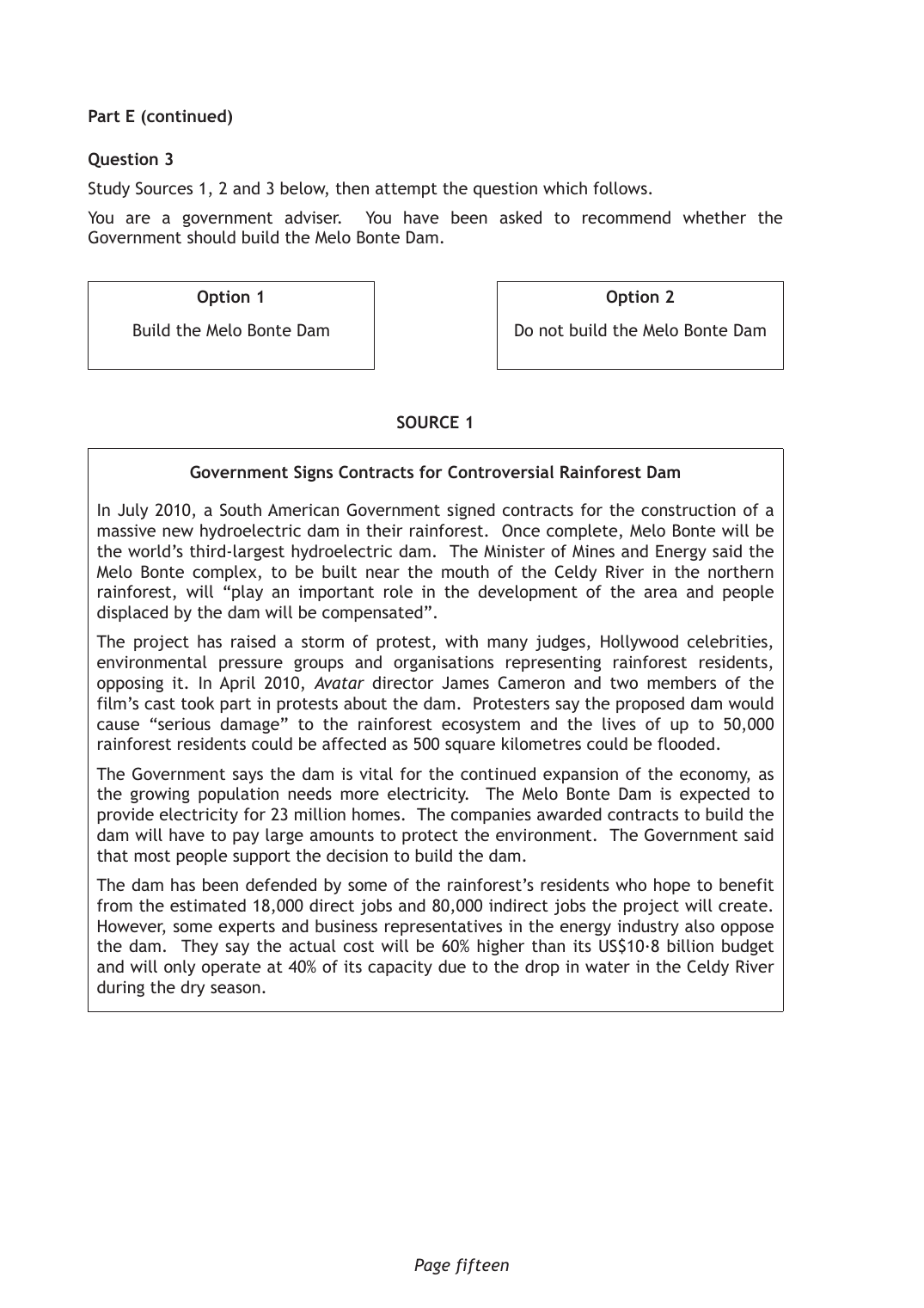
You are a government adviser. You have been asked to recommend whether the Government should build the Melo Bonte Dam.

Option 1

Build the Melo Bonte Dam

Option 2

Do not build the Melo Bonte Dam

You must decide which option to recommend, either build the Melo Bonte Dam (Option 1) or do not build the Melo Bonte Dam (Option 2).

(i) Using Sources 1, 2 and 3 above and opposite, which option would you choose?

(ii) Give reasons to support your choice.

(iii) Explain why you did not choose the other option.

Your answer must be based on all three sources.

Sources (Source 1, Source 2, Source 3)

Source page 1 for this questionSource page 2 for this question
πŸ“ Structure template β€” how to structure your answer

Decision making Β· A source-based skills question

WFQ (words from the question)

  1. I chose insert option name.
  2. Evidence to support this is in insert source which says/shows β€œinsert evidence”.βœ“ 1 mark per piece of evidence (up to 8)
  3. This is further supported by evidence in insert source which says/shows β€œinsert evidence”. (Repeat until you have 8 pieces of evidence = 8 marks.)
  4. Rebuttal: I rejected insert option name because insert source says/shows β€œinsert evidence”.βœ“ needed for full marks

How it's marked

  • Up to 3 marks for a developed justification; credit highly where you link evidence between sources.
  • For full marks you must justify your decision AND explain why you rejected the other option.
  • Maximum 8 marks if you only deal with one option.
  • Aim for around 8 pieces of evidence to build up the marks.
  • Don’t forget the rebuttal β€” say why you rejected the other option.
βœ“ Reveal marking scheme
Max 10 marks

These are possible/exemplar answers from the marking instructions β€” other valid points can also gain marks.

How marks are awarded
  • The candidate is required to evaluate a limited range of sources, in order to make and justify a decision/recommendation. The candidate must also explain why they have rejected the other option.
  • In order to achieve full marks candidates must say why they did not choose the other option. An answer which deals with only one option should be awarded a maximum of 8 marks.

Option 1: Build the Melo Bonte Dam

  1. The Government should build the Melo Bonte Dam as it is vital for the continued expansion of the economy, as the growing population needs more electricity. [1 markβ€”evidence drawn from Source 1]
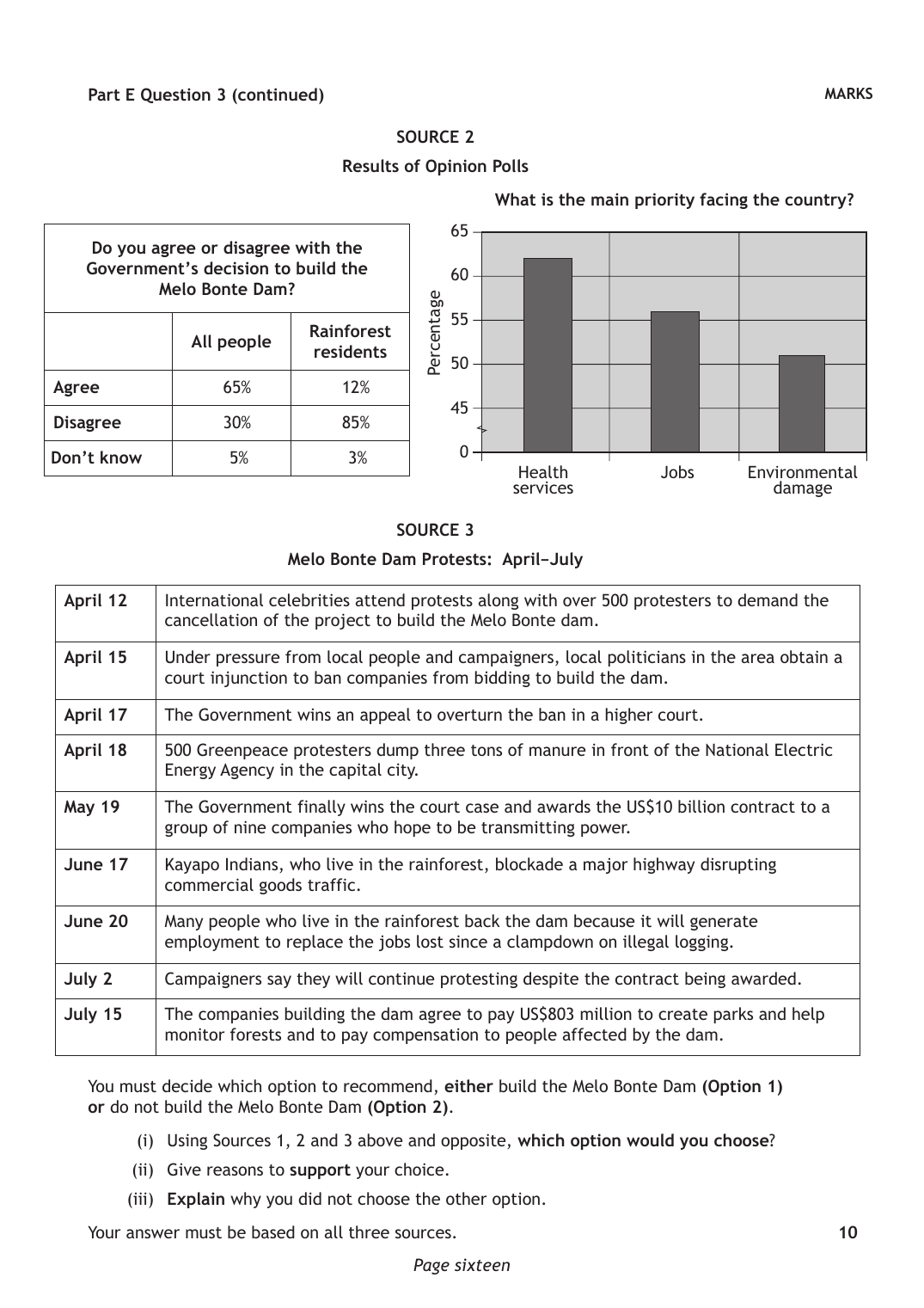
  2. The Government should build the Melo Bonte Dam as it is vital for the continued expansion of the economy, as Source 1 says that most people support the decision to build the dam and this is backed up by the opinion poll in Source 2 which shows 65% of all people agree with the decision to build the dam. [2 marksβ€”evidence linked from Source 1 and Source 2]
  3. The Minister of Mines and Energy said the Melo Bonte complex, to be built near the mouth of the Celdy River in the rainforest, will β€œplay an important role in the development” of the area and people displaced by the dam β€œwill be compensated.” (Source 1).
  4. The Government says the dam is vital for the continued expansion of the economy as the country needs more electricity (Source 1).
  5. The dam has been defended by some in the local population who hope to benefit from the estimated 18,000 direct jobs and 80,000 indirect jobs the Government says the project would create. (Source 1)
  6. The Melo Bonte Dam is expected to provide electricity to 23 million homes. (Source 1)
  7. The Government said that most people support the decision to build the dam (Source 1).
  8. 65% of the population agreed with the Government’s decision to build the Melo Bonte Dam (Source 2).
  9. June 20, Many indigenous people back the dam because it will generate employment to replace the jobs lost since a clamp down on illegal logging (Source 3).
  10. July 15, The companies building the dam agree to pay US$803 million to create parks and help monitor forests and to pay compensation to people affected by the dam (Source 3).

Reasons for rejecting other option.

  1. I rejected the option to not build the dam as although protesters say the dam could cause serious damage to the rainforest and the lives of up to 50,000 rainforest residents could be affected, Source 3 says the companies building the dam agree to pay US$803 million to create parks and help monitor forests and to pay compensation to people affected by the dam. [2 marks]

Option 2: Do not build the Melo Bonte Dam

  1. The Government should not build the Melo Bonte Dam as protesters say the proposed dam would cause serious damage to the rainforest and the lives of up to 50,000 rainforest residents could be affected (Source 1). In an opinion poll only 12% of rainforest residents agreed and a large majority of 85% said they disagreed with the decision to build the dam. [3 marksβ€”evidence linked from Source 1 (1 mark) with detailed use of evidence from Source 2 demonstrating evaluative terminology (2 marks)].
  2. The project has raised a storm of protest, with judges, Hollywood celebrities, environmental pressure groups and local people in opposition (Source 1).
  3. In April 2010, Avatar director James Cameron and two members of the film’s cast, took part in protests. (Source 1)
  4. Protesters say the proposed dam would cause β€œserious damage” to the rainforest ecosystem, and the lives of up to 50,000 people could be affected as 500 square kilometres could be flooded (Source 1).
  5. Some experts and business representatives in the energy industry also oppose the dam. They say the actual cost will be 60% higher than its US$10.8 billion budget and will only operate at 40% of its installed capacity, due to the drop in water in the Celdy River during the dry season (Source 1).
  6. In an opinion poll 85% of rainforest residents disagreed with the Government’s decision to build the Melo Bonte Dam (Source 2).
  7. Over half of people think that environmental damage is the main priority facing the country (Source 2).
  8. 62% of people think the health service is the main priority facing the country. (Source 2)
  9. April 12, international celebrities attend protests with over 500 protesters to demand the cancellation of the project to build the Melo Bonte Dam (Source 3).
  10. April 15, under pressure from local people and campaigners, local politicians obtain a court injunction to ban companies bidding to build the dam (Source 3).
  11. July 2, Campaigners say they will continue protesting despite the contract being awarded (Source 3).

Reasons for rejecting other option.

  1. I rejected the option to build the dam as there have been a storm of protests from Hollywood celebrities and environmental pressure groups and organisations representing rainforest residents. [1 mark awarded for use of one piece of information from Source 1 with no linking. Do not credit if marks already awarded for this point.]
Source: 2019 specimen N5 History Β· X849/75/11 Β· Q3Question paper (PDF, p.15) β†—Marking instructions (PDF, p.48) β†—
Decision making10 marks2019 specimenQ3⏳ Older formatInternational Issues

Study Sources 1, 2 and 3 below, then attempt the question which follows.

You are an adviser to the European Union (EU). You have been asked to recommend whether Country A or Country B should be allowed to join the EU.

Option 1

Allow Country β€œA” to join the EU

Option 2

Allow Country β€œB” to join the EU

Country A and Country B are Candidate Countries hoping to be allowed to join the European Union. Source 1 and 2 contain information about both countries taken from their applications.

You must decide which option to recommend, either allow Country A to join the EU (Option 1) or allow Country B to join the EU (Option 2).

(i) Using Sources 1, 2 and 3 above, which option would you choose?

(ii) Give reasons to support your choice.

(iii) Explain why you did not choose the other option.

Your answer must be based on all three sources.

Sources (Source 1, Source 2, Source 3)

Source page 1 for this questionSource page 2 for this question
πŸ“ Structure template β€” how to structure your answer

Decision making Β· A source-based skills question

WFQ (words from the question)

  1. I chose insert option name.
  2. Evidence to support this is in insert source which says/shows β€œinsert evidence”.βœ“ 1 mark per piece of evidence (up to 8)
  3. This is further supported by evidence in insert source which says/shows β€œinsert evidence”. (Repeat until you have 8 pieces of evidence = 8 marks.)
  4. Rebuttal: I rejected insert option name because insert source says/shows β€œinsert evidence”.βœ“ needed for full marks

How it's marked

  • Up to 3 marks for a developed justification; credit highly where you link evidence between sources.
  • For full marks you must justify your decision AND explain why you rejected the other option.
  • Maximum 8 marks if you only deal with one option.
  • Aim for around 8 pieces of evidence to build up the marks.
  • Don’t forget the rebuttal β€” say why you rejected the other option.
βœ“ Reveal marking scheme
Max 10 marks

These are possible/exemplar answers from the marking instructions β€” other valid points can also gain marks.

How marks are awarded
  • The candidate is required to evaluate a limited range of sources, in order to make and justify a decision/recommendation. The candidate must also explain why they did not choose the other option.
  • In order to achieve full marks candidates must say why they did not choose the other option. An answer which deals with only one option should be awarded a maximum of 8 marks.

For option 1: Country A

  1. Country A should be allowed to join the EU as many drug dealers have been sent to prison. [1 markβ€”one piece of evidence from one source]
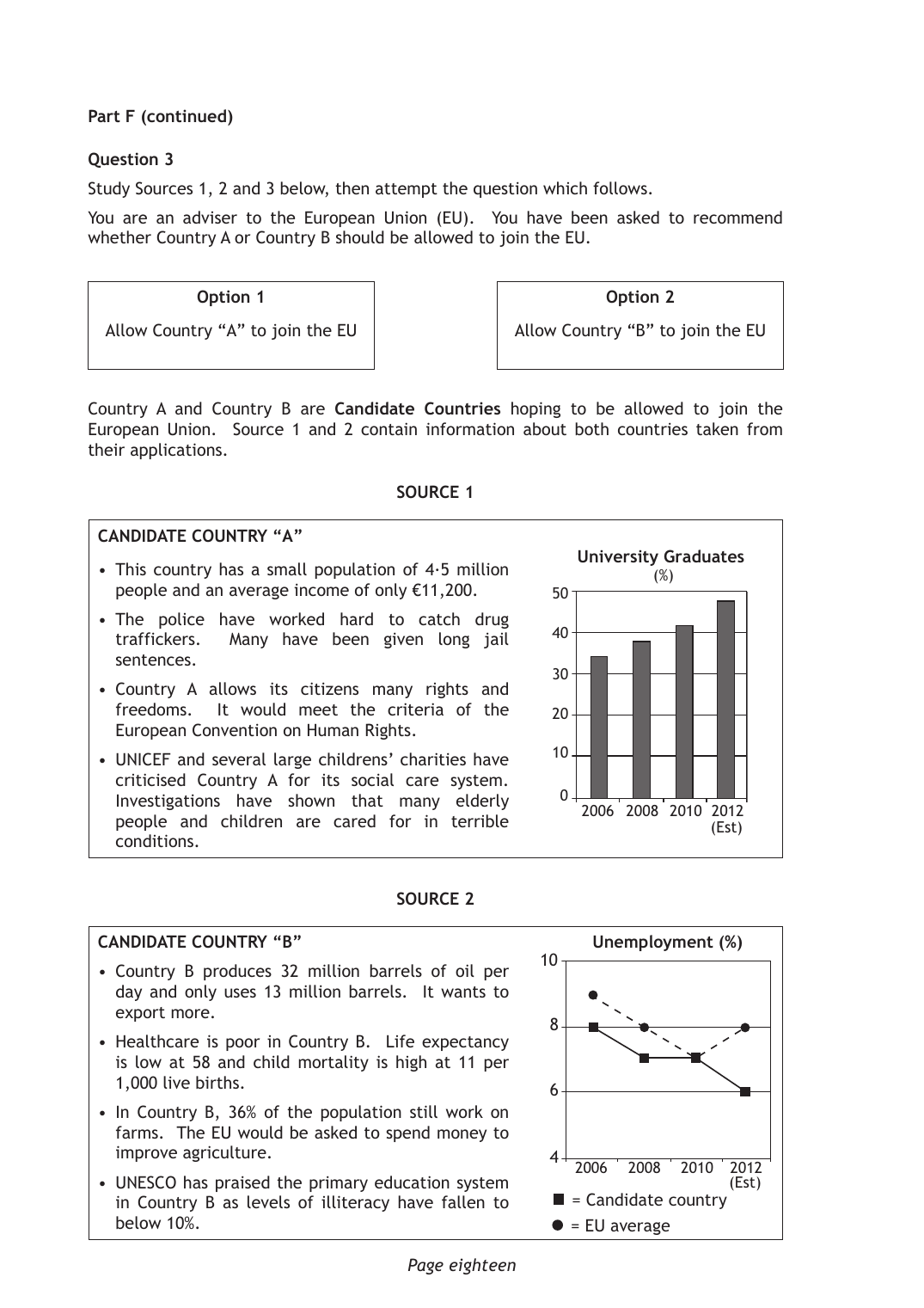
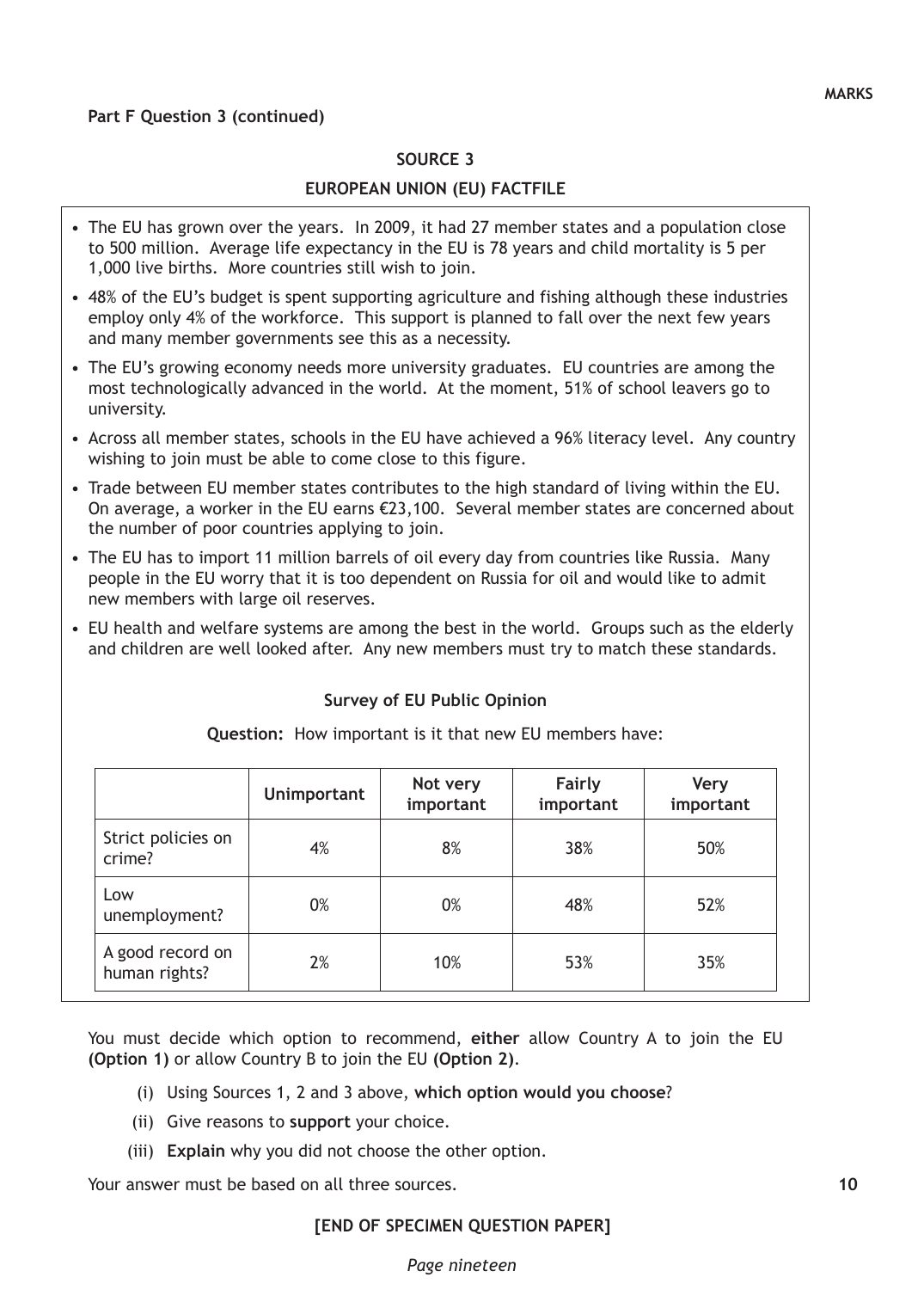
  2. I rejected the second option (allowing country B to join) as over one third (36%) of its population still work in agriculture. This is nine times the level in the EU (4%) which would not allow the EU to reduce its huge expenditure on agriculture which stands at almost half of the entire budget (48%). Many of the EU members see a drop in this 48% as essential. [3 marksβ€”accurate information from two sources with some evaluative comment]
  3. Country A’s police have done well in clamping down on drug trafficking. According to the EU opinion survey, 88% of Europeans saw this as fairly important or very important.
  4. 88% of respondents in the survey also saw a good human rights record as fairly or very important. Country A would meet the criteria for the ECHR.
  5. University entrants in Country A have been growing in number and are getting close to the EU average of 51%. The EU’s economy needs more university graduates.

Against option 1: Country A

  1. Several member states have become concerned about the number of poor countries who are applying to join the EU. Country A’s average income (11,200) is less than half of the EU average (23,100).
  2. The EU takes good care of vulnerable groups, like children. Country A would struggle to meet these standards as shown in a recent UNICEF investigation, which criticized it for β€œterrible conditions”.

For option 2: Country B

  1. Country B should be allowed to join the EU as it produces 32 million barrels of oil and the EU doesn’t want to rely on Russia. [2 marksβ€”evidence linked from Source 1 and Source 2]
  2. I rejected country A as its average income is €11,200. In the EU it is €23,100. [2 marks awarded for use of two pieces of evidence from different sources. Do not credit if marks already awarded for this point in justification of choice.]
  3. Country B is self-sufficient in oil and is already producing 19 million barrels per day more than it uses. EU dependence on Russia would be reduced. This would be good as many would like to admit countries with oil reserves.
  4. 100% in the survey said that low unemployment was fairly important or very important. The graph shows that Country B’s unemployment rate is consistently less than the EU average.
  5. Country B has been praised for reducing illiteracy rates to below 10%. This is coming close to the levels achieved by schools in the EU.

Against option 2: Country B

  1. Country B has a huge agricultural industry. Over one third of workers are employed in this sector. This would make it difficult to reduce the EU’s agriculture budget, which the member states see as necessary.
  2. Country B has poor health care. Life expectancy is twenty years below the EU average and infant mortality rate is more than double.
Source: 2019 specimen N5 History Β· X849/75/11 Β· Q3Question paper (PDF, p.18) β†—Marking instructions (PDF, p.57) β†—
Decision making10 marks2019Q21International Issues

Study Sources 1, 2 and 3 and then answer the question which follows.

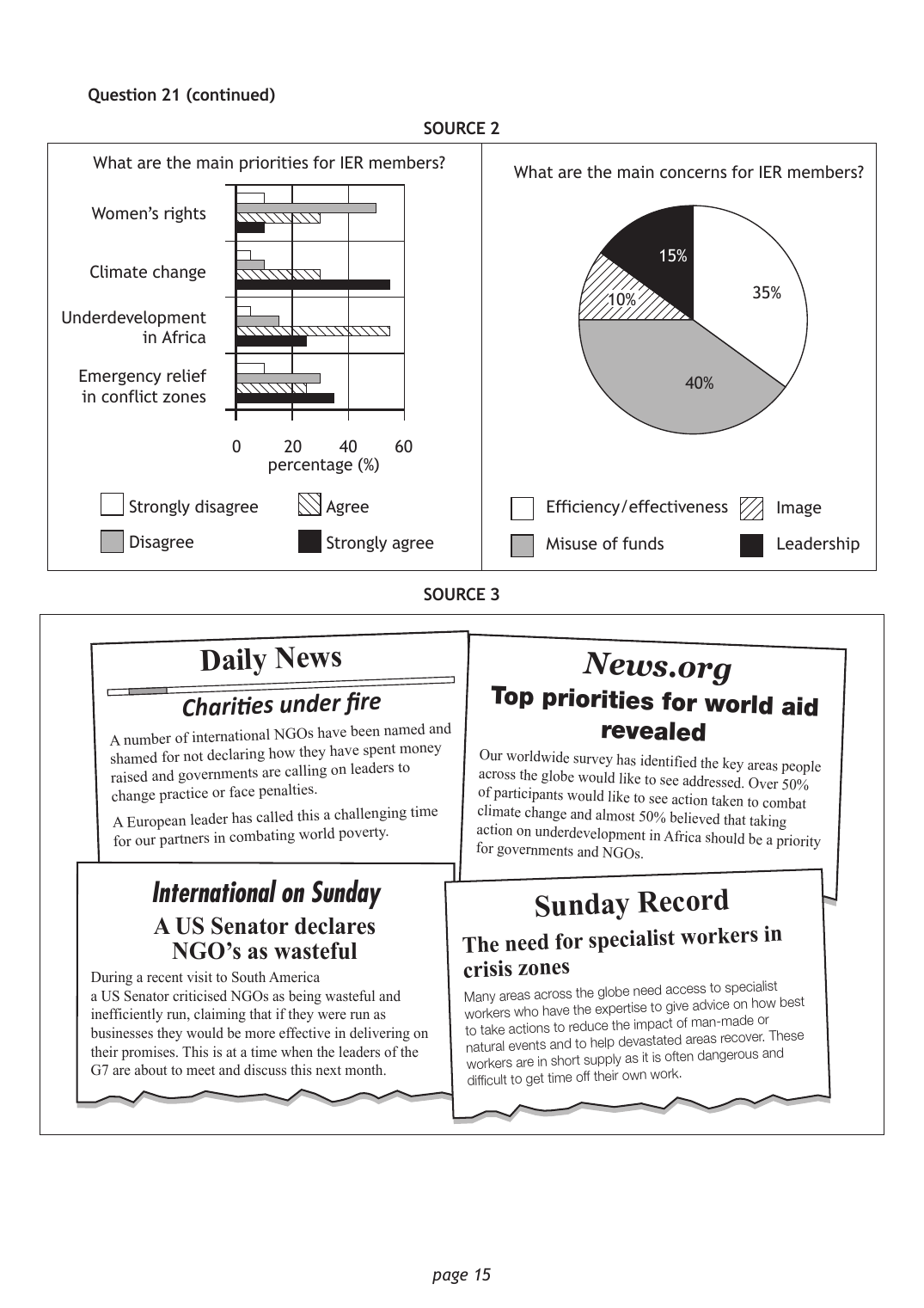
International Emergency Relief (IER) is about to elect a new Executive Leader. You are a member of this non-governmental organisation (NGO) and will vote to decide who should be the next leader of IER. There are two candidates, Option 1 or Option 2.

Option 1

James Peddie

Option 2

Elizabeth Sharp

You must decide which option to recommend, either James Peddie (Option 1) or Elizabeth Sharp (Option 2).

(i) Using Sources 1, 2 and 3, which option would you choose?

(ii) Give reasons to support your choice.

(iii) Explain why you did not choose the other option.

Your answer must be based on all three sources.

Sources (Source 1, Source 2, Source 3)

Source page 1 for this questionSource page 2 for this question
πŸ“ Structure template β€” how to structure your answer

Decision making Β· A source-based skills question

WFQ (words from the question)

  1. I chose insert option name.
  2. Evidence to support this is in insert source which says/shows β€œinsert evidence”.βœ“ 1 mark per piece of evidence (up to 8)
  3. This is further supported by evidence in insert source which says/shows β€œinsert evidence”. (Repeat until you have 8 pieces of evidence = 8 marks.)
  4. Rebuttal: I rejected insert option name because insert source says/shows β€œinsert evidence”.βœ“ needed for full marks

How it's marked

  • Up to 3 marks for a developed justification; credit highly where you link evidence between sources.
  • For full marks you must justify your decision AND explain why you rejected the other option.
  • Maximum 8 marks if you only deal with one option.
  • Aim for around 8 pieces of evidence to build up the marks.
  • Don’t forget the rebuttal β€” say why you rejected the other option.
βœ“ Reveal marking scheme
Max 10 marks

These are possible/exemplar answers from the marking instructions β€” other valid points can also gain marks.

How marks are awarded
  • The candidate is required to evaluate a limited range of sources, in order to justify a decision/recommendation.
  • The candidate must also explain why they have rejected the other option.
  • In order to achieve full marks candidates must say why they did not choose the other option. An answer which deals with only one option should be awarded a maximum of 8 marks.

Option 1: elect James Peddie

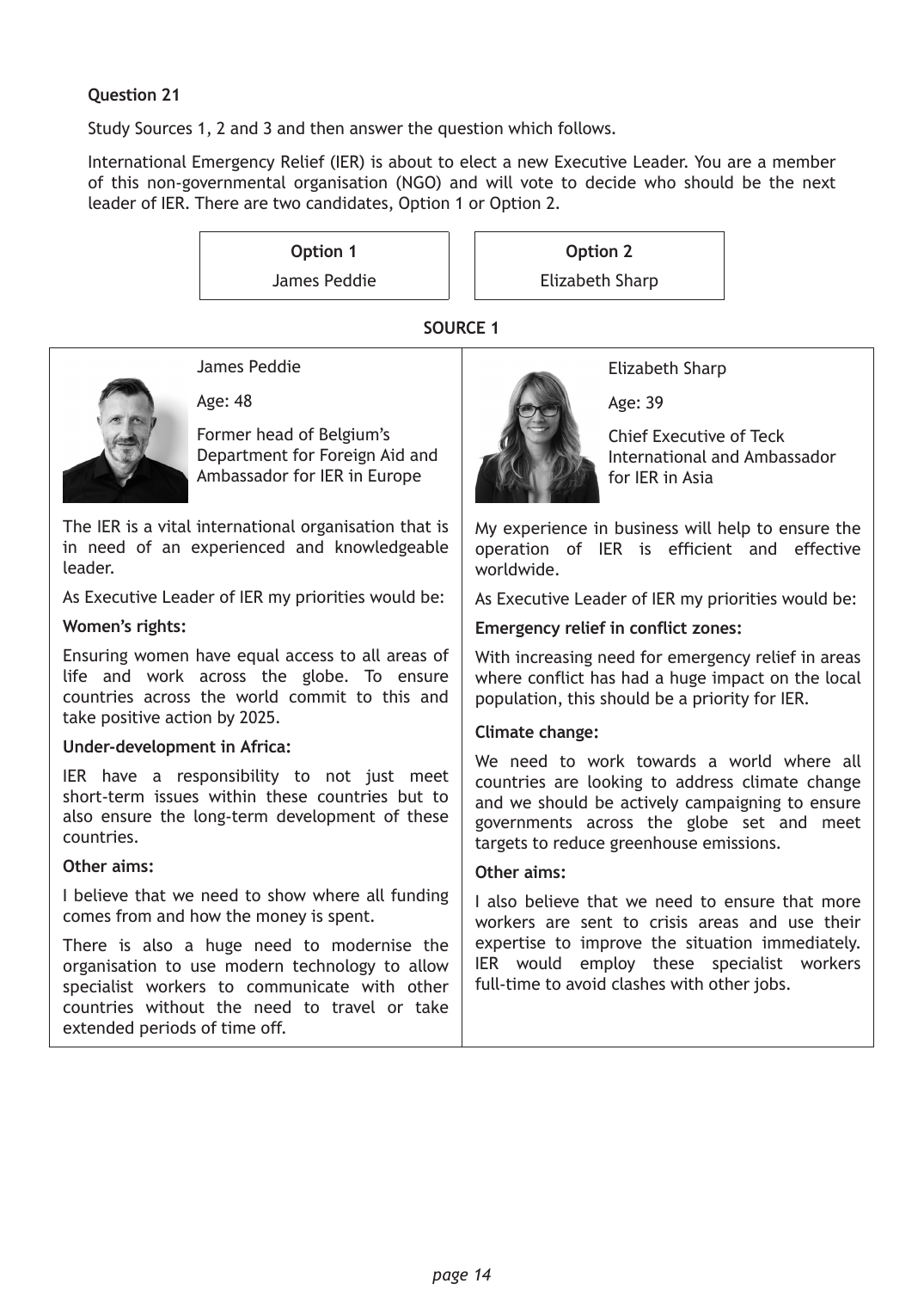
  1. IER should select James Peddie as he says in Source 1 'we need to show where all funding comes from and how the money is spent'. (1 mark β€” evidence drawn from Source 1)
  2. IER should select James Peddie as he says in Source 1 'we need to show where all funding comes from and how the money is spent'. This is backed up in Source 3 from the Daily News when it says 'A number of international NGOs have been named and shamed for not declaring how they have spent money raised and governments are calling on leaders to change practice or face penalties'. (2 marks β€” evidence linked from Source 1 and Source 3)
  3. IER should select James Peddie as he says in Source 1 'we need to show where all funding comes from and how the money is spent'. This is backed up in Source 3 from the Daily News when it says 'A number of international NGOs have been named and shamed for not declaring how they have spent money raised and governments are calling on leaders to change practice or face penalties' and Source 2 which shows that the misuse of funds is the main concern for IER members. (3 marks β€” evidence linked from all three Sources)

Credit reference to aspects of the following (Option 1)

  1. under-development in Africa: James Peddie says that IER have a responsibility to not just meet short-term issues within these countries but to also ensure the long-term development of these countries (Source 1) and over 50% believe that underdevelopment in Africa should be a priority for governments and NGOs (Source 3)
  2. specialist workers are in short supply as it is often dangerous and difficult to get time off their own work (Source 3) and there is also a huge need to modernise the organisation to use modern technology to allow specialist workers to communicate with other countries without the need to travel or take extended periods of time off (Source 1)
  3. the IER is a vital international organisation that is in need of an experienced and knowledgeable leader (Source 1) and James Peddie is 'Former head of Belgium's Department for Foreign Aid and Ambassador for IER in Europe'. (Source 1)

Reasons for rejecting the other option (Option 1 chosen)

  1. I rejected option 2, Elizabeth Sharp, as she said she would prioritise emergency relief in conflict zones (Source 1) but more IER members agreed that underdevelopment in Africa should be a priority. (Source 2) (2 marks β€” evidence linked from Source 1 and Source 2)

Option 2: elect Elizabeth Sharp

  1. IER should select Elizabeth Sharp as she says 'My experience in business will help to ensure the operation of IER is efficient and effective worldwide'. (1 mark β€” evidence drawn from Source 1)
  2. IER should select Elizabeth Sharp as she says 'My experience in business will help to ensure the operation of IER is efficient and effective worldwide'. This is supported in Source 3 when the news article says 'A US Senator criticised NGOs as being wasteful and inefficiently run, claiming that if they were run as businesses they would be more effective in delivering on their promises'. (2 marks β€” evidence linked from Source 1 and Source 3)
  3. IER should select Elizabeth Sharp as she says 'My experience in business will help to ensure the operation of IER is efficient and effective worldwide'. This is supported in Source 3 when the news article says 'A US Senator has criticised NGOs as being wasteful and inefficiently run, claiming that if they were run as businesses they would be more effective in delivering on their promises'. This is further shown in the pie chart in Source 2 as 35% of members are concerned about efficiency/effectiveness. (3 marks β€” evidence linked from all three Sources)

Credit reference to aspects of the following (Option 2)

  1. many areas across the globe need access to specialist workers who have the expertise to give advice on how best to take actions to reduce the impact of man-made or natural events and to help areas devastated recover (Source 3) and we need to ensure that more workers are sent to crisis areas and use their expertise to improve the situation immediately. IER would employ these specialist workers full-time to avoid clashes with other jobs (Source 1)
  2. emergency relief in conflict zones: with increasing need for emergency relief in areas where conflict has had a huge impact on the local population, this should be a priority for IER (Source 1) and a majority of people said they agreed or strongly agreed that emergency relief in conflict zones should be a priority. (Source 2)

Reasons for rejecting the other option (Option 2 chosen)

  1. I rejected option 1 because James Peddie says 'Women's Rights: Ensuring women have equal access to all areas of life and work across the globe' should be a priority but Source 2 shows that this has the highest number of people disagreeing in comparison to the other priorities. (2 marks β€” evidence linked from Source 1 and Source 2)
Source: 2019 N5 History Β· X849/75/11 Β· Q21Question paper (PDF, p.14) β†—Marking instructions (PDF, p.40) β†—
Decision making10 marks2018Q14Social Issues in the United Kingdom

Study Sources 1, 2 and 3, then answer the question which follows.

You are an advisor to the Scottish Government. You have been asked to recommend whether the Scottish Government should build a prison for elderly prisoners or if they should adapt existing prisons for elderly prisoners.

Option 1

The Scottish Government should build a prison for elderly prisoners.

Option 2

The Scottish Government should adapt existing prisons for elderly prisoners.

You must decide which option to recommend, either the Scottish Government should build a prison for elderly prisoners (option 1) or the Scottish Government should adapt existing prisons for elderly prisoners (option 2).

(i) Using Sources 1, 2 and 3, which option would you choose?

(ii) Give reasons to support your choice.

(iii) Explain why you did not choose the other option.

Your answer must be based on all three sources.

Sources (Source 1, Source 2, Source 3)

Source page 1 for this questionSource page 2 for this question
πŸ“ Structure template β€” how to structure your answer

Decision making Β· A source-based skills question

WFQ (words from the question)

  1. I chose insert option name.
  2. Evidence to support this is in insert source which says/shows β€œinsert evidence”.βœ“ 1 mark per piece of evidence (up to 8)
  3. This is further supported by evidence in insert source which says/shows β€œinsert evidence”. (Repeat until you have 8 pieces of evidence = 8 marks.)
  4. Rebuttal: I rejected insert option name because insert source says/shows β€œinsert evidence”.βœ“ needed for full marks

How it's marked

  • Up to 3 marks for a developed justification; credit highly where you link evidence between sources.
  • For full marks you must justify your decision AND explain why you rejected the other option.
  • Maximum 8 marks if you only deal with one option.
  • Aim for around 8 pieces of evidence to build up the marks.
  • Don’t forget the rebuttal β€” say why you rejected the other option.
βœ“ Reveal marking scheme
Max 10 marks

These are possible/exemplar answers from the marking instructions β€” other valid points can also gain marks.

How marks are awarded
  • The candidate is required to evaluate a limited range of sources, in order to justify a decision/recommendation.
  • The candidate must also explain why they have rejected the other option.
  • In order to achieve full marks candidates must say why they did not choose the other option. An answer which deals with only one option should be awarded a maximum of 8 marks.

Option 1: The Scottish Government should build a prison for elderly prisoners.

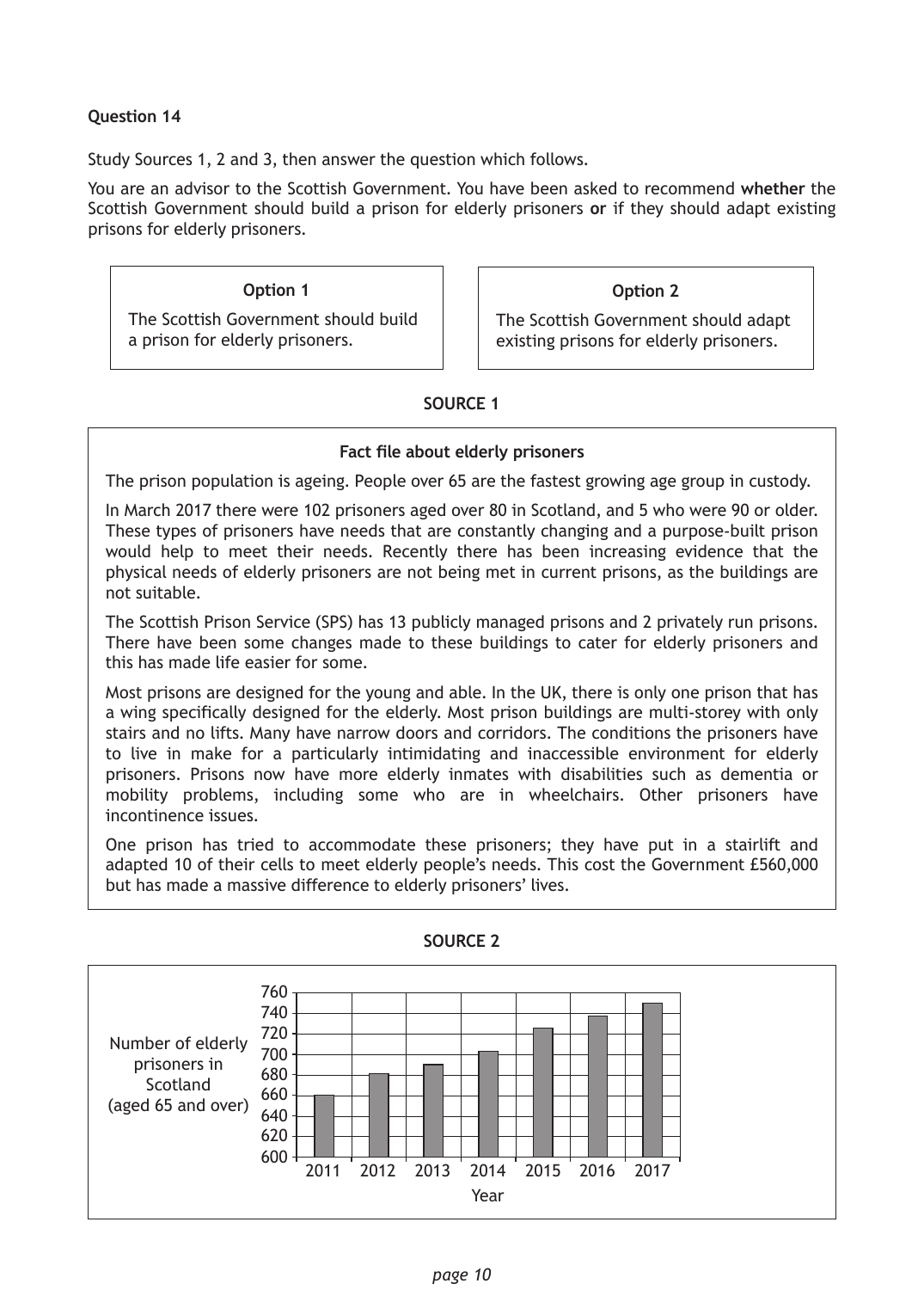
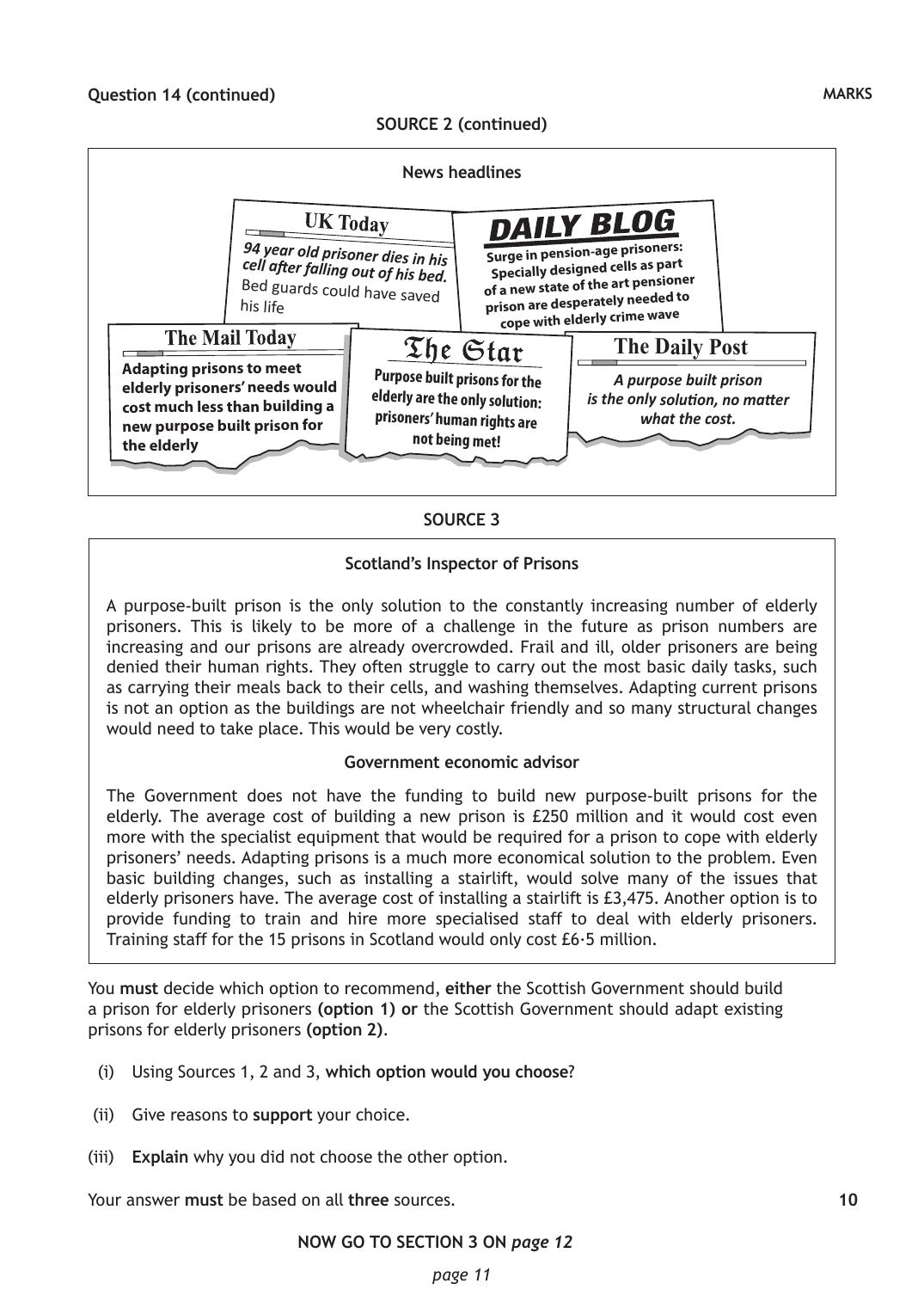
  1. The Scottish Government should build a new prison for elderly prisoners. Evidence to support this can be found in Source 2 where it states that 'Purpose built prisons for the elderly are the only solution: prisoners' human rights are not being met!' This is further backed up in Source 3 where it states 'Frail and ill, older prisoners are being denied their human rights. They often struggle to carry out the most basic daily tasks, such as carrying their meals back to their cells and washing themselves.' (2 marks – evidence linked from Source 2 and Source 3)
  2. Credit reference to aspects of the following:
  3. recently there has been increasing evidence that the physical needs of elderly prisoners are not being met in current prisons, as the buildings are not suitable (Source 1)
  4. most prisons are designed for the young and able. In the UK, there is only one prison that has a wing specifically designed for the elderly (Source 1)
  5. most prison buildings are multi-storey with only stairs and no lifts. Many have narrow doors and corridors. The conditions the prisoners have to live in make for a particularly intimidating and inaccessible environment for elderly prisoners (Source 1)
  6. in March 2017, there were 102 prisoners aged over 80 in Scotland, and 5 who were 90 or older. These types of prisoners have needs that are constantly changing and a purpose built prison would help to meet their needs (Source 1)
  7. 'Surge in pension-age prisoners: Specially designed cells as part of a new state of the art pensioner prison are desperately needed to cope with elderly crime wave' (Source 2)
  8. elderly prisoner numbers have increased from 660 in 2011 to approximately 750 in 2017 (Source 2)
  9. 'A purpose built prison is the only solution, no matter what the cost' (Source 2)
  10. a purpose built prison is the only solution to the constantly increasing number of elderly prisoners and this is likely to be more of a challenge in the future as prison numbers are increasing and our prisons are already overcrowded (Source 3).

Reasons for rejecting other option:

  1. I did not choose Option 2 as although some people may say that 'Even basic building changes such as installing a stairlift, would solve many of the issues that elderly prisoners have.' (Source 3), this is not true as in Source 3 it also says 'Adapting current prisons is not an option as the buildings are not wheelchair friendly and so many structural changes would need to take place, this would be very costly'. (2 marks awarded for using two pieces of information from Source 3 to form a rebuttal. Do not credit if marks have already been awarded for this point)

Option 2: The Scottish Government should adapt existing prisons for elderly prisoners.

  1. The Scottish Government should adapt existing prisons to meet the needs of elderly prisoners as in Source 2 it states that 'Adapting prisons to meet elderly prisoners' needs would cost much less than building a new purpose built prison for the elderly'. (1 mark – evidence drawn from Source 2)
  2. The Scottish Government should adapt current prisons to meet the needs of elderly prisoners as in Source 2 it states 'Adapting prisons to meet elderly prisoners' needs would cost much less than building a new purpose built prison for the elderly' and Source 3 states 'The Government does not have the funding to build new purpose built prisons for the elderly'. (2 marks – evidence linked from Sources 2 and 3)
  3. the Scottish Prison Service (SPS) has 13 publicly managed prisons and 2 privately run prisons. There have been some changes made to these buildings to cater for elderly prisoners and this has made life easier for some (Source 1)
  4. one prison has tried to accommodate these prisoners; they have put in a stairlift and adapted 10 of their cells to meet elderly people's needs. This cost the Government Β£560,000 but has made a massive difference to elderly prisoners' lives (Source 1)
  5. '94 year old prisoner dies in his cell after falling out of his bed. Bed guards could have saved his life' (Source 2)
  6. 'Adapting prisons to meet elderly prisoners' needs would cost much less than building a new purpose built prison for the elderly' (Source 2)
  7. adapting prisons is a much more economical solution to the problem (Source 3)
  8. even basic building changes such as installing a stairlift, would solve many of the issues that elderly prisoners have. The average cost of installing a stairlift is Β£3,475 (Source 3).

Reasons for rejecting the other option:

  1. Although some people would argue that building a purpose built prison for elderly prisoners is the best option, this would cost Β£250 million (Source 3). Therefore, Option 1 is not the correct choice as Source 2 states that 'Adapting prisons to meet elderly prisoners' needs would cost much less than building a new purpose built prison for the elderly'. This is further backed up in Source 3 where it states that even really basic building changes like putting a stairlift in, would solve many of the issues that elderly prisoners have. The average cost of putting a stairlift in is Β£3,475. This shows that there are much more economical solutions to the issues arising from an elderly prison population as even fitting a stairlift in each of the prisons in Scotland would cost less than building a purpose built prison. (3 marks – evidence drawn from two sources, with evaluative comment)
Source: 2018 N5 History Β· X849/75/11 Β· Q14Question paper (PDF, p.10) β†—Marking instructions (PDF, p.25) β†—
Decision making10 marks2017Q15⏳ Older formatInternational Issues

Study Sources 1, 2 and 3 and then answer the question which follows.

You are an advisor at the European Union. You have been asked to recommend whether or not Serbia should be allowed to join the European Union.

Option 1

Serbia should be allowed to join the European Union.

Option 2

Serbia should not be allowed to join the European Union.

You must decide which option to recommend, either recommend Serbia should be allowed to join the European Union (Option 1) or recommend that Serbia should not be allowed to join the European Union (Option 2).

(i) Using Sources 1, 2 and 3, which option would you choose?

(ii) Give reasons to support your choice.

(iii) Explain why you did not choose the other option.

Your answer must be based on all three sources.

Sources (Source 1, Source 2, Source 3)

Source page 1 for this questionSource page 2 for this question
πŸ“ Structure template β€” how to structure your answer

Decision making Β· A source-based skills question

WFQ (words from the question)

  1. I chose insert option name.
  2. Evidence to support this is in insert source which says/shows β€œinsert evidence”.βœ“ 1 mark per piece of evidence (up to 8)
  3. This is further supported by evidence in insert source which says/shows β€œinsert evidence”. (Repeat until you have 8 pieces of evidence = 8 marks.)
  4. Rebuttal: I rejected insert option name because insert source says/shows β€œinsert evidence”.βœ“ needed for full marks

How it's marked

  • Up to 3 marks for a developed justification; credit highly where you link evidence between sources.
  • For full marks you must justify your decision AND explain why you rejected the other option.
  • Maximum 8 marks if you only deal with one option.
  • Aim for around 8 pieces of evidence to build up the marks.
  • Don’t forget the rebuttal β€” say why you rejected the other option.
βœ“ Reveal marking scheme
Max 10 marks

These are possible/exemplar answers from the marking instructions β€” other valid points can also gain marks.

How marks are awarded
  • The candidate is required to evaluate a limited range of sources, in order to make and justify a decision/recommendation. The candidate must also explain why they have rejected the other option.
  • In order to achieve full marks candidates must say why they did not choose the other option. An answer which deals with only one option should be awarded a maximum of 8 marks.

For Option One: Serbia is allowed to join the European Union

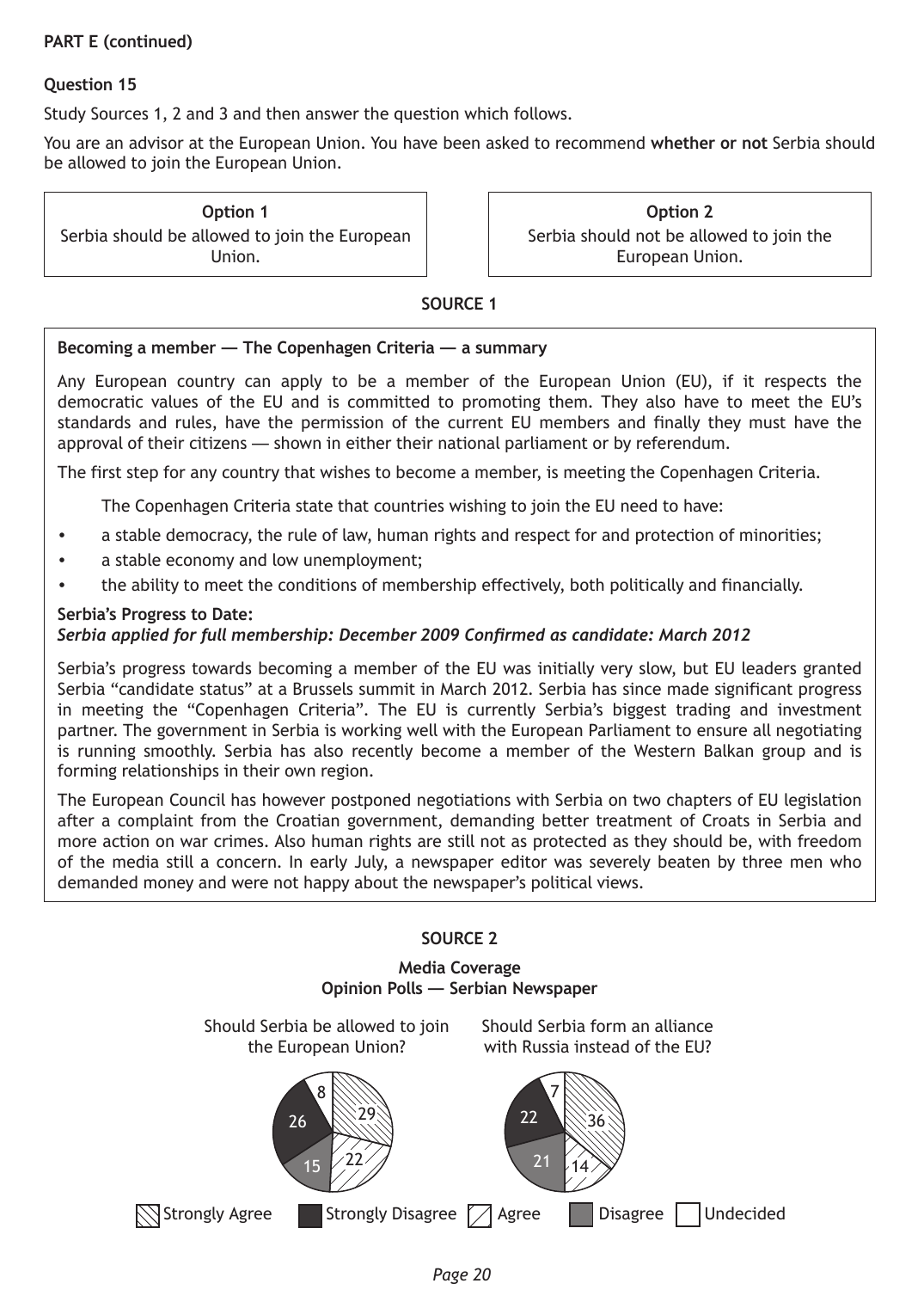
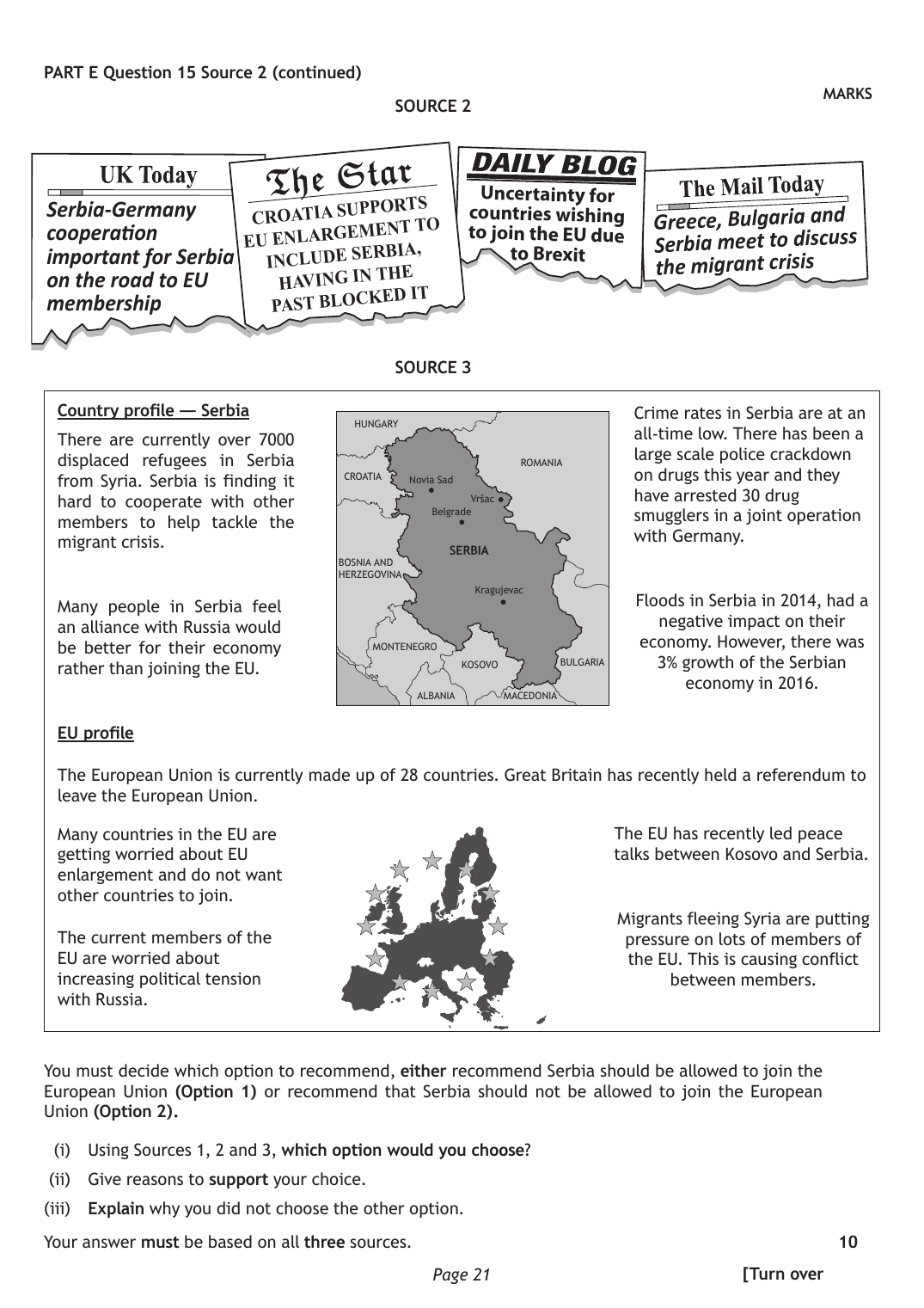
  1. Serbia should be allowed to join the European Union, evidence to support this can be found in source 1 where it states that β€œSerbia has made significant progress in meeting the Copenhagen Criteria”. The Copenhagen Criteria states that countries who wish to join should have β€œa stable democracy, the rule of law, human rights and respect for and protection of minorities”. This is backed up in source 3 where it states that β€œcrime rates in Serbia are at an all-time low.” (3 Marks – detailed evidence linked from sources 1 and 3)
  2. Credit reference to aspects of the following:
  3. The government in Serbia is working well with the European Parliament to ensure all negotiating is running smoothly (source 1)
  4. Serbia has also recently become a member of the Western Balkan group and is forming relationships in their own region (source 1)
  5. The EU is currently Serbia’s biggest trading and investment partner (source 1)
  6. 51% of the public in Serbia either agree or strongly agree with Serbia joining the European Union (source 2)
  7. Serbia-Germany cooperation is important for Serbia on the road to EU membership (source 2)
  8. Croatia supports EU enlargement to include Serbia, having in the past blocked it (source 2)
  9. Crime rates in Serbia are at an all-time low. There has been a large scale police crackdown on drugs this year and they arrested 30 drug smugglers in a joint operation with Germany (source 3)
  10. 3% growth of the Serbian economy in 2016 (source 3).

Reasons for rejecting other option: Option 2: Serbia should not be allowed to join the European Union.

  1. I did not choose option 2 as although some people may say that Serbia have not made a lot of progress, they have recently taken part in EU-led peace talks between Serbia and Kosovo. (1 mark awarded for use of one piece of information with no linking. Do not credit if marks have already been awarded for this point)
  2. Serbia should not be allowed to join the European Union as β€œmany people in Serbia feel an alliance with Russia would be better for their economy rather than joining the EU”. (1 mark – evidence drawn from source 3)
  3. Serbia should not be allowed to join the European Union as they have not made great progress toward meeting the Copenhagen criteria, they have still not met the following criteria discussed in source 1, β€œa stable economy and low unemployment” as it states in source 3 that β€œfloods in Serbia in 2014, had a negative impact on their economy”. (2 marks – evidence linked from sources 1 and 3)
  4. The European Council has however postponed negotiations with Serbia on two chapters of EU legislation after a complaint from the Croatian government, demanding better treatment of Croats in Serbia and more action on war crimes (source 1)
  5. Human rights are still not as protected as they should be, with freedom of the media still a concern. In early July, a newspaper editor was severely beaten by three men who demanded money and were not happy about the newspaper’s political views (source 1)
  6. Uncertainty for countries wishing to join the EU due to Brexit (source 2)
  7. Greece, Bulgaria and Serbia meet to discuss the migrant crisis (source 2)
  8. Migrants fleeing Syria are putting pressure on lots of members of the EU, this is causing conflict between members (source 3)
  9. Many countries in the EU are getting worried about enlargement and don’t want other countries to join (source 3)

Reasons for rejecting the other option (rejecting Option 1)

  1. Although many people would argue that Serbia has made great progress in meeting their targets, Serbia should not be allowed to join the European Union as in source 3 it states that many people in Serbia β€œfeel an alliance with Russia would be better for their economy rather than joining the EU”. This is backed up in source 2 where the graph shows that 50% of the people in the opinion poll either agreed or strongly agreed that Serbia would be better off in an alliance with Russia rather than in the EU. This shows that lots of people do in fact think that Russia would be a better economic alliance that the EU. (3 marks – evidence drawn from two sources, with evaluative comment)
Source: 2017 N5 History Β· X749/75/11 Β· Q15Question paper (PDF, p.20) β†—Marking instructions (PDF, p.23) β†—
Decision making10 marks2017Q18⏳ Older formatInternational Issues

Study Sources 1, 2 and 3 and then answer the question which follows.

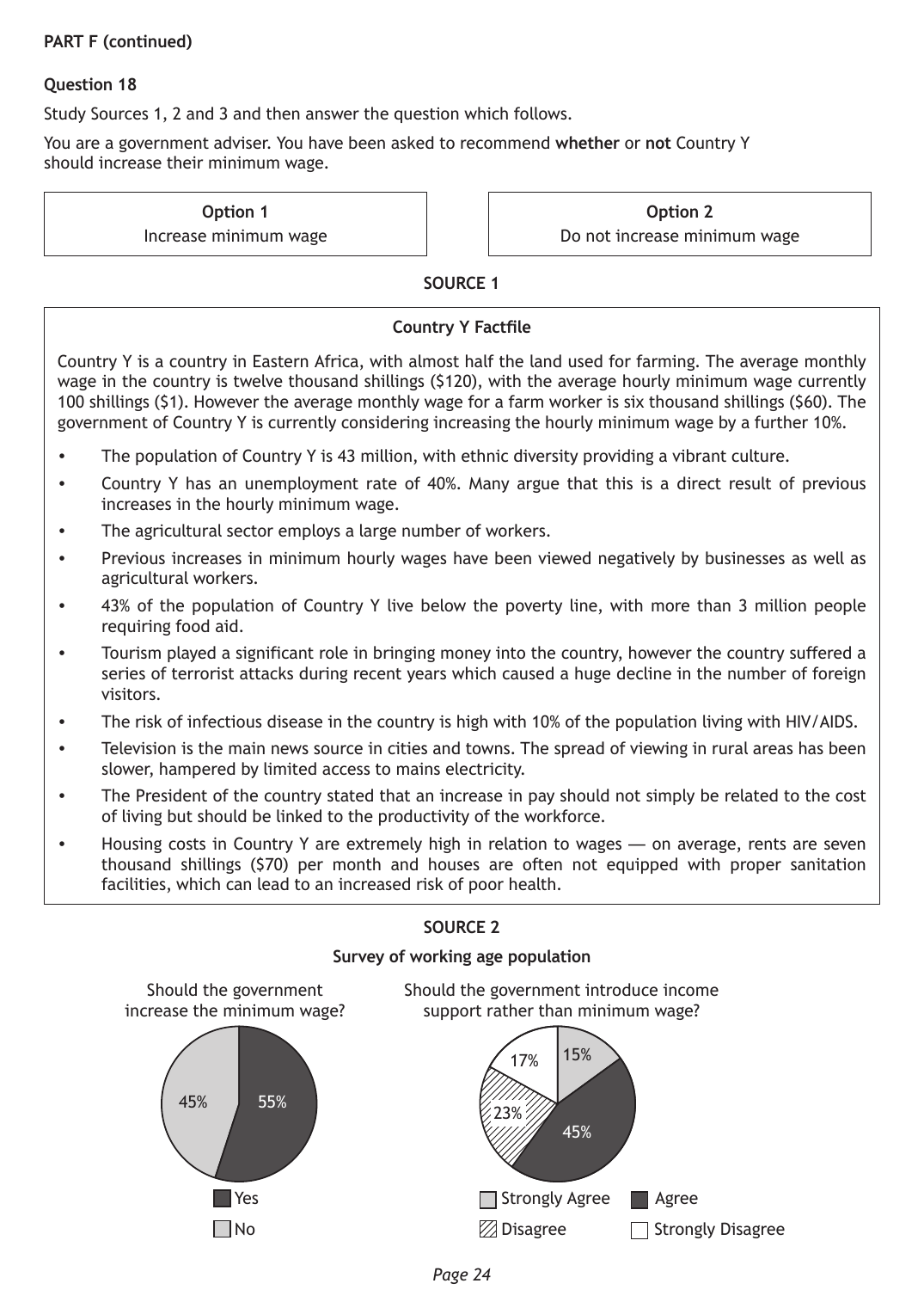
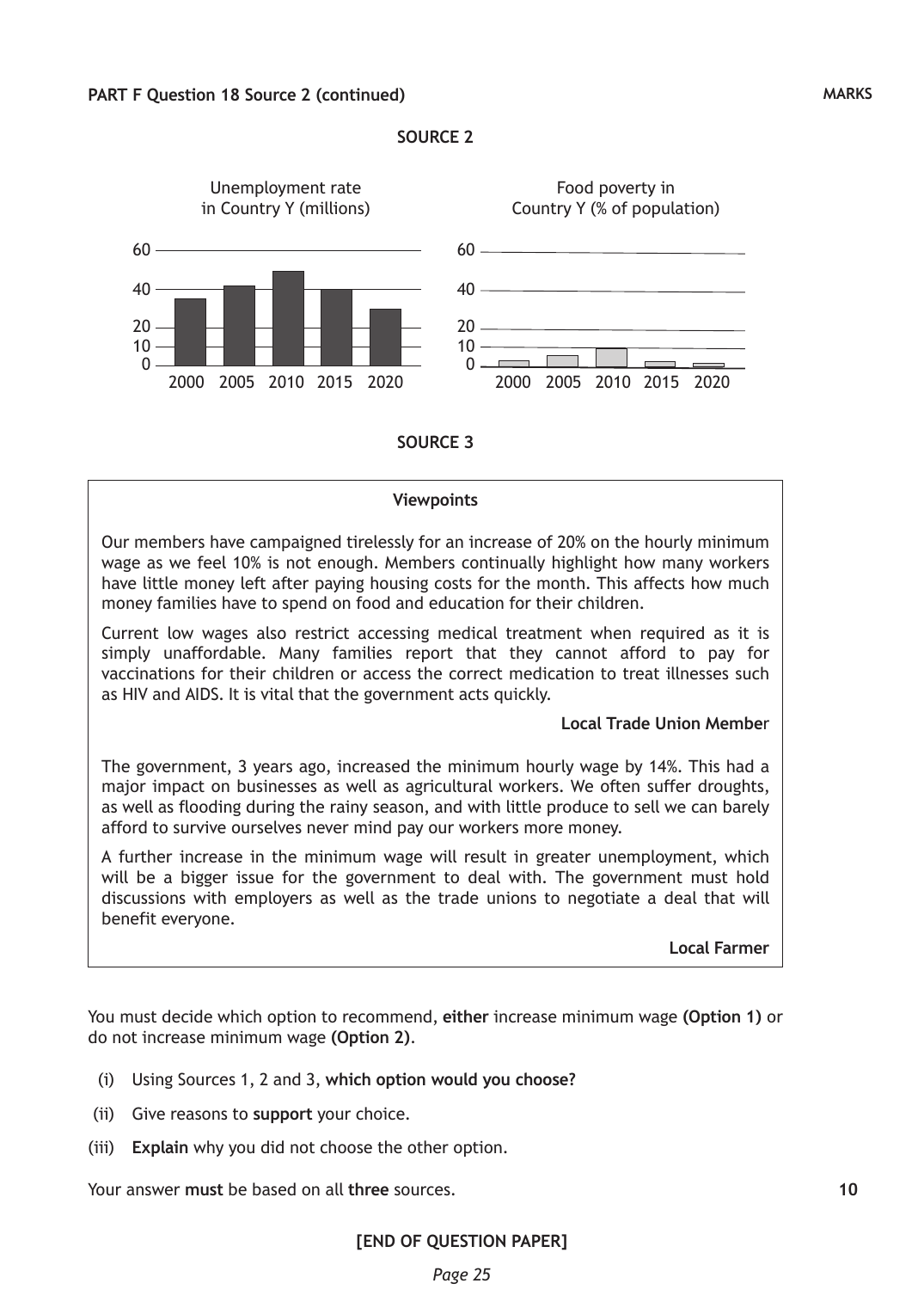
You are a government adviser. You have been asked to recommend whether or not Country Y should increase their minimum wage.

Option 1

Increase minimum wage

Option 2

Do not increase minimum wage

You must decide which option to recommend, either increase minimum wage (Option 1) or do not increase minimum wage (Option 2).

(i) Using Sources 1, 2 and 3, which option would you choose?

(ii) Give reasons to support your choice.

(iii) Explain why you did not choose the other option.

Your answer must be based on all three sources.

Sources (Source 1, Source 2, Source 3)

Source page 1 for this questionSource page 2 for this question
πŸ“ Structure template β€” how to structure your answer

Decision making Β· A source-based skills question

WFQ (words from the question)

  1. I chose insert option name.
  2. Evidence to support this is in insert source which says/shows β€œinsert evidence”.βœ“ 1 mark per piece of evidence (up to 8)
  3. This is further supported by evidence in insert source which says/shows β€œinsert evidence”. (Repeat until you have 8 pieces of evidence = 8 marks.)
  4. Rebuttal: I rejected insert option name because insert source says/shows β€œinsert evidence”.βœ“ needed for full marks

How it's marked

  • Up to 3 marks for a developed justification; credit highly where you link evidence between sources.
  • For full marks you must justify your decision AND explain why you rejected the other option.
  • Maximum 8 marks if you only deal with one option.
  • Aim for around 8 pieces of evidence to build up the marks.
  • Don’t forget the rebuttal β€” say why you rejected the other option.
βœ“ Reveal marking scheme
Max 10 marks

These are possible/exemplar answers from the marking instructions β€” other valid points can also gain marks.

How marks are awarded
  • The candidate is required to evaluate a limited range of sources, in order to make and justify a decision/recommendation. The candidate must also explain why they have rejected the other option.
  • In order to achieve full marks candidates must say why they did not choose the other option. An answer which deals with only one option should be awarded a maximum of 8 marks.

For Option 1

  1. I would choose option 1 because source 1 states 43% of the population of country Y live below the poverty line. This is supported in source 2 when 55% of people surveyed said the government should increase the minimum wage. (2 marks evidence linked from sources 1 and 2)
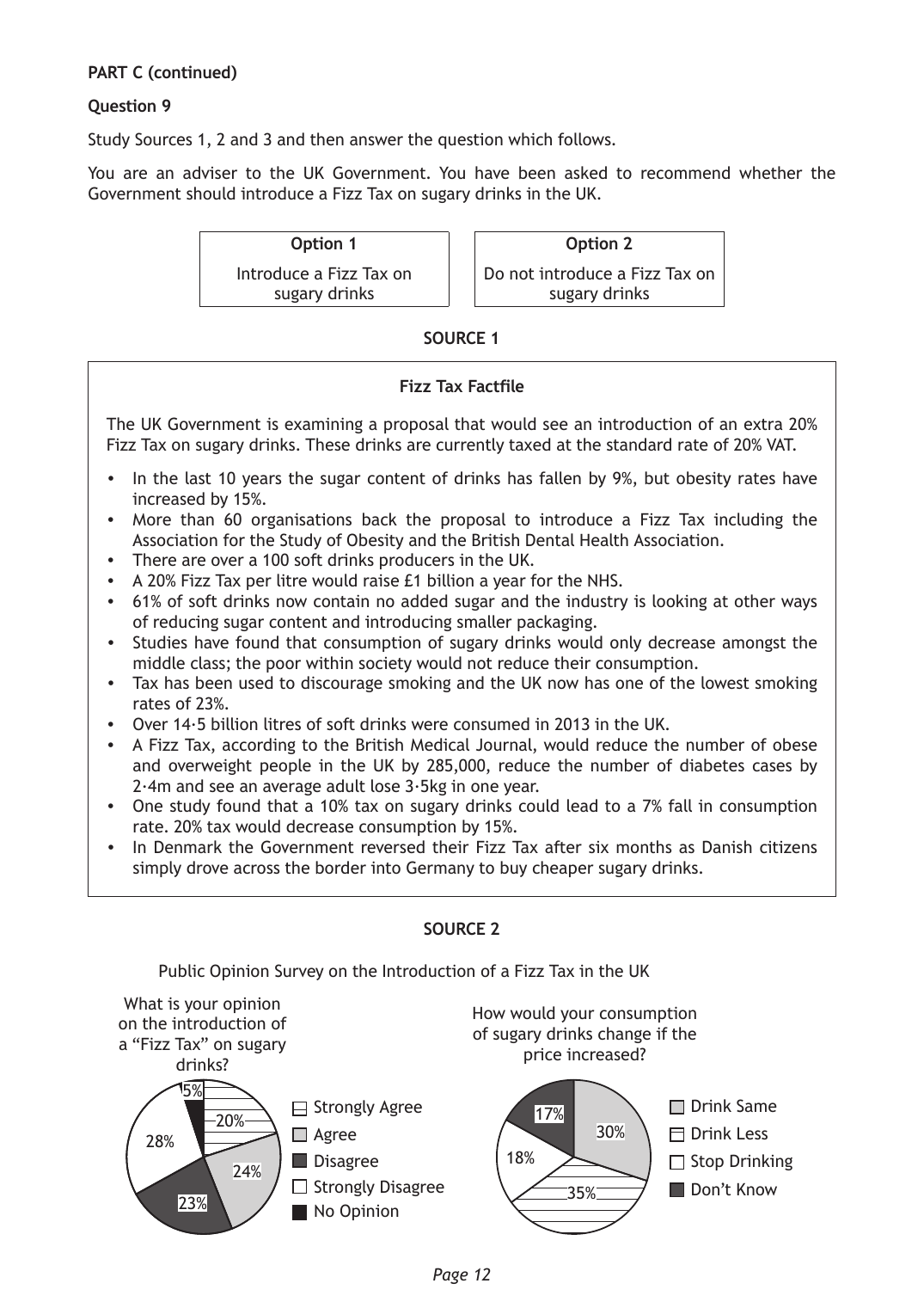
  2. I would choose option 1 because source 1 states 43% of the population of country Y live below the poverty line. This is supported in source 2 when 55% of people surveyed said the government should increase the minimum wage. This highlights that there are huge numbers of people living in poverty and more than half of the people surveyed support option 1. (3 marks evidence linked from sources 1 and 2 with evaluation)
  3. Reference to aspects of the following will be credited:
  4. More than 3 million people requiring food aid (source 1)
  5. Housing costs are extremely high in relation to wages (source 1)
  6. Many workers have little money left after housing costs (source 3)
  7. Low wages restrict access to medical treatment (source 3).
  8. Reason for rejecting other option:
  9. I could have chosen option 2 because in source 1 it states previous increases in minimum hourly wages have been viewed negatively by businesses, however, I picked option 1 because in source 3, it states many workers have little money left after housing costs. (2 marks – evidence linked between two sources)

For Option 2

  1. I would choose option 2 because source 1 states that many people think that the high unemployment rate is a direct result of previous increases in the hourly minimum wage. This is supported in source 2 where the opinion poll highlights 60% either agree or strongly agree that the government should introduce income support rather than minimum wage. (2 marks evidence linked from sources 1 and 2)
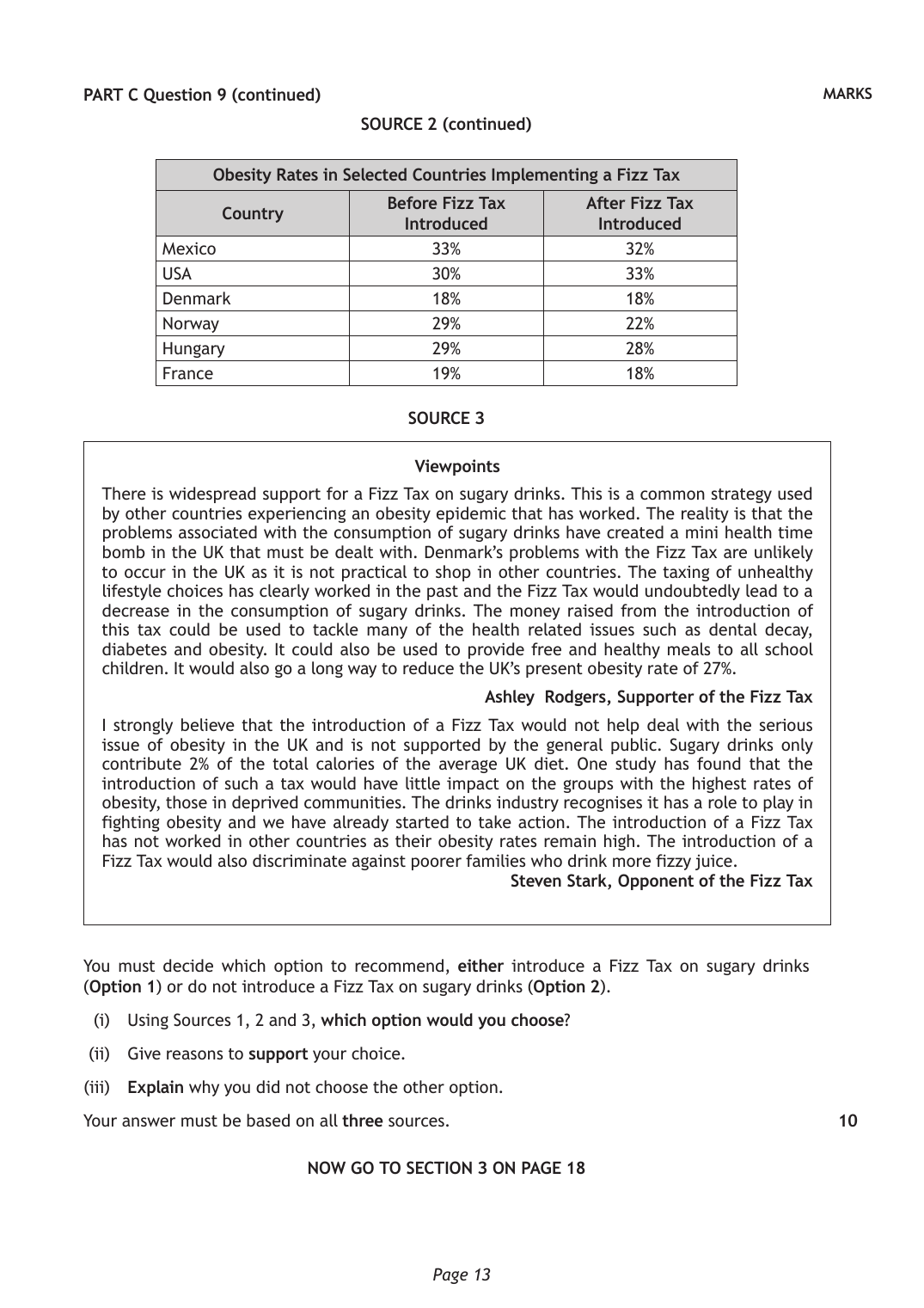
  2. I would choose option 2 because source 1 states that many people think that the high unemployment rate is a direct result of previous increases in the hourly minimum wage. This is supported in source 2 where the opinion poll highlights 60% either agree or strongly agree that the government should introduce income support rather than minimum wage. This highlights that the majority of people are against the minimum wage. (3 marks evidence linked from sources 1 and 2 with evaluation)
  3. The President of country Y stated an increase in pay should not be related to the cost of living but should be linked to productivity (source 1)
  4. Increases in minimum wage are viewed negatively by businesses as well as agricultural workers (source 1)
  5. Recent increases in minimum wage have a major impact on businesses (source 3)
  6. A further increase will result in greater unemployment (source 3).
  7. Reasons for rejecting the other option:
  8. I could have chosen option 1 because in source 3 it states many workers have little money left after housing costs, however, I picked option 2 because it states in source 1, previous increases in minimum hourly wages have been viewed negatively by businesses. (2 marks – evidence linked between two sources)
Source: 2017 N5 History Β· X749/75/11 Β· Q18Question paper (PDF, p.24) β†—Marking instructions (PDF, p.29) β†—
Decision making10 marks2016Q9⏳ Older formatSocial Issues in the United Kingdom

Study Sources 1, 2 and 3 and then answer the question which follows.

You are an adviser to the UK Government. You have been asked to recommend whether the Government should introduce a Fizz Tax on sugary drinks in the UK.

Option 1

Introduce a Fizz Tax on sugary drinks

Option 2

Do not introduce a Fizz Tax on sugary drinks

You must decide which option to recommend, either introduce a Fizz Tax on sugary drinks (Option 1) or do not introduce a Fizz Tax on sugary drinks (Option 2).

(i) Using Sources 1, 2 and 3, which option would you choose?

(ii) Give reasons to support your choice.

(iii) Explain why you did not choose the other option.

Your answer must be based on all three sources.

Sources (Source 1, Source 2, Source 3)

Source page 1 for this questionSource page 2 for this question
πŸ“ Structure template β€” how to structure your answer

Decision making Β· A source-based skills question

WFQ (words from the question)

  1. I chose insert option name.
  2. Evidence to support this is in insert source which says/shows β€œinsert evidence”.βœ“ 1 mark per piece of evidence (up to 8)
  3. This is further supported by evidence in insert source which says/shows β€œinsert evidence”. (Repeat until you have 8 pieces of evidence = 8 marks.)
  4. Rebuttal: I rejected insert option name because insert source says/shows β€œinsert evidence”.βœ“ needed for full marks

How it's marked

  • Up to 3 marks for a developed justification; credit highly where you link evidence between sources.
  • For full marks you must justify your decision AND explain why you rejected the other option.
  • Maximum 8 marks if you only deal with one option.
  • Aim for around 8 pieces of evidence to build up the marks.
  • Don’t forget the rebuttal β€” say why you rejected the other option.
βœ“ Reveal marking scheme
Max 10 marks

These are possible/exemplar answers from the marking instructions β€” other valid points can also gain marks.

How marks are awarded
  • The candidate is required to evaluate a limited range of sources, in order to make and justify a decision/recommendation. The candidate must also explain why they have rejected the other option.
  • In order to achieve full marks candidates must say why they did not choose the other option. An answer which deals with only one option should be awarded a maximum of 8 marks.

Option 1: Introduce a Fizz Tax on sugary drinks

  1. The Government should introduce a Fizz Tax as Ashley Rodgers states that there is wide spread support for a Fizz Tax on sugary drinks. This is supported by the Factfile which states that more than 60 organisations back the proposal, including the Study of Obesity and the British Dental Health Association. This is further supported by Source 1 when it states according to the British Medical Journal, a Fizz Tax, would reduce the number of diabetes cases by 2.4m and see an average adult lose 3.5kg in one year. [3 Marks – detailed evidence linked from Sources 1& 3]

Option 1 β€” Credit reference to aspects of the following

  1. A 20p Fizz Tax per litre would raise Β£1 billion a year for the NHS (S1)
  2. Tax has been used to discourage smoking and the UK now has one of the lowest smoking rates of 23% (S1)
  3. One study found that a 10% tax on sugary drinks could lead to a 7% consumption rate. 20% tax would decrease consumption by 15% (S1)
  4. 35% of people said they would drink less sugary drinks if the price increased and 18% said they would stop drinking fizzy drinks (S2)
  5. A Fizz Tax has worked in Norway, obesity has decreased from 29% to 22% (S2)
  6. Sugary Drinks creating a 'mini health time bomb'(S3)

Reasons for rejecting the other option (Option 1 chosen)

  1. I rejected option 2, not to introduce a fizz Tax, because Source 3 shows that the taxing of unhealthy lifestyle choices has clearly worked in the past so we must introduce the tax. [1 mark awarded for use of one piece of information with no linking. Do not credit if marks have already been awarded for this point]

Option 2: Do not introduce a Fizz Tax on sugary drinks

  1. The Government should not introduce a Fizz Tax on sugary drinks as 61% of soft drinks now contain no added sugar and the industry is looking at other ways of reducing sugar. [1 mark – evidence drawn from Source 1]
  2. The Government should not introduce a Fizz Tax on sugary drinks as one study has found that the introduction of such a tax would have little impact on the groups with the highest rates of obesity, those in deprived communities and this is supported as studies have found that consumption on sugary drinks would only decrease amongst the middle class: the poor within society would not reduce their consumption. [2 marks – evidence linked from Sources 1&3]

Option 2 β€” Credit reference to aspects of the following

  1. In the last 10 years the sugar content of drinks has fallen by 9%, but obesity rate have increased by 15% (S1)
  2. In Denmark the Government reversed their Fizz Tax six months later as Danish citizens simply crossed the border to buy cheaper sugary drinks elsewhere. (S1) linked to source 2 showing obesity in Denmark stay the same at 18%.
  3. Fizz Tax not supported by the public as Public Opinion poll – 51% either disagree or strongly disagree (S2)
  4. Drinks industry already started to take action (S3)
  5. Sugary drinks only account for 2% of the total calories of the average UK diet (S3)

Reasons for rejecting the other option (Option 2 chosen)

  1. I rejected the option to introduce the Fizz Tax as Ashley Roger states this is a common strategy used by other countries experiencing an obesity epidemic that has worked however source 2 highlights that before the fizz tax was introduced in the USA obesity rates were 30%, yet they increased to 33% after the fizz tax was introduced, which is evidence that it in fact does not work. [3 marks – evidence drawn from two sources, with evaluative comment]
Decision making10 marks2016Q12⏳ Older formatSocial Issues in the United Kingdom

Study Sources 1, 2 and 3 and then answer the question which follows.

You are a government adviser. You have been asked to recommend whether or not the United Kingdom Government should ban Legal Highs.

Option 1

Ban Legal Highs

Option 2

Do not ban Legal Highs

You must decide which option to recommend, either ban Legal Highs (Option 1) or do not ban Legal Highs (Option 2).

(i) Using Sources 1, 2 and 3, which option would you choose?

(ii) Give reasons to support your choice.

(iii) Explain why you did not choose the other option.

Your answer must be based on all three sources.

Sources (Source 1, Source 2, Source 3)

Source page 1 for this questionSource page 2 for this question
πŸ“ Structure template β€” how to structure your answer

Decision making Β· A source-based skills question

WFQ (words from the question)

  1. I chose insert option name.
  2. Evidence to support this is in insert source which says/shows β€œinsert evidence”.βœ“ 1 mark per piece of evidence (up to 8)
  3. This is further supported by evidence in insert source which says/shows β€œinsert evidence”. (Repeat until you have 8 pieces of evidence = 8 marks.)
  4. Rebuttal: I rejected insert option name because insert source says/shows β€œinsert evidence”.βœ“ needed for full marks

How it's marked

  • Up to 3 marks for a developed justification; credit highly where you link evidence between sources.
  • For full marks you must justify your decision AND explain why you rejected the other option.
  • Maximum 8 marks if you only deal with one option.
  • Aim for around 8 pieces of evidence to build up the marks.
  • Don’t forget the rebuttal β€” say why you rejected the other option.
βœ“ Reveal marking scheme
Max 10 marks

These are possible/exemplar answers from the marking instructions β€” other valid points can also gain marks.

How marks are awarded
  • The candidate is required to evaluate a limited range of sources, in order to make and justify a decision/recommendation. The candidate must also explain why they have rejected the other option.
  • In order to achieve full marks candidates must say why they did not choose the other option. An answer which deals with only one option should be awarded a maximum of 8 marks.

Option 1: Ban Legal Highs

  1. The Government should ban Legal Highs as legal highs have been linked to hospital admissions for things such as poisoning, mental health issues, and in extreme cases death. [1 markβ€”evidence drawn from Source 1]
  2. The Government should ban Legal Highs as legal highs have been linked to hospital admissions for things such as poisoning, mental health issues, and in extreme cases death. This is backed up in Source 2 which shows that there has been an increase in deaths as a result of legal highs. [2 marksβ€”evidence linked from Source 1 and Source 2]
  3. The Government should ban Legal Highs as legal highs have been linked to hospital admissions for things such as poisoning, mental health issues, and in extreme cases death. This is backed up in Source 2 which shows that there has been an increase in deaths as a result of legal highs. The increase in deaths has gone from just over 40 to almost 120, which is almost triple the number. [3 marksβ€”evidence linked from Source 1 and 2 with evaluative comment]

Option 1 β€” Credit reference to aspects of the following

  1. These drugs are often included in everyday household products and are often labelled not for human consumption (S1)
  2. Mandeep Khan states that "more of my time as a paramedic is being taken up dealing with the consequences of legal highs. The misuse of these drugs diverts our attention from cases that are much more important.

Reasons for rejecting the other option (Option 1 chosen)

  1. I rejected Option 2 as although source 2 states 66% of young people know that legal highs could result in death source 1 highlights that the UK has the most severe problem with legal highs in Western Europe, with significant numbers of young people regularly admitting to taking legal highs [2 marks – evidence linked from source 1 & 2]

Option 2: Do not ban Legal Highs

  1. The Government should not ban Legal Highs as in a recent survey, the majority (53%) of 16-25 year olds stated that they had never taken legal highs with a further 10% only ever having taken them once (S2). This is supported by Source 1 when it states that despite media attention around half of young people have never experimented with legal highs. [2 marksβ€”evidence linked from Source 1 and Source 2]

Option 2 β€” Credit reference to aspects of the following

  1. Control and monitoring of Legal Highs is very difficult (S3)
  2. Often new versions are created and sold just as fast as the government can ban them (S3)
  3. There has been little or no research into the long term or short term risks of taking Legal Highs (S1)

Reasons for rejecting the other option (Option 2 chosen)

  1. I rejected Option 1 as although Mandeep Khan states that lots of people are unaware of the dangers of legal highs source 2 highlights that 66% of young people know that legal highs result in death. [2 marksβ€”evidence linked from Source 2 and 3]
Source: 2016 N5 History Β· X749/75/11 Β· Q12Question paper (PDF, p.17) β†—Marking instructions (PDF, p.20) β†—
Decision making10 marks2015Q3⏳ Older formatDemocracy in Scotland and the United Kingdom

Study Sources 1, 2 and 3 and then answer the question which follows.

Glenlochy is about to elect a new MSP. You are a voter in Glenlochy. You are undecided between Option 1 and Option 2.

Using sources 1, 2 and 3 you must decide which option to choose.

Option 1

Daisy Frost, candidate for the Scottish Labour Party

Option 2

Tom Kirk, candidate for the Scottish National Party

You must decide which option to recommend, either Daisy Frost (Option 1) or Tom Kirk (Option 2).

(i) Using Sources 1, 2 and 3, which option would you choose?

(ii) Give reasons to support your choice.

(iii) Explain why you did not choose the other option.

Your answer must be based on all three sources.

Sources (Source 1, Source 2, Source 3)

Source page 1 for this questionSource page 2 for this question
πŸ“ Structure template β€” how to structure your answer

Decision making Β· A source-based skills question

WFQ (words from the question)

  1. I chose insert option name.
  2. Evidence to support this is in insert source which says/shows β€œinsert evidence”.βœ“ 1 mark per piece of evidence (up to 8)
  3. This is further supported by evidence in insert source which says/shows β€œinsert evidence”. (Repeat until you have 8 pieces of evidence = 8 marks.)
  4. Rebuttal: I rejected insert option name because insert source says/shows β€œinsert evidence”.βœ“ needed for full marks

How it's marked

  • Up to 3 marks for a developed justification; credit highly where you link evidence between sources.
  • For full marks you must justify your decision AND explain why you rejected the other option.
  • Maximum 8 marks if you only deal with one option.
  • Aim for around 8 pieces of evidence to build up the marks.
  • Don’t forget the rebuttal β€” say why you rejected the other option.
βœ“ Reveal marking scheme
Max 10 marks

These are possible/exemplar answers from the marking instructions β€” other valid points can also gain marks.

How marks are awarded
  • The candidate is required to evaluate a limited range of sources, in order to make and justify a decision/recommendation. The candidate must also explain why they have rejected the other option.
  • In order to achieve full marks candidates must say why they did not choose the other option. An answer which deals with only one option should be awarded a maximum of 8 marks.
  • Do not award marks for evidence which has been previously credited.

For Option 1

  1. I would choose Daisy as she has experience as a councillor. [1 mark -evidence drawn from Source 1]
  2. In Source 1 Daisy says that health needs to improve as lives are being cut short. She is right as life expectancy is less in Glenlochy. [2 marks -evaluative terminology with limited evidence from Source 1 and Source 2]
  3. In Source 1 Daisy states that "The lives of people in Glenlochy are being cruelly cut short". She is correct as Source 2 states life expectancy is only 77 years compared to 79 in the rest of Scotland, a significant difference of two years. [3 marks - evidence drawn from two Sources with detailed use of evidence and evaluative terminology]
  4. Reference to aspects of the following will be credited:
  5. Local Councillor [Source 1] – constituents want an experienced politician [Source 2].
  6. Source 1 - "I will work to ensure that more women are elected" Source 2 - 54% agree.
  7. 54% think the Scottish parliament needs more female MSPs [Source 2] and Daisy as a female would be a good choice [Source 1].
  8. Source 1 - number of women working locally – Source 3 only 34% in Glenlochy but 45% in Scotland.
  9. Source 1 - unemployment a problem – true as 9% unemployed in Glenlochy and 7% in Scotland [Source 3].
  10. Childcare is a problem [Source 1] – 68% in Source 2 agree.

Against Option 1

  1. Daisy claims a lack of internet access is an obvious barrier however Source 3 shows 3% more households in Glenlochy have access to the internet [2 marks].
  2. A lack of internet access [Source 1] – but Source 3 shows 79% have access compared to 76% in Scotland.
  3. Crime is not a concern [Source 1] but Source 2 shows 530 people attended a local meeting and raised valid concerns.
  4. Crime is not a concern [Source 1] Source 2 - 65% disagree with her.
  5. Daisy says health needs to improve but there are fewer long term illnesses in Glenlochy, 3% less than the UK [Source 3].
  6. Community council say a legal background is necessary [Source 2] but Daisy doesn't have this [Source 1].

For Option 2

  1. I would choose Tom because he is a lawyer and Source 2 says our new MSPs should have a legal background. [2 marks -evidence drawn from Sources 1 and 2]
  2. Tom says that employment is a key issue which has to be improved [Source1]. He is right as Source 3 shows that unemployment is higher in Glenlochy. [2 marks - evidence drawn from Sources 1 and 3]
  3. In Source 1 - Tom says that "Too few people are in full time work. He is right as Glenlochy's full time employment rate is 6% lower than the rest of Scotland according to Source 3. This is clearly a problem, especially as according to Source 2 there is only one major employer in the local area and it recently made 100 people redundant. [3 marks - evidence drawn from 3 Sources with detailed use of evidence and evaluative terminology]
  4. Source 1 - Tom is a lawyer and Source 2 - local people worried about crime would like an MSP with a legal background.
  5. Source 1 - too few people are in full time work and Source 3 shows only 42% working compared to 48%.
  6. Source 1 - many relying on benefits and Source 3 shows 1.7% more claimants in Glenlochy compared to Scotland as whole.
  7. Source 1 - crime is a major concern and Source 2 shows 530 people attended a meeting to voice concerns.
  8. Source 1 - crime is a major concern and Source 2 shows 65% of people agree it's a problem.

Against Option 2

  1. Tom claims that a lack of childcare isn't a problem in Glenlochy but 68% of local people think it is a major problem [2 marks].
  2. Any other valid reason that meets the criteria described in the general marking instructions for this kind of question (see column to left).
  3. "The majority of local people agree with me that elderly people are well cared for" [Source 1] but Source 2 shows only 35% agree.
  4. Childcare not a problem [Source 1] – Source 2 68% feel it is.
  5. Tom says too many are leaving school before S6 [Source 1] - this isn't the case according to Source 3 – 2% more stay to S6 than the Scottish average.
  6. Many feel Glenlochy needs an experienced representative [Source 2] and Tom has no experience as a representative [Source 1].
Source: 2015 N5 History Β· X749/75/11 Β· Q3Question paper (PDF, p.4) β†—Marking instructions (PDF, p.8) β†—
Decision making10 marks2015Q6⏳ Older formatDemocracy in Scotland and the United Kingdom

Study Sources 1, 2 and 3 and then answer the question which follows.

Millwood is about to elect a new MP. You are a voter in Millwood. You are undecided between Option 1 and Option 2.

Using sources 1, 2 and 3 you must decide which option to choose.

Option 1

Nora Manson, candidate for the Scottish Conservative Party

Option 2

John Donaldson, candidate for the Scottish Liberal Democratic Party

You must decide which option to recommend, either Nora Manson (Option 1) or John Donaldson (Option 2).

(i) Using Sources 1, 2 and 3, which option would you choose?

(ii) Give reasons to support your choice.

(iii) Explain why you did not choose the other option.

Your answer must be based on all three sources.

Sources (Source 1, Source 2, Source 3)

Source page 1 for this questionSource page 2 for this question
πŸ“ Structure template β€” how to structure your answer

Decision making Β· A source-based skills question

WFQ (words from the question)

  1. I chose insert option name.
  2. Evidence to support this is in insert source which says/shows β€œinsert evidence”.βœ“ 1 mark per piece of evidence (up to 8)
  3. This is further supported by evidence in insert source which says/shows β€œinsert evidence”. (Repeat until you have 8 pieces of evidence = 8 marks.)
  4. Rebuttal: I rejected insert option name because insert source says/shows β€œinsert evidence”.βœ“ needed for full marks

How it's marked

  • Up to 3 marks for a developed justification; credit highly where you link evidence between sources.
  • For full marks you must justify your decision AND explain why you rejected the other option.
  • Maximum 8 marks if you only deal with one option.
  • Aim for around 8 pieces of evidence to build up the marks.
  • Don’t forget the rebuttal β€” say why you rejected the other option.
βœ“ Reveal marking scheme
Max 10 marks

These are possible/exemplar answers from the marking instructions β€” other valid points can also gain marks.

How marks are awarded
  • The candidate is required to evaluate a limited range of sources, in order to make and justify a decision/recommendation. The candidate must also explain why they have rejected the other option.
  • In order to achieve full marks candidates must say why they did not choose the other option. An answer which deals with only one option should be awarded a maximum of 8 marks.
  • Do not award marks for evidence which has been previously credited.

For Option 1

  1. I would choose Nora as she has experience as a councillor. [1 mark -evidence drawn from Source 1]
  2. In Source 1 Nora says that health needs to improve as lives are being cut short. She is right as life expectancy is less in Millwood. [2 marks -evaluative terminology with limited evidence from Source 1 and Source 2]
  3. In Source 1 Nora states that "The lives of people in Millwood are being cruelly cut short". She is correct as Source 2 states life expectancy is only 77 years compared to 80 in the rest of the UK, a significant difference of three years. [3 marks - evidence drawn from 2 Sources with detailed use of evidence and evaluative terminology].
  4. Reference to aspects of the following will be credited:
  5. Local Councillor [Source 1] – constituents want an experienced politician [Source 2].
  6. Source 1 - more women are elected – Source 2 54% agree.
  7. Source 1 - number of women working locally – Source 3 only 34% in Millwood but 45% in UK.
  8. Source 1 - unemployment a problem; true as 9% unemployed in Millwood and 6% in UK [Source 3].
  9. Childcare is a problem [Source 1] and 68% in Source 2 agree.

Against Option 1

  1. Nora claims a lack of internet access is an obvious barrier however Source 3 shows 2% more households in Millwood have access to the internet [2 marks].
  2. Source 1 - a lack of internet access Source 1 – but Source 3 shows 79% have access compared to 77% in UK.
  3. Source 1 - crime is not a problem but Source 2 shows 530 people attended a local meeting and raised valid concerns.
  4. Source 1 - crime is not a problem – Source 2 - 61% disagree with Nora.
  5. Nora says health needs to improve but there are fewer long term illnesses in Millwood, 3% less than the UK [Source 3].
  6. Community council say a legal background [Source 2] is necessary but Nora doesn't have this [Source 1].

For Option 2

  1. I would choose John because he is a lawyer and Source 2 says our new MP should have a legal background. [2 marks -evidence drawn from Sources 1 and 2]
  2. John says that employment is a key issue which has to be improved (Source1). He is right as Source 3 shows 9% of Millwood are unemployed compared to 6% of UK. [2 marks - evidence drawn from Sources 1 and 3].
  3. In Source 1 John says that "Too few people are in full time work. He is right as Millwood's full time employment rate is 7% lower than the UK's. This is clearly a problem, especially as according to Source 2 there is only one major employer in the local area and it recently made 100 people redundant. [3 marks - evidence drawn from 3 Sources with detailed use of evidence and evaluative terminology].
  4. Source 1 - John is a lawyer and Source 2 shows local people are worried about crime and would like an MP with a legal background.
  5. Source 1 - too few people are in full time work and Source 3 shows only 42% working compared to 49%.
  6. Source 1 - too many relying on benefits – Source 3 shows 2.3% more claimants in Millwood.
  7. Source 1 - crime is a major concern and Source 2 shows 530 people attended a meeting to voice concerns.
  8. Source 1 - crime is a major concern and 61% of people agree it's a problem [Source 2].

Against Option 2

  1. John claims that a lack of childcare isn't a problem in Millwood but 68% of local people think it is a major problem [2 marks].
  2. Any other valid reason that meets the criteria described in the general marking instructions for this kind of question (see column to left).
  3. The majority agree elderly are well cared for but Source 2 shows only 35% agree.
  4. Childcare not a problem – Source 2 68% feel it is.
  5. John says too many are leaving school before S6- this isn't the case according to Source 3 – 3% more stay to S6 than the UK average.
Decision making10 marks2014Q3⏳ Older formatWorld Issues

Study Sources 1, 2 and 3 then attempt the question which follows.

You are a military adviser working for the North Atlantic Treaty Organisation (NATO) which is a military alliance. This is made up of the USA, UK and twenty six other Western countries.

You have been asked to recommend whether or not NATO should send in troops to stop the civil war in Country A.

Option 1

Send NATO troops to Country A

Option 2

Do not send NATO troops to Country A

You must decide which option to recommend, either send NATO troops to Country A (Option 1) or do not send NATO troops to Country A (Option 2).

(i) Using Sources 1, 2 and 3 which option would you choose?

(ii) Give reasons to support your choice.

(iii) Explain why you did not choose the other option.

Your answer must be based on all three sources.

Sources (Source 1, Source 2, Source 3)

Source page 1 for this questionSource page 2 for this question
πŸ“ Structure template β€” how to structure your answer

Decision making Β· A source-based skills question

WFQ (words from the question)

  1. I chose insert option name.
  2. Evidence to support this is in insert source which says/shows β€œinsert evidence”.βœ“ 1 mark per piece of evidence (up to 8)
  3. This is further supported by evidence in insert source which says/shows β€œinsert evidence”. (Repeat until you have 8 pieces of evidence = 8 marks.)
  4. Rebuttal: I rejected insert option name because insert source says/shows β€œinsert evidence”.βœ“ needed for full marks

How it's marked

  • Up to 3 marks for a developed justification; credit highly where you link evidence between sources.
  • For full marks you must justify your decision AND explain why you rejected the other option.
  • Maximum 8 marks if you only deal with one option.
  • Aim for around 8 pieces of evidence to build up the marks.
  • Don’t forget the rebuttal β€” say why you rejected the other option.
βœ“ Reveal marking scheme
Max 10 marks

These are possible/exemplar answers from the marking instructions β€” other valid points can also gain marks.

How marks are awarded
  • The candidate is required to evaluate a limited range of sources, in order to make and justify a decision/recommendation. The candidate must also explain why they have rejected the other option.
  • In order to achieve full marks candidates must say why they did not choose the other option. An answer which deals with only one option should be awarded a maximum of 8 marks.

OPTION 1

  1. NATO should send troops to Country A as 140 000 people have been killed. [1 mark- evidence from Source 1]
  2. Source 1 points out that free elections were never held and that many people see democracy as the solution. Andy N from source three agrees that democracy is the solution. [2 marks-evidence linked from Source 1 and Source 3]
  3. It is believed that the President has used chemical weapons to kill 600 of his own people (S1). David W argues that we cannot stand by and watch this happen and a massive majority of 85% of those asked in Source 2 agree that NATO should do everything it can to stop chemical weapons. [3 mark- evaluative terminology, evidence linked from Source 1, 2 and 3]

Credit reference to aspects of the following (Option 1)

  1. The people want democratic reform (Sources 1 and/or 3).
  2. Many civilians have been killed (Sources 1 and/or 3).
  3. It worked in Libya, so why not in Country A? ie NATO got rid of Gaddafi (Source 3)
  4. People want chemical attacks stopped (Sources 2 and 3 )
  5. NATO needs friendly Middle Eastern governments (Sources 1and/or2)

Reasons for rejecting the other option (Option 1)

  1. Source one tells us that the UK and the USA would like a friendlier government in Country A. 59% (a majority) of those asked in Source 2 agree that this is vital for NATO, so option 2 (doing nothing) is not a good option. (3 marks – evidence from two sources with an evaluative comment.) Do not credit if marks already awarded for this point in arguments for option 1.

OPTION 2

  1. NATO should not send troops to Country A as 54% of the public strongly disagree. [1 mark- evidence from Source 2]
  2. NATO should not send troops to Country A as the majority of those questioned think that NATO cannot afford it. 27% agree and 42% strongly agree, this is well over half. [2 marks- evidence from Source 2 with evaluative comment]
  3. The vast majority,83% think that sending NATO troops to Country A would not help the refugees (S2). Two million refugees really need help as they are living in terrible conditions (S3). So option two should not be followed. [3 marks- evidence linked from Source 2 and 3 with evaluative comment]

Credit reference to aspects of the following (Option 2)

  1. Cost is too high ( S2 and S3)
  2. More troops make things worse (S1,S2 and S3)
  3. Wouldn't help refugees (S2 and S3)
  4. Loss of life would be too much (S3)

Reasons for rejecting the other option (Option 2)

  1. A huge majority of people in NATO countries (69%) believe that NATO cannot afford any more missions. (S2) This is supported by information from Source 3 which shows that the Libyan conflict cost the UK and USA alone, $21.5 billion without using ground troops. (3 mark - evaluative terminology, detailed evidence from Sources 2 and 3) Do not credit if marks already awarded for this point in arguments for option 2.
Decision making10 marks2014Q3⏳ Older formatWorld Powers

Study Sources 1, 2 and 3 then attempt the question which follows.

You are a government adviser. You have been asked to recommend whether or not the Government of Australia should abolish compulsory voting.

Option 1

Keep compulsory voting in Australia

Option 2

Get rid of compulsory voting in Australia

You must decide which option to recommend, either keep compulsory voting in Australia (Option 1) or get rid of compulsory voting in Australia (Option 2).

(i) Using Sources 1, 2 and 3 which option would you choose?

(ii) Give reasons to support your choice.

(iii) Explain why you did not choose the other option.

Your answer must be based on all three sources.

Sources (Source 1, Source 2, Source 3)

Source page 1 for this questionSource page 2 for this question
πŸ“ Structure template β€” how to structure your answer

Decision making Β· A source-based skills question

WFQ (words from the question)

  1. I chose insert option name.
  2. Evidence to support this is in insert source which says/shows β€œinsert evidence”.βœ“ 1 mark per piece of evidence (up to 8)
  3. This is further supported by evidence in insert source which says/shows β€œinsert evidence”. (Repeat until you have 8 pieces of evidence = 8 marks.)
  4. Rebuttal: I rejected insert option name because insert source says/shows β€œinsert evidence”.βœ“ needed for full marks

How it's marked

  • Up to 3 marks for a developed justification; credit highly where you link evidence between sources.
  • For full marks you must justify your decision AND explain why you rejected the other option.
  • Maximum 8 marks if you only deal with one option.
  • Aim for around 8 pieces of evidence to build up the marks.
  • Don’t forget the rebuttal β€” say why you rejected the other option.
βœ“ Reveal marking scheme
Max 10 marks

These are possible/exemplar answers from the marking instructions β€” other valid points can also gain marks.

How marks are awarded
  • The candidate is required to evaluate a limited range of sources, in order to make and justify a decision/recommendation. The candidate must also explain why they have rejected the other option.
  • In order to achieve full marks candidates must say why they did not choose the other option. An answer which deals with only one option should be awarded a maximum of 8 marks.

OPTION 1

  1. Australia should keep compulsory voting as more people vote. [1 mark- evidence from Source 1]
  2. Source 1 points out that compulsory voting is widely supported among Australian people and the pie chart shows 65% do not want to get rid of it. [2 marks- evidence linked from Source 1 and Source 3]
  3. Turnout is higher in Australia with compulsory voting- it was only 47% before it was introduced and now it is around 95% - supported by evidence in Source 2 where turnout at the most recent parliamentary election was 93.22%. Turnout has doubled since it was introduced. [3 mark- evaluative terminology, evidence linked from Source 1 and 2]

Credit reference to aspects of the following (Option 1)

  1. The Australian Prime Minister wants to keep compulsory voting (Source 3).
  2. Result is more accurate when everyone has participated (Source 3).

Reasons for rejecting the other option (Option 1)

  1. In all countries where there is compulsory voting, turnout is much higher compared to all countries where there isn't eg Brazil and Argentina have turnout rates near 80% while Canada and Russia have only 60%. [3 mark- detailed evidence with evaluative comments from Source 2. Do not credit if marks already awarded for this point in arguments for option 1]

OPTION 2

  1. Australia should get rid of compulsory voting as it is undemocratic to force people to vote. [1 mark- evidence from Source 1]
  2. People with little interest in politics are forced to the polls (Source 1) and source 3. 'People who aren't interested should not be required to vote - bad decisions in the voting booth contribute to bad government.' [2 marks- evidence linked from Source 1 and 3]
  3. Resources must be allocated to determine whether those who failed to vote have "valid and sufficient" reasons. Source 1 also says 'millions of dollars are spent on checking up on those who didn't turn up.' In the state of Queensland almost $1 million in state funds has been allocated to chase up those who failed to vote. This is a lot of money. [3 marks- evidence linked from Source 1 and 3]

Credit reference to aspects of the following (Option 2)

  1. It's unfair to punish people for not voting - only 37% of people think you should be fined (Source 1).
  2. Some people cannot get to polling stations due to genuine reasons ('poor people don't have a way to get to their voting place unlike rich people who have cars.') (Source 3).

Reasons for rejecting the other option (Option 2)

  1. Eileen Smith in Source 3 says 'Forcing the population to vote means they will just deliberately spoil their ballot papers to avoid a fine' and in source 2 it is clear that in all of the countries with compulsory voting, the number of informal ballot papers are much higher (eg Brazil it is 8.64% compared to only 0.7% on Canada). Source 1 shows that 9% of Australians have at some point registered an informal vote. [3 mark- evaluative terminology, detailed evidence from Sources 1, 2 and 3. Do not credit if marks already awarded for this point in arguments for option 2]