Revise Nat 5
← All years & topics

National 5 Modern Studies

2016 exam paper

Every question from the 2016 paper. Refine by section, topic or question type.

Filter
Section
Topic
Type
View

Showing 18 of 18 questions

Describe, in detail4 marks2016Q1⏳ Older formatDemocracy in Scotland

In Scottish Parliament Elections political parties campaign in many ways.

Describe, in detail, two ways political parties campaign in Scottish Parliament Elections.

WFQ = words from the question — reuse in every point.

📝 Structure template — how to structure your answer

Describe, in detail · A knowledge (KU) question · use PEE

Remember PEE

  • Point — make your point
  • Explanation — develop it
  • Example — a specific, recent example

WFQ (words from the question)

  1. One words from the question is insert point.✓ 1 mark — Point
  2. This means that … (explain your point).✓ 1 mark — Explanation
  3. For example, … (give a specific, recent example).✓ 1 mark — Example
  4. Then repeat with a second point — two developed points are needed for full marks.

How it's marked

  • 1 mark for an accurate but undeveloped point (P).
  • +1 mark for developing/explaining it (E).
  • +1 mark for a specific example (E). Up to 3 marks per description; two descriptions needed for full marks.
  • The example is where learners most often drop the mark — always add “For example, …”.
✓ Reveal marking scheme
Max 4 marks

These are possible/exemplar answers from the marking instructions — other valid points can also gain marks.

How marks are awarded
  • Award up to three marks for a single description, depending on quality, level of detail, relevance, accuracy and exemplification. Two descriptions are necessary for full marks.

Possible approaches to answering the question

  1. Political parties can campaign during a Scottish Parliament election by canvassing. [1 mark]
  2. Political parties can campaign during a Scottish Parliament election by canvassing. Canvassing gives parties the opportunity to go door to door to speak with the public in an attempt to increase voter awareness of the party. [2 marks—developed point]
  3. Political parties can campaign during a Scottish Parliament election by canvassing. Canvassing gives parties the opportunity to go door to door to speak with the public in an attempt to increase voter awareness of the party. This may secure more votes for the party as the canvassers will outline and explain the party policies to be implemented once elected. [3 marks—developed point with detail and analysis]

Credit reference to aspects of the following

  1. Use of the media – newspapers, PEBs, TV Debates, Social Media
  2. Leafleting
  3. Posters
  4. Holding a public meeting/rally
  5. Publishing a manifesto
  6. Use of celebrities to gain media attention and support from voters
Source: 2016 N5 History · X749/75/11 · Q1Question paper (PDF, p.2) ↗Marking instructions (PDF, p.4) ↗
Explain, in detail8 marks2016Q2⏳ Older formatDemocracy in Scotland

The Additional Member System (AMS) has several advantages.

Explain, in detail, the advantages of the Additional Member System (AMS). You should give a maximum of three advantages in your answer.

WFQ = words from the question — reuse in every point.

📝 Structure template — how to structure your answer

Explain, in detail · A knowledge (KU) question · use PEE (+ analysis)

Remember PEE

  • Point — give your reason
  • Explanation — “this means that…”
  • Example — a specific, recent example

WFQ (words from the question)

  1. One reason words from the question is insert point.✓ 1 mark — Point
  2. This means that … (explain the reason).✓ 1 mark — Explanation
  3. For example, … (give a specific, recent example).✓ 1 mark — Example
  4. This is important because … (analysis — how it links to other factors).✓ 1 mark — Analysis
  5. Then repeat with a second reason — a maximum of two explanations are credited.

How it's marked

  • 1 mark for an accurate but undeveloped reason (P).
  • +1 for explanation (E), +1 for a specific example (E), +1 for analysis. Up to 4 marks per explanation.
  • A maximum of two explanations are credited.
  • Build each reason: Point → Explanation → Example → Analysis.
✓ Reveal marking scheme
Max 8 marks

These are possible/exemplar answers from the marking instructions — other valid points can also gain marks.

How marks are awarded
  • Award up to four marks for a single explanation, depending on quality, level of detail, relevance, accuracy, exemplification and answers which show the interaction of various factors. A maximum of three explanations should be credited.

Possible approaches to answering the question

  1. The Additional Member System is a more proportional system. [1 mark]
  2. The Additional Member System is a more proportional system because the percentage of votes relates to the percentage of seats won by a party. [2 marks—developed point]
  3. The Additional Member System is a broadly proportional system because the percentage of votes relates to the percentage of seats won by a party for example, in the 2011 election the Conservatives won about 12% of the vote and 12% of the seats. [3 marks — developed point with exemplification]
  4. The Additional Member System is a broadly proportional system because the percentage of votes relates to the percentage of seats won by a party for example, in the 2011 election the Conservatives won about 12% of the vote and 12% of the seats. This often leads to coalition governments which mean parties work together providing better representation for voters. [4 marks—developed point with exemplification and analysis]

Credit reference to aspects of the following

  1. Retains elements of FPTP so some direct representation—voters in every constituency know who to contact.
  2. Greater choice - each voter can contact a number of MSPs due to the regional list element.
  3. Greater choice – two votes at the ballot box.
  4. Smaller parties can be successful, eg Greens in Scottish Parliament.
Source: 2016 N5 History · X749/75/11 · Q2Question paper (PDF, p.2) ↗Marking instructions (PDF, p.5) ↗
Support or oppose8 marks2016Q3⏳ Older formatDemocracy in Scotland and the United Kingdom

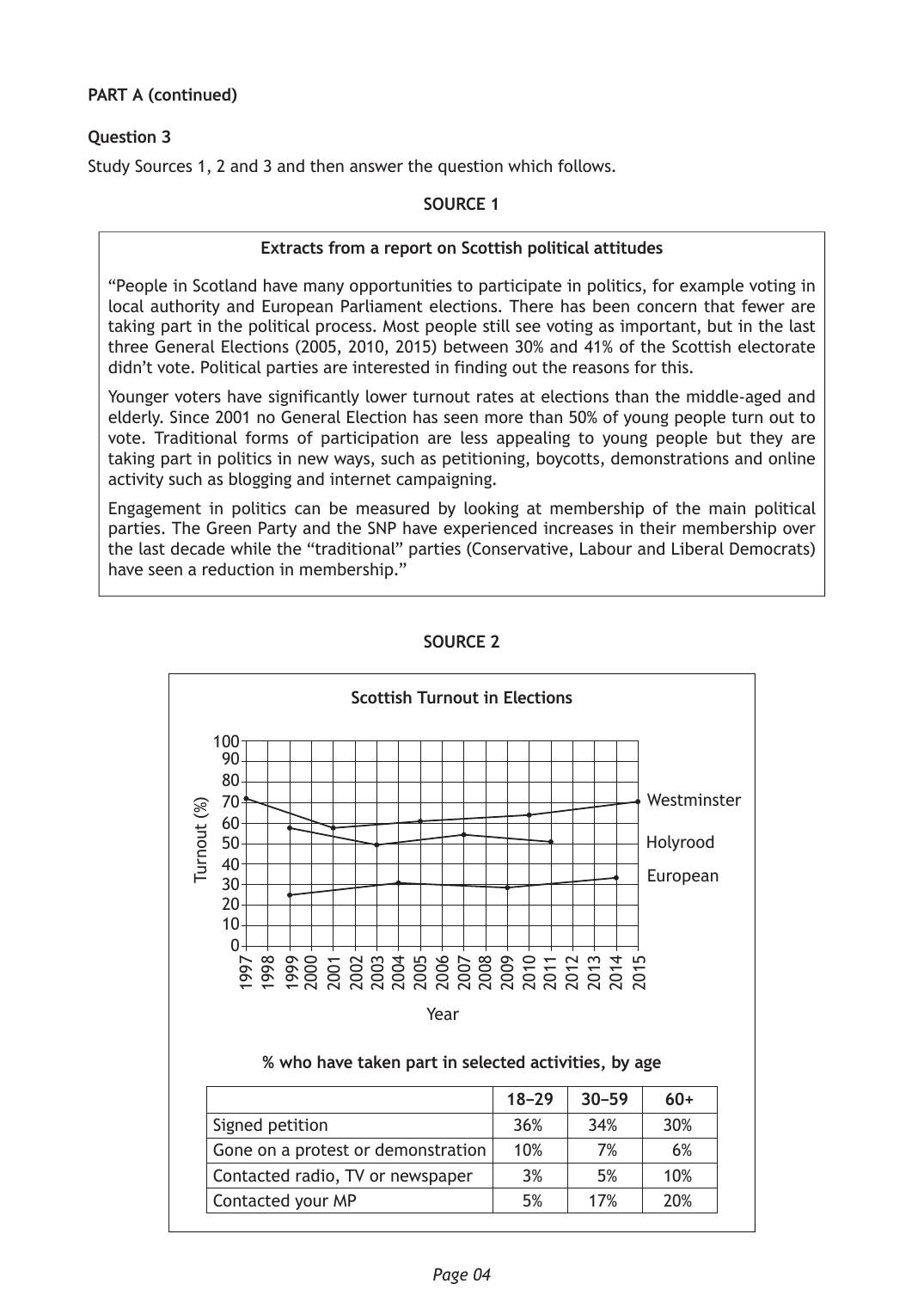
Study Sources 1, 2 and 3 and then answer the question which follows.

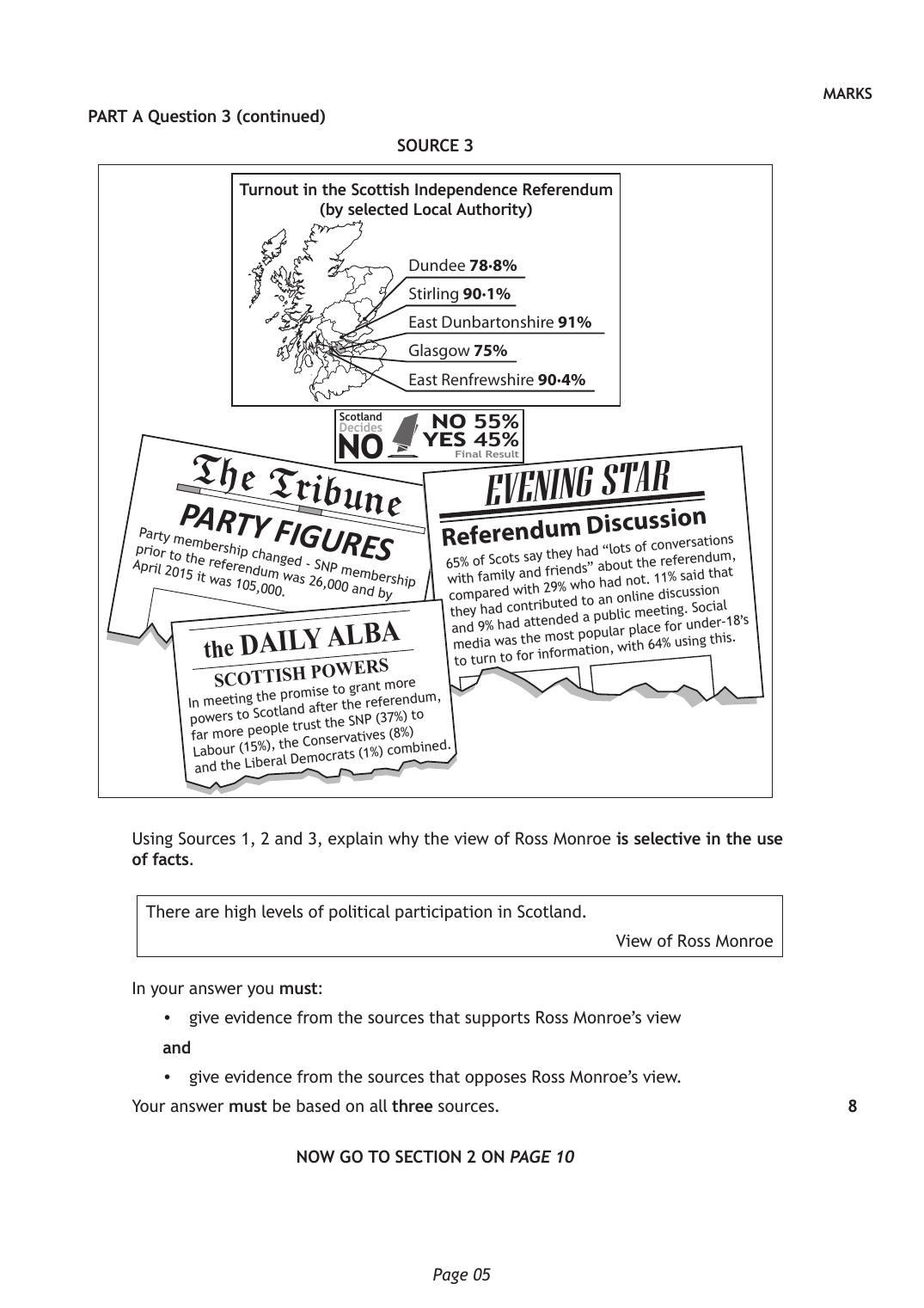
Using Sources 1, 2 and 3, explain why the view of Ross Monroe is selective in the use of facts.

There are high levels of political participation in Scotland.
— View of Ross Monroe

In your answer you must:

  • give evidence from the sources that supports Ross Monroe's view

and

  • give evidence from the sources that opposes Ross Monroe's view.

Your answer must be based on all three sources.

Sources (Source 1, Source 2, Source 3)

Source page 1 for this questionSource page 2 for this question
📝 Structure template — how to structure your answer

Support or oppose · A source-based skills question

WFQ (words from the question)

  1. I can support the view of insert name that “insert view” because Source 1 says “insert evidence”.✓ up to 3 marks
  2. Source 2 also supports the view when it says “insert evidence”.✓ up to 3 marks
  3. Source 3 also supports the view when it says “insert evidence”.✓ up to 3 marks
  4. I can oppose the view of insert name that “insert view” because Source 1 says “insert evidence”.✓ up to 3 marks
  5. Source 2 also opposes the view when it says “insert evidence”.✓ up to 3 marks
  6. Source 3 also opposes the view when it says “insert evidence”.✓ up to 3 marks

How it's marked

  • Up to 3 marks for each developed point using accurate source evidence.
  • Maximum 6 marks if you only support OR only oppose.
  • For full marks you must use all sources and give evidence that supports AND opposes the view.
  • Do as many support / oppose points as you like (e.g. 8 support + 2 oppose)…
  • …but you MUST have evidence for BOTH support and oppose to reach full marks.
✓ Reveal marking scheme
Max 8 marks

These are possible/exemplar answers from the marking instructions — other valid points can also gain marks.

How marks are awarded
  • The candidate is required to evaluate a limited range of sources, detecting and explaining instances of exaggeration and/or selective use of facts, giving developed arguments.
  • In order to achieve full marks candidates must show evidence that has been selected as it supports the view and show evidence that has not been selected as it does not support the view. An answer which deals with only one side of the explanation should be awarded a maximum of 6 marks.

Support

  1. Some parties, such as the SNP, have experienced huge increases in their membership. After the referendum, SNP membership rose from 26,000 to over 100,000. (S1 & S3) [2 marks – developed point]
  2. Young people are taking part in politics in new ways such as petitioning, boycotts, demonstrations and online activity such as blogging and internet campaigning (S1). 64% of under18s used social media for information on the referendum (S3). Source 2 also shows 36% of young people have signed a petition, the highest of all age groups (S2) [3 marks – developed point]

Support — Credit reference to aspects of the following

  1. People were very engaged in the Independence Referendum eg East Dunbartonshire 91% (S3)
  2. 65% of Scots say they have had "lots of conversations with family and friends" about the referendum, compared with 29% who have not (S3)
  3. Scottish turnout in elections to Westminster was 70% in 2015 and has always been over 50% (S2)
  4. Participation in the Independence Referendum was high, Glasgow had the lowest turnout at 75% which is a large majority of the population (S3)

Oppose

  1. Younger voters have significantly lower turnout rates at elections than the middle-aged and elderly and since 2001 no General Election has seen more than 50% of young people turn out to vote (S1) [1 mark – basic point]
  2. Ross Monroe is wrong because in the last three General Elections (2005, 2010, 2015) between 30% and 41% of the Scottish electorate didn't bother to vote (S1) and recent election figures in source 2 show that turnout for European elections is especially low, about a third, and turnout for Scottish elections is below 60% (S2) [3 marks – developed point with evaluative comment]

Oppose — Credit reference to aspects of the following

  1. Membership of the three traditional Westminster parties (Conservative, Labour and Liberal Democrat) has fallen (S1)
  2. Participation varies by region: in the Independence Referendum Glasgow had the lowest turnout at 75%. The highest was East Dunbartonshire at 91% (S3)
  3. Very few people contact their MP, contacted radio, TV or newspapers or went on a protest or demonstration (S2)
Source: 2016 N5 History · X749/75/11 · Q3Question paper (PDF, p.5) ↗Marking instructions (PDF, p.6) ↗
Support or oppose8 marks2016Q6⏳ Older formatDemocracy in Scotland and the United Kingdom

Study Sources 1, 2 and 3 and then answer the question which follows.

Using Sources 1, 2 and 3, explain why the view of Morag Watt is selective in the use of facts.

The House of Lords is in need of further reform.
— View of Morag Watt

In your answer you must:

  • give evidence from the sources that supports Morag Watt's view

and

  • give evidence from the sources that opposes Morag Watt's view.

Your answer must be based on all three sources.

Sources (Source 1, Source 2, Source 3)

Source page 1 for this questionSource page 2 for this question
📝 Structure template — how to structure your answer

Support or oppose · A source-based skills question

WFQ (words from the question)

  1. I can support the view of insert name that “insert view” because Source 1 says “insert evidence”.✓ up to 3 marks
  2. Source 2 also supports the view when it says “insert evidence”.✓ up to 3 marks
  3. Source 3 also supports the view when it says “insert evidence”.✓ up to 3 marks
  4. I can oppose the view of insert name that “insert view” because Source 1 says “insert evidence”.✓ up to 3 marks
  5. Source 2 also opposes the view when it says “insert evidence”.✓ up to 3 marks
  6. Source 3 also opposes the view when it says “insert evidence”.✓ up to 3 marks

How it's marked

  • Up to 3 marks for each developed point using accurate source evidence.
  • Maximum 6 marks if you only support OR only oppose.
  • For full marks you must use all sources and give evidence that supports AND opposes the view.
  • Do as many support / oppose points as you like (e.g. 8 support + 2 oppose)…
  • …but you MUST have evidence for BOTH support and oppose to reach full marks.
✓ Reveal marking scheme
Max 8 marks

These are possible/exemplar answers from the marking instructions — other valid points can also gain marks.

How marks are awarded
  • The candidate is required to evaluate a limited range of sources, detecting and explaining instances of exaggeration and/or selective use of facts, giving developed arguments.
  • In order to achieve full marks candidates must show evidence that has been selected as it supports the view and show evidence that has not been selected as it does not support the view. An answer which deals with only one side of the explanation should be awarded a maximum of 6 marks.

Support

  1. Evidence to support (not selective) Morag's view that the House of Lords does need reform include:
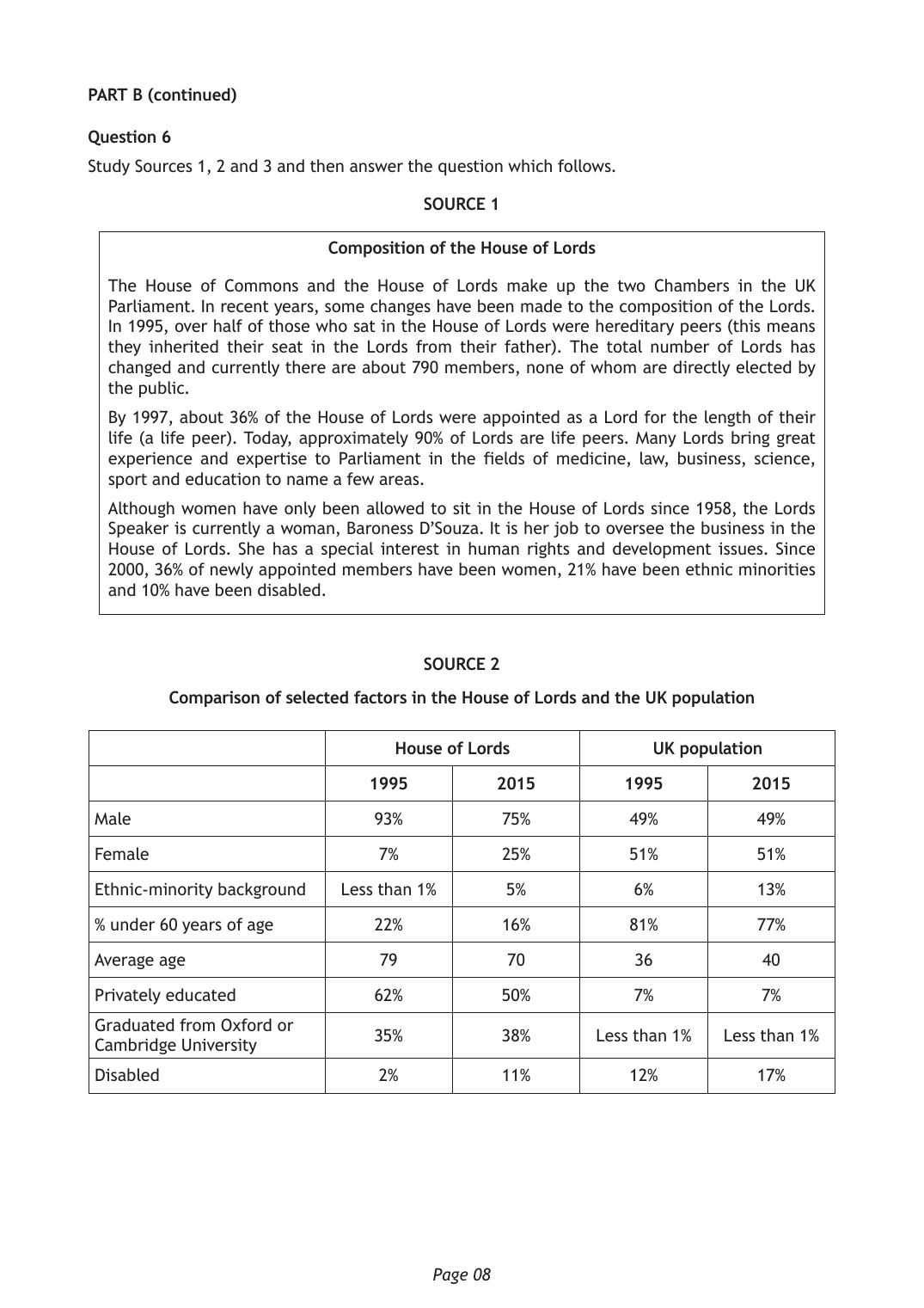
  2. Source 2 highlights that the % of house of Lords under 60 has decreased from 22% to 16% [1 mark – accurate use of Source 2 but minimal development]
  3. Source 2 highlights that the % of House of Lords under 60 has decreased from 22% to 16% yet almost ¾ of the population (77%) are under 60, highlighting underrepresentation of under 60s. [2 marks – accurate use of Source 2 with analysis]
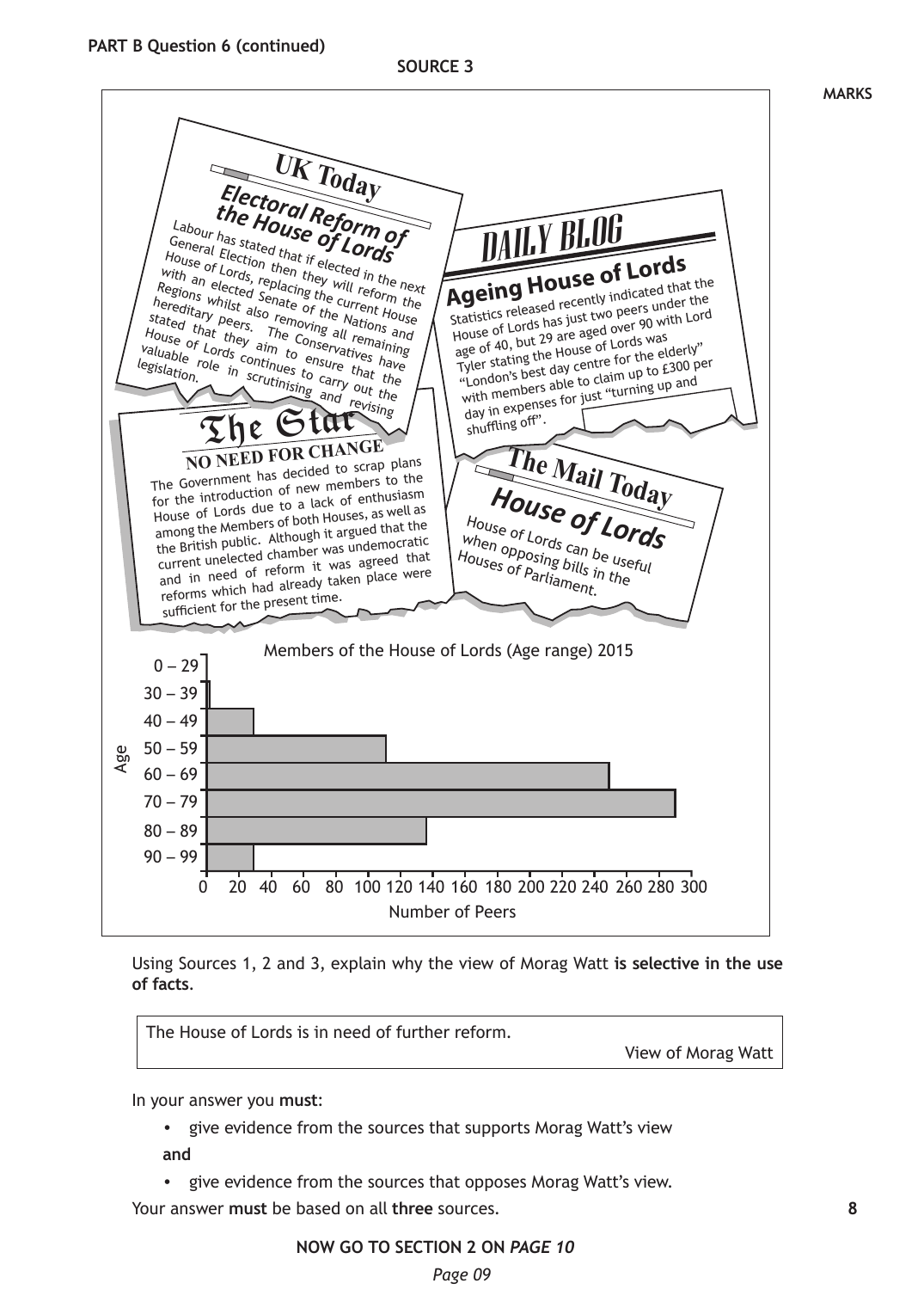
  4. Source 2 highlights that the % of House of Lords under 60 has decreased from 22% to 16% yet almost ¾ of the population (77%) are under 60, highlighting underrepresentation of under 60s. This is backed up by Source 3 that shows that 2 peers are under the age of 40 but more than ten times that number are over the age of 90 [3 marks – accurate information from two sources with analysis]

Support — Credit reference to aspects of the following

  1. None of the 790 members are directly elected (S1)
  2. Women, ethnic minorities and disabled are underrepresented (S2)
  3. The number of privately educated Lords is 50% which is disproportionate to the UK population of 7% (S2)
  4. Lord Tyler states that House of Lords was "London's best day centre for the elderly" with members able to claim up to £300 per day in expenses for just "turning up and shuffling off"

Oppose

  1. Evidence to oppose (selective) Morag's view that the House of Lords does not need reform include:
  2. Source 1 highlights that many Lords bring great experience and expertise to Parliament. [1 mark –accurate use of Source 1 but minimal development]
  3. Source 1 highlights that many Lords bring great experience and expertise to Parliament in the field of medicine, law, business and science and this is supported by Source 3 which states that the House of lords can be useful when opposing bills in the House of Parliament [2 marks – accurate use of 2 sources]
  4. Source 1 highlights that many Lords bring great experience and expertise to Parliament in the field of medicine, law, business and science and this is supported by Source 3 which states that the House of lords can be useful when opposing bills in the House of Parliament. Source 3 also highlights that House of Lords can play a valuable role in scrutinising and revising legislation [3 marks – well developed point – accurate use of 2 sources]

Oppose — Credit reference to aspects of the following

  1. In 1995 there were 7% women in the Lords, today about 25% are women (S2)
  2. Lord Speaker is female - Baroness d'Souza (S1)
  3. Female members increased significantly – 7% to 25% (S2)
  4. Lack of enthusiasm for change from both houses as well as the British public (S3)
  5. Disabled members has increased by 9% (S2)
  6. 1995 over ½ of the members were hereditary peers whereas by 2016 approximately 90% of members are life peers
Describe, in detail4 marks2016Q4⏳ Older formatDemocracy in the United Kingdom

In General Elections political parties campaign in many ways.

Describe, in detail, two ways in which political parties campaign during General Elections.

WFQ = words from the question — reuse in every point.

📝 Structure template — how to structure your answer

Describe, in detail · A knowledge (KU) question · use PEE

Remember PEE

  • Point — make your point
  • Explanation — develop it
  • Example — a specific, recent example

WFQ (words from the question)

  1. One words from the question is insert point.✓ 1 mark — Point
  2. This means that … (explain your point).✓ 1 mark — Explanation
  3. For example, … (give a specific, recent example).✓ 1 mark — Example
  4. Then repeat with a second point — two developed points are needed for full marks.

How it's marked

  • 1 mark for an accurate but undeveloped point (P).
  • +1 mark for developing/explaining it (E).
  • +1 mark for a specific example (E). Up to 3 marks per description; two descriptions needed for full marks.
  • The example is where learners most often drop the mark — always add “For example, …”.
✓ Reveal marking scheme
Max 4 marks

These are possible/exemplar answers from the marking instructions — other valid points can also gain marks.

How marks are awarded
  • Award up to three marks for a single description, depending on quality, level of detail, relevance, accuracy and exemplification. Two descriptions are necessary for full marks.

Possible approaches to answering the question

  1. Political parties can campaign during a General Election by canvassing. [1 mark]
  2. Political parties can campaign during a General election by canvassing. Canvassing gives parties the opportunity to go door to door to speak with the public in an attempt to increase voter awareness of the party. [2 marks—developed point]
  3. Political parties can campaign during a General Election by canvassing. Canvassing gives parties the opportunity to go door to door to speak with the public in an attempt to increase voter awareness of the party. This may secure more votes for the party as the canvassers will outline and explain the party policies to be implemented once elected. [3 marks—developed point with detail and analysis]

Credit reference to aspects of the following

  1. Use of the media – newspapers, PEBs, TV Debates, Social Media
  2. Leafleting
  3. Posters
  4. Holding a public meeting/rally
  5. Publishing a manifesto
  6. Use of celebrities to gain media attention and support from voters
Source: 2016 N5 History · X749/75/11 · Q4Question paper (PDF, p.6) ↗Marking instructions (PDF, p.8) ↗
Explain, in detail8 marks2016Q5⏳ Older formatDemocracy in the United Kingdom

First Past the Post has several disadvantages.

Explain, in detail, the disadvantages of First Past the Post. You should give a maximum of three disadvantages in your answer.

WFQ = words from the question — reuse in every point.

📝 Structure template — how to structure your answer

Explain, in detail · A knowledge (KU) question · use PEE (+ analysis)

Remember PEE

  • Point — give your reason
  • Explanation — “this means that…”
  • Example — a specific, recent example

WFQ (words from the question)

  1. One reason words from the question is insert point.✓ 1 mark — Point
  2. This means that … (explain the reason).✓ 1 mark — Explanation
  3. For example, … (give a specific, recent example).✓ 1 mark — Example
  4. This is important because … (analysis — how it links to other factors).✓ 1 mark — Analysis
  5. Then repeat with a second reason — a maximum of two explanations are credited.

How it's marked

  • 1 mark for an accurate but undeveloped reason (P).
  • +1 for explanation (E), +1 for a specific example (E), +1 for analysis. Up to 4 marks per explanation.
  • A maximum of two explanations are credited.
  • Build each reason: Point → Explanation → Example → Analysis.
✓ Reveal marking scheme
Max 8 marks

These are possible/exemplar answers from the marking instructions — other valid points can also gain marks.

How marks are awarded
  • Award up to four marks for a single explanation, depending on quality, level of detail, relevance, accuracy, exemplification and answers which show the interaction of various factors. A maximum of three explanations should be credited.

Possible approaches to answering the question

  1. One disadvantage of FPTP is that small parties are underrepresented. [1 mark]
  2. One disadvantage of FPTP is that small parties are underrepresented because the percentage of seats which a party wins in Parliament does not represent the percentage of votes they win in the election. [2 marks – developed point]
  3. One disadvantage of FPTP is that small parties are underrepresented because the percentage of seats which a party wins in Parliament does not represent the percentage of votes they win in the election. In the 2015 General Election, UKIP got 12.6% of the votes (almost four million votes) and 1 seat [3 marks – developed point with exemplification]
  4. One disadvantage of FPTP is that small parties are underrepresented because the percentage of seats which a party wins in Parliament does not represent the percentage of votes they win in the election. In the 2015 General Election, UKIP got 12.6% of the votes (almost four million votes) and 1 seat. This is unfair and is a reason why some people believe that FPTP is undemocratic and as a result, do not vote. [4 marks - developed point with exemplification and analysis]

Credit reference to aspects of the following

  1. If party support is spread out and not concentrated in a constituency, parties will find it very difficult to get any MPs elected
  2. Tactical voting is possible
  3. There are no prizes for second place
  4. In safe seats parties have a great power to choose the MP
  5. Many won't vote for smaller parties in a safe seat
  6. Strong government isn't always good government
  7. Political parties often target marginal seats and can be seen to ignore constituencies with safe seats
Source: 2016 N5 History · X749/75/11 · Q5Question paper (PDF, p.6) ↗Marking instructions (PDF, p.9) ↗
Conclusions8 marks2016Q15⏳ Older formatInternational Issues

Study Sources 1, 2 and 3 and then answer the question which follows.

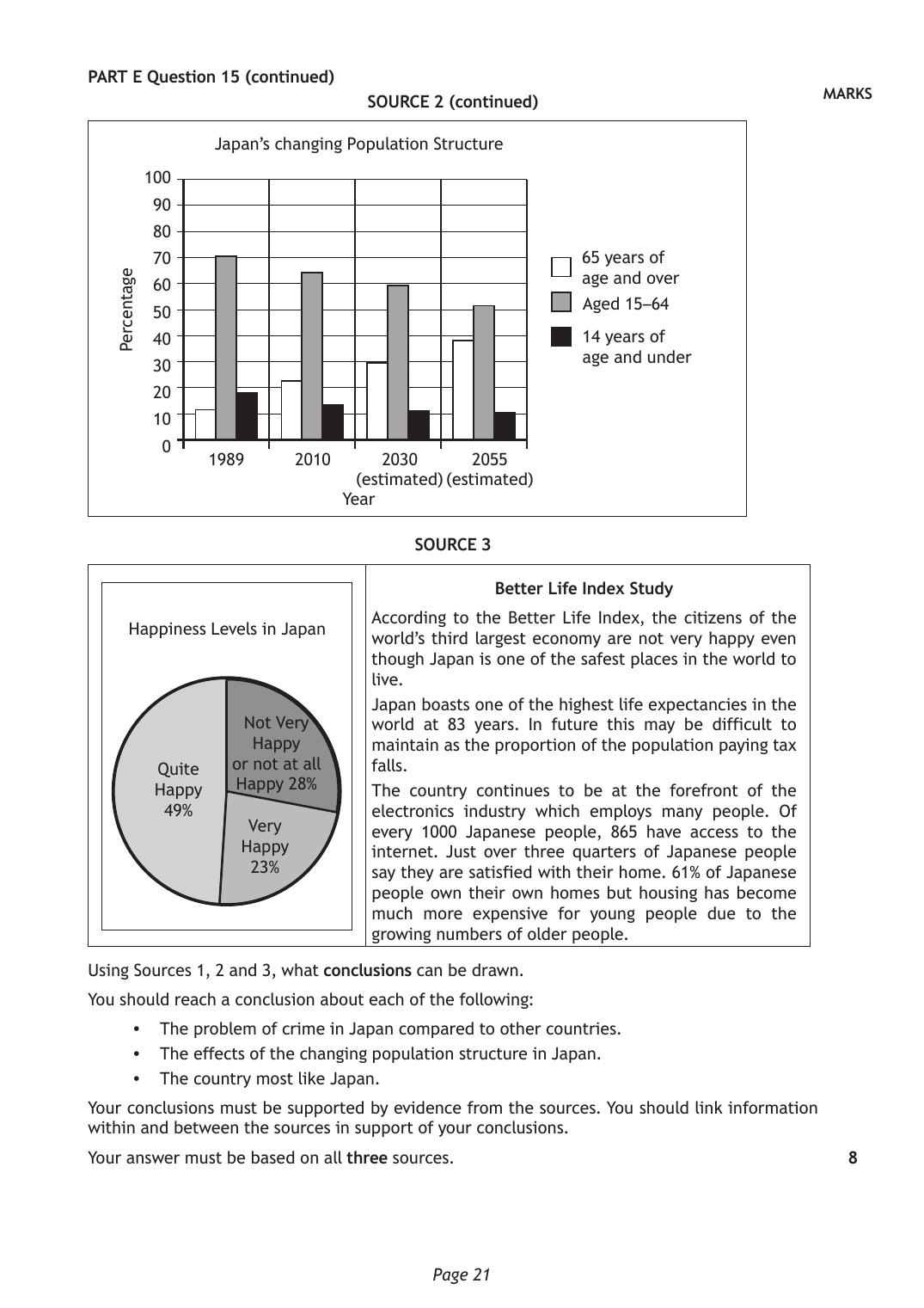
Using Sources 1, 2 and 3, what conclusions can be drawn.

You should reach a conclusion about each of the following:

  • The problem of crime in Japan compared to other countries.
  • The effects of the changing population structure in Japan.
  • The country most like Japan.

Your conclusions must be supported by evidence from the sources. You should link information within and between the sources in support of your conclusions.

Your answer must be based on all three sources.

Sources (Source 1, Source 2, Source 3)

Source page 1 for this questionSource page 2 for this question
📝 Structure template — how to structure your answer

Conclusions · A source-based skills question

WFQ (words from the question)

  1. For EACH bullet point in the question, write the bullet point as a subheading, then:
  2. One conclusion that can be made about insert bullet point is insert valid conclusion.✓ 1 mark — valid conclusion
  3. Evidence to support this is shown in insert source which says/shows “insert evidence”.✓ 1 mark — evidence
  4. This clearly shows / strongly suggests insert valid conclusion — evaluative language earns the 3rd mark.✓ 1 mark — evaluative language

How it's marked

  • Conclusion + one piece of evidence = 2 marks. That is all you need for two of the three marks.
  • The 3rd mark does NOT come from a second piece of evidence linked to the same point — it comes from using evaluative terminology (e.g. “this clearly shows”, “the strongest evidence is”, “significantly”, “overwhelmingly”).
  • Comparison bullets (e.g. the UK compared with another country): you must give evidence about BOTH sides — but two pieces of evidence together still earn only ONE evidence mark, not two. You can still earn the 3rd mark with evaluative language, exactly as normal.
  • Up to 3 marks per bullet point; four conclusions (one per bullet point) are needed for full marks (10).
  • Tip: turn each bullet point into a question (e.g. “What is…?”, “What are…?”, “Which…?”, “How…?”) — the answer you give is your conclusion.
  • Conclusion + evidence = 2 marks. For the 3rd mark add evaluative language — a second quote linked to the same point does NOT earn it.
  • For a comparison bullet you must back BOTH sides with evidence — but that is still only one evidence mark, not two. The 3rd mark still comes from evaluative language.
✓ Reveal marking scheme
Max 8 marks

These are possible/exemplar answers from the marking instructions — other valid points can also gain marks.

How marks are awarded
  • The candidate is required to use a limited range of sources and draw valid conclusions from them, with supporting evidence

The problem of Crime in Japan compared to other countries

  1. Conclusion: Compared to many other countries there are relatively low levels of crime in Japan. [1 mark for a valid conclusion]
  2. Conclusion: Compared to many other countries there are relatively low levels of crime in Japan. Evidence - It is one of the safest places in the world to live (S3) [2 marks for a valid conclusion with supporting evidence]
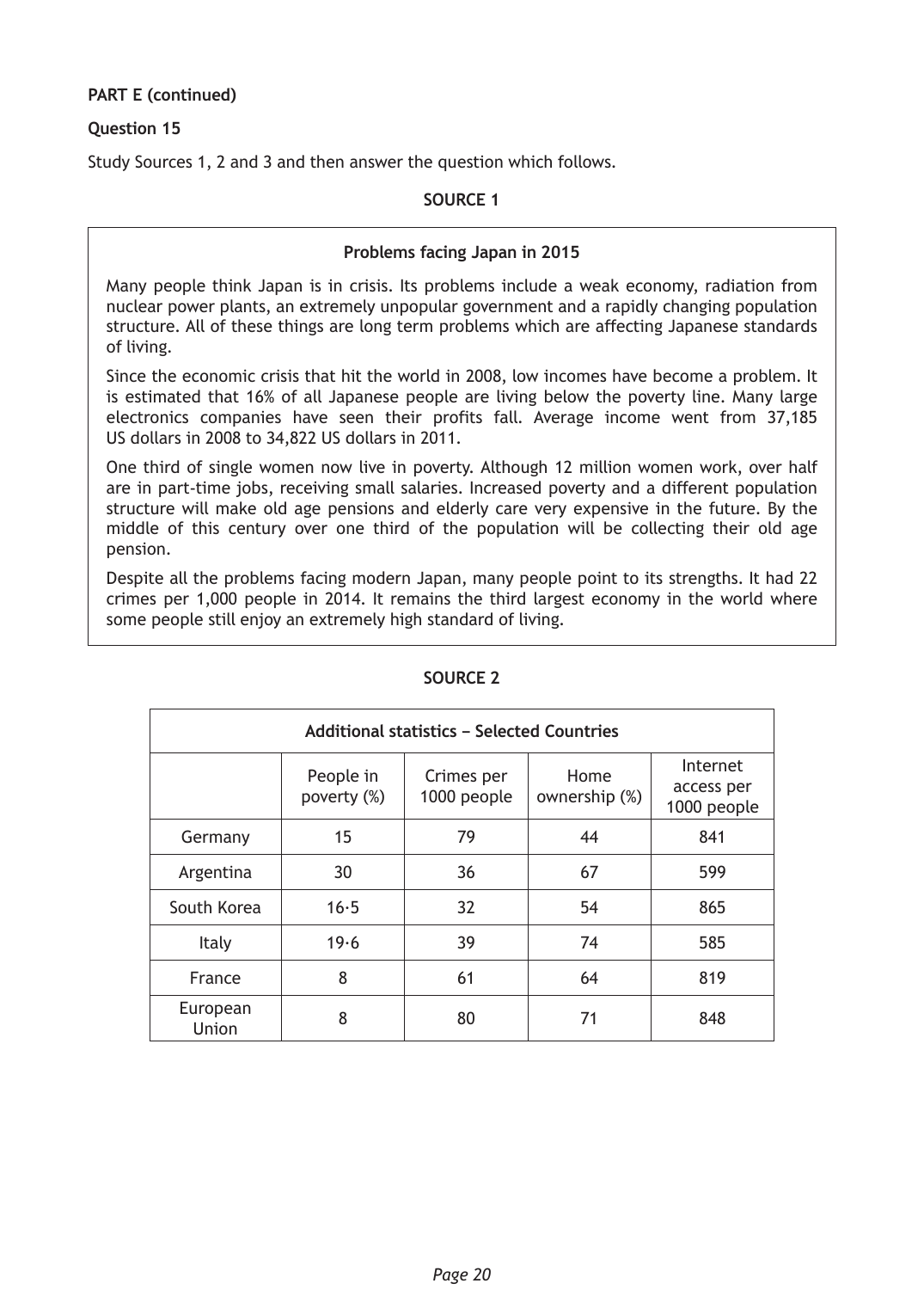
  3. Conclusion: Compared to many other countries there are relatively low levels of crime in Japan. Evidence - Japan had 22 crimes per 1000 people in 2014 (S1), which is only about one quarter of the EU figure of 80 and lower than all the countries mentioned (S2). [3 marks - valid conclusion with evidence from two sources and synthesis]

The effects of the changing population structure in Japan

  1. Conclusion: As the elderly population increases so do social and economic problems in Japan. [1 mark for a valid conclusion]
  2. Conclusion: As the elderly population increases so do social and economic problems in Japan. Evidence – Pensions will be very expensive in the future [2 marks for a valid conclusion with supporting evidence from source 1]
  3. Conclusion: As the elderly population increases so do social and economic problems in Japan. Evidence - Pensions will be very expensive in the future. As Source 1 shows the elderly population will almost double in forty years but those paying tax (15-64 years) will fall to just over 50% of the population. [3 marks for a valid conclusion with supporting evidence from sources 1 and 3]
  4. Also credit reference to:
  5. Housing is getting expensive as a result of the aging population (S3) 61% own their home, lower than the EU, France, Italy and Argentina.
  6. Japan has a high life expectancy (S3) but this will be difficult to maintain as fewer will be paying tax (S3)
  7. A growing elderly population is listed as one of Japan's problems. (S1).

The country most like Japan

  1. Conclusion: South Korea is most like Japan [1 mark for a valid conclusion]
  2. Conclusion: South Korea is most like Japan Evidence – In south Korea the poverty rate is 16.5% and Japan is 16% (S1&2) [2 marks for a valid conclusion with supporting evidence]
  3. Conclusion: South Korea is most like Japan Evidence – In south Korea only 0·5% more people in poverty – this is the closest to Japan at 16% with crime rate in South Korea also being closest to that of Japan – 22 per 1000 in Japan and 32 per 1000 in South Korea [3 marks for valid conclusion with supporting evidence from sources 1 and 2]
  4. Internet users – 865 per 1000 in Japan and South Korea – highest of all the countries mentioned [S1 & 3]
Source: 2016 N5 History · X749/75/11 · Q15Question paper (PDF, p.21) ↗Marking instructions (PDF, p.24) ↗
Conclusions8 marks2016Q18⏳ Older formatInternational Issues

Study Sources 1, 2 and 3 and then answer the question which follows.

Using Sources 1, 2 and 3, what conclusions can be drawn.

You should reach a conclusion about each of the following:

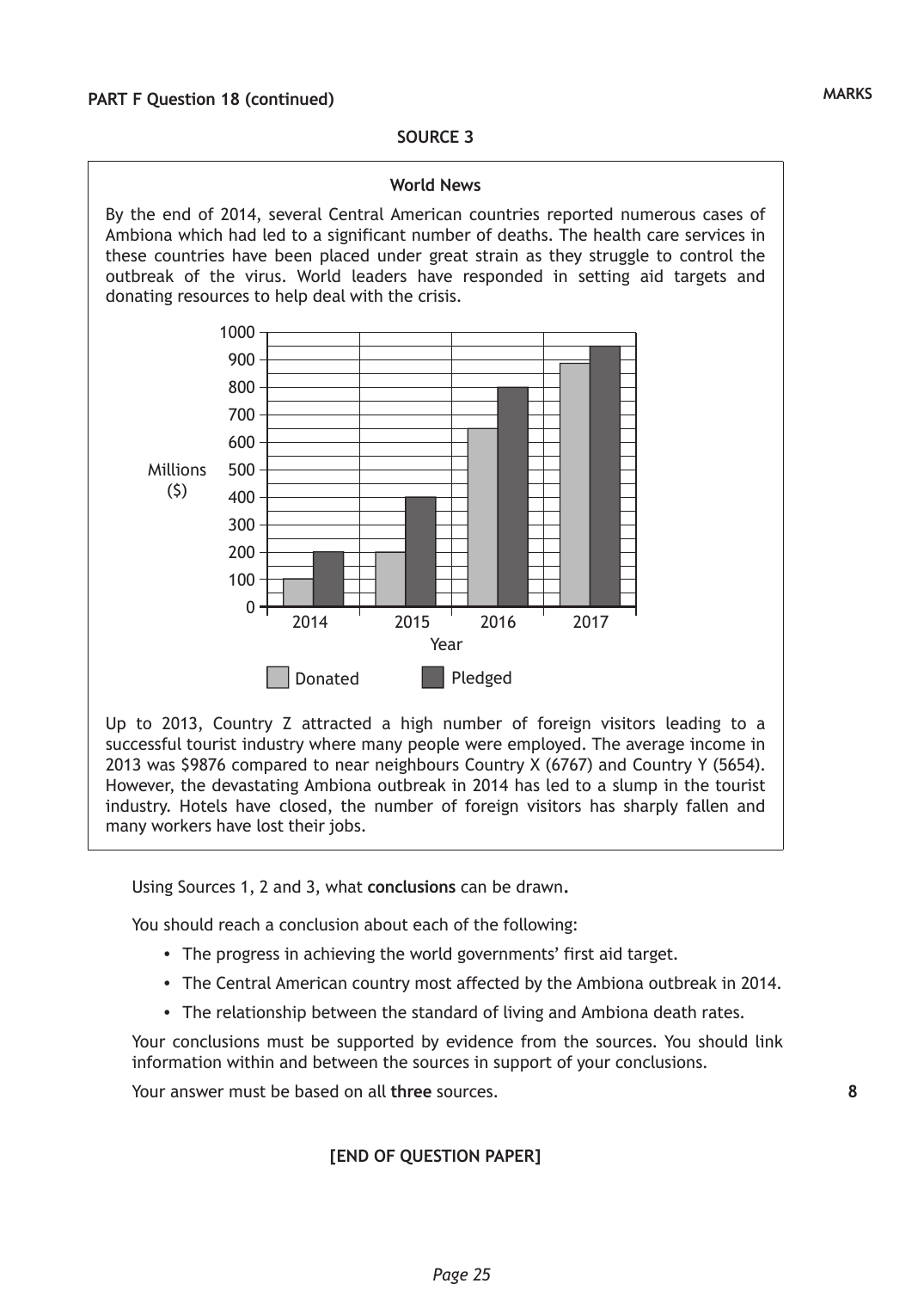
  • The progress in achieving the world governments' first aid target.
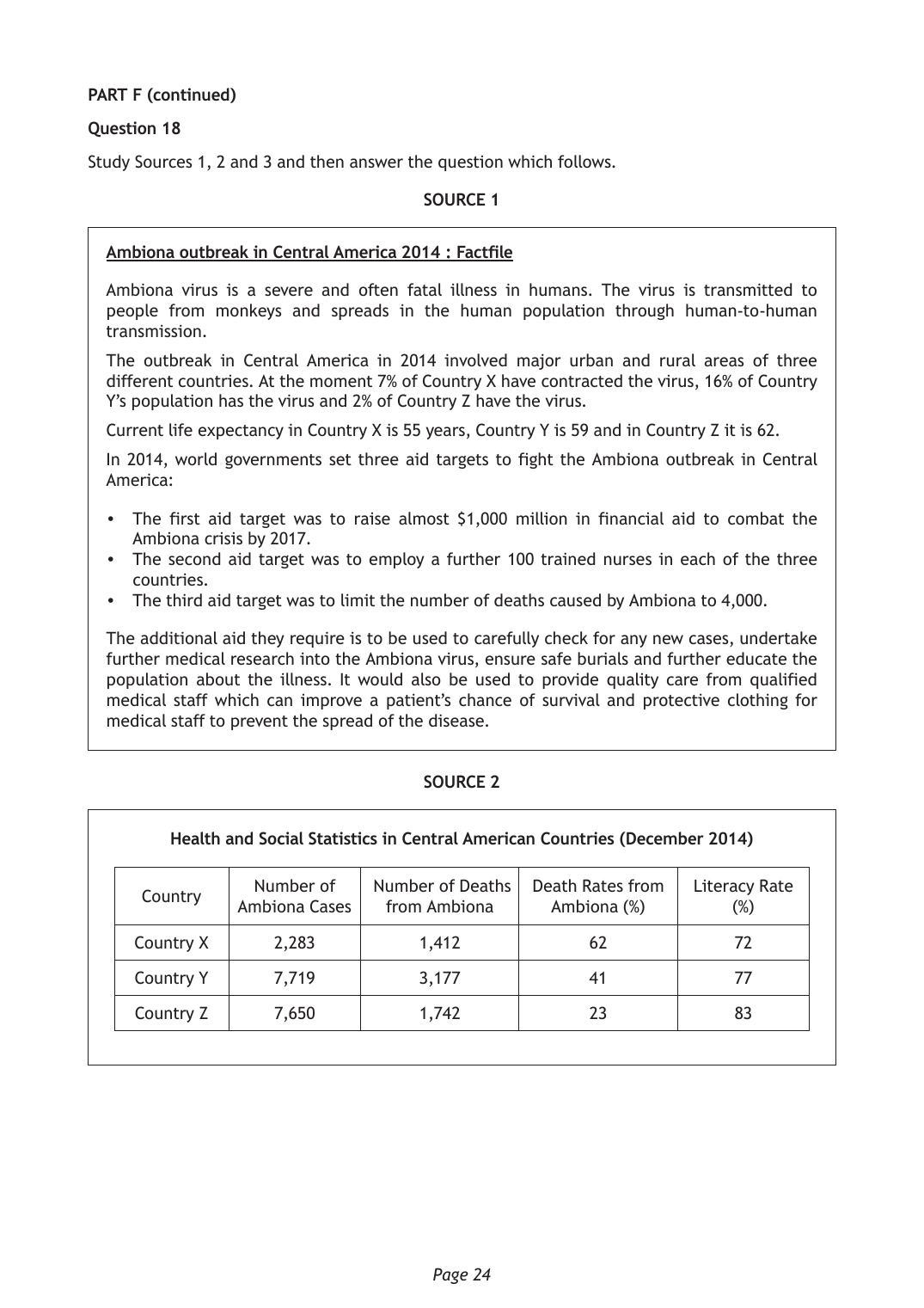
  • The Central American country most affected by the Ambiona outbreak in 2014.
  • The relationship between the standard of living and Ambiona death rates.

Your conclusions must be supported by evidence from the sources. You should link information within and between the sources in support of your conclusions.

Your answer must be based on all three sources.

Sources (Source 1, Source 2, Source 3)

Source page 1 for this questionSource page 2 for this question
📝 Structure template — how to structure your answer

Conclusions · A source-based skills question

WFQ (words from the question)

  1. For EACH bullet point in the question, write the bullet point as a subheading, then:
  2. One conclusion that can be made about insert bullet point is insert valid conclusion.✓ 1 mark — valid conclusion
  3. Evidence to support this is shown in insert source which says/shows “insert evidence”.✓ 1 mark — evidence
  4. This clearly shows / strongly suggests insert valid conclusion — evaluative language earns the 3rd mark.✓ 1 mark — evaluative language

How it's marked

  • Conclusion + one piece of evidence = 2 marks. That is all you need for two of the three marks.
  • The 3rd mark does NOT come from a second piece of evidence linked to the same point — it comes from using evaluative terminology (e.g. “this clearly shows”, “the strongest evidence is”, “significantly”, “overwhelmingly”).
  • Comparison bullets (e.g. the UK compared with another country): you must give evidence about BOTH sides — but two pieces of evidence together still earn only ONE evidence mark, not two. You can still earn the 3rd mark with evaluative language, exactly as normal.
  • Up to 3 marks per bullet point; four conclusions (one per bullet point) are needed for full marks (10).
  • Tip: turn each bullet point into a question (e.g. “What is…?”, “What are…?”, “Which…?”, “How…?”) — the answer you give is your conclusion.
  • Conclusion + evidence = 2 marks. For the 3rd mark add evaluative language — a second quote linked to the same point does NOT earn it.
  • For a comparison bullet you must back BOTH sides with evidence — but that is still only one evidence mark, not two. The 3rd mark still comes from evaluative language.
✓ Reveal marking scheme
Max 8 marks

These are possible/exemplar answers from the marking instructions — other valid points can also gain marks.

How marks are awarded
  • The candidate is required to use a limited range of sources and draw valid conclusions from them, with supporting evidence.

The progress in achieving the world government's aid targets.

  1. Conclusion - There has been good progress in achieving the world government's financial aid target. [1 mark for valid conclusion]
  2. Evidence - In 2014 world government's requested almost $1 Billion in financial aid to combat the Ambiona crisis (S1) and by 2017 almost 900 million dollars will have been donated with 950 million dollars pledged (S3). [3 marks for valid conclusion with supporting evidence from sources 1 and 3]

The Central American country most affected by the Ambiona outbreak in 2014

  1. Conclusion – Country Y has been most affected by the Ambiona outbreak (1 mark for valid conclusion)
  2. Evidence – Source 2 highlights that it has the highest number of cases of Ambiona at 7719 and by far the highest number of deaths – 3177 – more than double that of country X and almost double that of country Z. This is linked to Source 1 which highlights that country Y has the highest proportion which has contracted the virus at 16%. [3 marks for valid conclusion with supporting evidence from sources 1 and 3]

The relationship between the standard of living and Ambiona death rates.

  1. Conclusion – The higher the standard of living the lower the death rate. [1 mark for valid conclusion]
  2. Evidence – Source 2 highlights that the country Z has the lowest death rate at 23% with the highest literacy rate at 83% and Source 3 supports this by showing that country Z has the highest average income of $9876 compared to country Y at $5654. [3 marks for valid conclusion with supporting evidence from sources 2 and 3]
Source: 2016 N5 History · X749/75/11 · Q18Question paper (PDF, p.25) ↗Marking instructions (PDF, p.29) ↗
Describe, in detail6 marks2016Q16⏳ Older formatWorld Issues

People are affected by international conflicts and issues in many different ways.

Describe, in detail, two ways in which people have been affected by an international conflict or issue you have studied.

WFQ = words from the question — reuse in every point.

📝 Structure template — how to structure your answer

Describe, in detail · A knowledge (KU) question · use PEE

Remember PEE

  • Point — make your point
  • Explanation — develop it
  • Example — a specific, recent example

WFQ (words from the question)

  1. One words from the question is insert point.✓ 1 mark — Point
  2. This means that … (explain your point).✓ 1 mark — Explanation
  3. For example, … (give a specific, recent example).✓ 1 mark — Example
  4. Then repeat with a second point — two developed points are needed for full marks.

How it's marked

  • 1 mark for an accurate but undeveloped point (P).
  • +1 mark for developing/explaining it (E).
  • +1 mark for a specific example (E). Up to 3 marks per description; two descriptions needed for full marks.
  • The example is where learners most often drop the mark — always add “For example, …”.
✓ Reveal marking scheme
Max 6 marks

These are possible/exemplar answers from the marking instructions — other valid points can also gain marks.

How marks are awarded
  • Award up to three marks for a single description, depending on quality, level of detail, relevance, accuracy and exemplification. Two descriptions are necessary for full marks.

Possible approaches to answering the question

  1. ISSUE – UNDERDEVELOPMENT IN AFRICA
  2. Many people in African countries do not have access to appropriate levels of healthcare. (1 mark – accurate but undeveloped point)
  3. Many people in African countries do not have access to appropriate levels of healthcare and as a result many people die each year from illnesses such as malaria. (2 marks – accurate point with development).
  4. Some poorer African countries have inadequate health care with too few doctors and nurses. This makes it more difficult to treat preventable illnesses such as diarrhoeal diseases. Each day over 2,000 children die from diarrhoeal diseases around the world more than AIDS, malaria and measles. (3 marks – accurate point with development and exemplification)

Credit reference to aspects of the following

  1. Unsafe water/poor sanitary conditions
  2. Low life expectancy/high infant mortality rates
  3. High illiteracy rates/low levels of education (including attendance)
  4. Gender inequalities
  5. Refugees
  6. Piracy
  7. Deaths from conflict
  8. Child soldiers
  9. Destroyed infrastructure
  10. Human rights abuses
  11. Effects of Terrorism
  12. Restrictions to civil liberties
Source: 2016 N5 History · X749/75/11 · Q16Question paper (PDF, p.22) ↗Marking instructions (PDF, p.26) ↗
Explain, in detail6 marks2016Q17⏳ Older formatWorld Issues

The attempts of international organisations to tackle conflicts and issues are sometimes unsuccessful.

Explain, in detail, two reasons why international organisations have either been successful or unsuccessful in tackling an international conflict or issue you have studied.

WFQ = words from the question — reuse in every point.

📝 Structure template — how to structure your answer

Explain, in detail · A knowledge (KU) question · use PEE (+ analysis)

Remember PEE

  • Point — give your reason
  • Explanation — “this means that…”
  • Example — a specific, recent example

WFQ (words from the question)

  1. One reason words from the question is insert point.✓ 1 mark — Point
  2. This means that … (explain the reason).✓ 1 mark — Explanation
  3. For example, … (give a specific, recent example).✓ 1 mark — Example
  4. This is important because … (analysis — how it links to other factors).✓ 1 mark — Analysis
  5. Then repeat with a second reason — a maximum of two explanations are credited.

How it's marked

  • 1 mark for an accurate but undeveloped reason (P).
  • +1 for explanation (E), +1 for a specific example (E), +1 for analysis. Up to 4 marks per explanation.
  • A maximum of two explanations are credited.
  • Build each reason: Point → Explanation → Example → Analysis.
✓ Reveal marking scheme
Max 6 marks

These are possible/exemplar answers from the marking instructions — other valid points can also gain marks.

How marks are awarded
  • Award up to four marks for a single explanation, depending on quality, level of detail, relevance, accuracy, exemplification and answers which show the interaction of various factors. A maximum of two explanations should be credited

Possible approaches to answering the question

  1. Some international organisations are unsuccessful at tackling international terrorism because they do not get enough help from member countries. (1 mark – accurate but undeveloped point)
  2. NATOs methods are unsuccessful at tackling international terrorism because, although they are a very powerful military alliance, terrorists are often not easily identifiable. They are not like a country which would be easier for NATO to fight against in the traditional sense. Terrorists don't wear uniforms and don't stick to one country's borders. (3 marks – accurate developed point with exemplification)
  3. NATO can't support people who have come under threat from their own governments. Since 2011 they have not been able to stop the on-going conflict between the two warring factions in Libya and as a result they have been unable to protect civilians effectively. NATO is not set up to help install new governments and ensure security and stability in places like Libya, it was only effective in the military conflict against Colonel Gaddafi. After this, NATO members did not want the expense of rebuilding the country in the long term. (4 marks - accurate developed point with exemplification and analysis)

Credit reference to aspects of the following

  1. Lack of training of local security services
  2. Tribal/Civil War in Africa
  3. Corrupt government
  4. Sanctions affect some countries more than others
  5. The extent of poverty
  6. Financial constraints
  7. Lack of cooperation
  8. Inappropriate aid
  9. Unfair trade
  10. Fair Trade
  11. Increased access to anti-retroviral therapy
  12. Increased enrolment in education
  13. Success of UN Specialised Agencies
  14. Success of Sustainable Development Goals
Source: 2016 N5 History · X749/75/11 · Q17Question paper (PDF, p.22) ↗Marking instructions (PDF, p.27) ↗
Describe, in detail6 marks2016Q13⏳ Older formatWorld Powers

The citizens of every world power have political rights.

Describe, in detail, two political rights that the citizens have in the world power you have studied. In your answer you must state the world power you have studied.

WFQ = words from the question — reuse in every point.

📝 Structure template — how to structure your answer

Describe, in detail · A knowledge (KU) question · use PEE

Remember PEE

  • Point — make your point
  • Explanation — develop it
  • Example — a specific, recent example

WFQ (words from the question)

  1. One words from the question is insert point.✓ 1 mark — Point
  2. This means that … (explain your point).✓ 1 mark — Explanation
  3. For example, … (give a specific, recent example).✓ 1 mark — Example
  4. Then repeat with a second point — two developed points are needed for full marks.

How it's marked

  • 1 mark for an accurate but undeveloped point (P).
  • +1 mark for developing/explaining it (E).
  • +1 mark for a specific example (E). Up to 3 marks per description; two descriptions needed for full marks.
  • The example is where learners most often drop the mark — always add “For example, …”.
✓ Reveal marking scheme
Max 6 marks

These are possible/exemplar answers from the marking instructions — other valid points can also gain marks.

How marks are awarded
  • Award up to three marks for a single description, depending on quality, level of detail, relevance, accuracy and exemplification. Two descriptions are necessary for full marks.

Possible approaches to answering the question

  1. US citizens have the right to own a gun. [0 marks]
  2. US citizens have the right to own a gun as it states that they have this right in the constitution. [1 mark – undeveloped point]
  3. Australian citizens have freedom of speech. This means they are free to criticise government decisions. [2 marks – accurate point with development]
  4. People in China have the right to vote in village elections. This allows citizens the opportunity to elect village committees and village leaders as a form of local democracy. The elected representatives are entrusted with managing local affairs. [3 marks – accurate, well developed point]

Credit reference to aspects of the following

  1. Clear reference to specific aspects of political systems of chosen G20 country.
  2. Standing for election
  3. Voting in elections at various levels
  4. Participating in political parties, trade unions, pressure groups
  5. Free speech
  6. Freedom of press
  7. Protection by the law
Source: 2016 N5 History · X749/75/11 · Q13Question paper (PDF, p.18) ↗Marking instructions (PDF, p.22) ↗
Explain, in detail6 marks2016Q14⏳ Older formatWorld Powers

World powers have the ability to influence other countries.

Explain, in detail, two reasons why the world power you have studied has the ability to influence other countries. In your answer you must state the world power you have studied.

WFQ = words from the question — reuse in every point.

📝 Structure template — how to structure your answer

Explain, in detail · A knowledge (KU) question · use PEE (+ analysis)

Remember PEE

  • Point — give your reason
  • Explanation — “this means that…”
  • Example — a specific, recent example

WFQ (words from the question)

  1. One reason words from the question is insert point.✓ 1 mark — Point
  2. This means that … (explain the reason).✓ 1 mark — Explanation
  3. For example, … (give a specific, recent example).✓ 1 mark — Example
  4. This is important because … (analysis — how it links to other factors).✓ 1 mark — Analysis
  5. Then repeat with a second reason — a maximum of two explanations are credited.

How it's marked

  • 1 mark for an accurate but undeveloped reason (P).
  • +1 for explanation (E), +1 for a specific example (E), +1 for analysis. Up to 4 marks per explanation.
  • A maximum of two explanations are credited.
  • Build each reason: Point → Explanation → Example → Analysis.
✓ Reveal marking scheme
Max 6 marks

These are possible/exemplar answers from the marking instructions — other valid points can also gain marks.

How marks are awarded
  • Award up to four marks for a single explanation, depending on quality, level of detail, relevance, accuracy, exemplification and answers which show the interaction of various factors. A maximum of two explanations should be credited.

Possible approaches to answering the question

  1. The USA has the ability to influence other countries due to the size of its military [1 mark – undeveloped point]
  2. The USA has the ability to influence other countries due to the size of its military. The USA military is often referred to as the 'world policeman' and has been able to influence countries such as Afghanistan and Libya. [2 marks – accurate point with development]
  3. Brazil has the ability to influence other countries due to the fact it is a growing economy and is a member of BRICS. Brazil is also the single biggest supplier of agricultural products to the European Union so is a crucial trading partner. Furthermore Brazil has recently been influential in the 'South-South' Cooperation, becoming a donor to developing African countries, providing $23 million dollars to Mozambique to help with the development of HIV/AIDs treatments. This cooperation is seen as being more influential than the 'tied aid' models of the past. [4 marks – well explained point, with exemplification and analysis]

Credit reference to aspects of the following

  1. Trade
  2. Defence
  3. Diplomatic Support
  4. Ideology
  5. Immigration
  6. Culture
Source: 2016 N5 History · X749/75/11 · Q14Question paper (PDF, p.18) ↗Marking instructions (PDF, p.23) ↗
Describe, in detail4 marks2016Q10⏳ Older formatCrime and the Law

Groups that tackle crime in the UK Government Police Courts

Choose one of the groups above or any other group you have studied. Describe, in detail, two ways in which the group you have chosen has tried to tackle crime in the UK.

WFQ = words from the question — reuse in every point.

📝 Structure template — how to structure your answer

Describe, in detail · A knowledge (KU) question · use PEE

Remember PEE

  • Point — make your point
  • Explanation — develop it
  • Example — a specific, recent example

WFQ (words from the question)

  1. One words from the question is insert point.✓ 1 mark — Point
  2. This means that … (explain your point).✓ 1 mark — Explanation
  3. For example, … (give a specific, recent example).✓ 1 mark — Example
  4. Then repeat with a second point — two developed points are needed for full marks.

How it's marked

  • 1 mark for an accurate but undeveloped point (P).
  • +1 mark for developing/explaining it (E).
  • +1 mark for a specific example (E). Up to 3 marks per description; two descriptions needed for full marks.
  • The example is where learners most often drop the mark — always add “For example, …”.
✓ Reveal marking scheme
Max 4 marks

These are possible/exemplar answers from the marking instructions — other valid points can also gain marks.

How marks are awarded
  • Award up to three marks for a single description, depending on quality, level of detail, relevance, accuracy and exemplification. Two descriptions are necessary for full marks.

Possible approaches to answering the question

  1. The Scottish Government has tried to tackle crime by lowering drink-drive limits [1 mark—accurate but undeveloped point]
  2. The Scottish Government has tried to tackle crime by making drink-drive limits clearer by reducing the maximum limit, this means that there should be fewer road traffic accidents, deaths and injuries. [2 marks—accurate point with development]
  3. Government has tried to tackle crime by making drink-drive limits clearer by reducing the maximum limit, this means that there should be fewer road traffic accidents, deaths and injuries. People are less likely now to drink at all if driving given that the legal limit has been lowered from 80mg to 50mg of alcohol in every 100ml of blood. [3 marks—accurate point with development and exemplification]

Credit reference to aspects of the following

  1. Early release from prison
  2. Operation Blade
  3. Anti-sectarian legislation
  4. Neighbourhood watch
  5. CCTV
  6. Speed cameras
  7. Tags/alternatives to prison
  8. ASBOSs
  9. Supervision orders/tagging orders
  10. Community policing
Source: 2016 N5 History · X749/75/11 · Q10Question paper (PDF, p.14) ↗Marking instructions (PDF, p.18) ↗
Explain, in detail6 marks2016Q11⏳ Older formatCrime and the Law

Some people are affected by crime more than others.

Explain, in detail, two reasons why some people are affected by crime more than others.

WFQ = words from the question — reuse in every point.

📝 Structure template — how to structure your answer

Explain, in detail · A knowledge (KU) question · use PEE (+ analysis)

Remember PEE

  • Point — give your reason
  • Explanation — “this means that…”
  • Example — a specific, recent example

WFQ (words from the question)

  1. One reason words from the question is insert point.✓ 1 mark — Point
  2. This means that … (explain the reason).✓ 1 mark — Explanation
  3. For example, … (give a specific, recent example).✓ 1 mark — Example
  4. This is important because … (analysis — how it links to other factors).✓ 1 mark — Analysis
  5. Then repeat with a second reason — a maximum of two explanations are credited.

How it's marked

  • 1 mark for an accurate but undeveloped reason (P).
  • +1 for explanation (E), +1 for a specific example (E), +1 for analysis. Up to 4 marks per explanation.
  • A maximum of two explanations are credited.
  • Build each reason: Point → Explanation → Example → Analysis.
✓ Reveal marking scheme
Max 6 marks

These are possible/exemplar answers from the marking instructions — other valid points can also gain marks.

How marks are awarded
  • Award up to four marks for a single explanation, depending on quality, level of detail, relevance, accuracy, exemplification and answers which show the interaction of various factors. A maximum of two explanations should be credited.

Possible approaches to answering the question

  1. Some people are more affected by crime if they are the victim of a crime. [1 mark—accurate but undeveloped point]
  2. Some people are more affected by crime if they are the victim of a crime. Victims of assault may be fearful that it could happen and may be afraid to leave their home. [2 marks—accurate point with development]
  3. Some people are more affected by crime if they are the victim of a crime. Victims of assault may be fearful that it could happen and may be afraid to leave their home. They may also have alarm systems fitted in their home, at a cost, in order to try and feel more secure. [3 marks—accurate point with development and exemplification]

Credit reference to aspects of the following

  1. Business – Insurance premiums may rise in areas with high crime rate
  2. Perpetrators – Loss of family, job, house etc should be found guilty/given a prison sentence
  3. Community – closure of businesses, facilities due to crime/vandalism/robbery etc
  4. Families of perpetrators – targeted by others in the community
  5. Some people are more vulnerable to crime – ethnic minorities, young people, elderly
Source: 2016 N5 History · X749/75/11 · Q11Question paper (PDF, p.14) ↗Marking instructions (PDF, p.19) ↗
Describe, in detail4 marks2016Q7⏳ Older formatSocial Inequality

Groups that experience inequality within society Women Ethnic Minorities Elderly

Choose one of the groups above or any other group you have studied. Describe, in detail, two ways the Government has tried to reduce the inequalities experienced by the group you have chosen.

WFQ = words from the question — reuse in every point.

📝 Structure template — how to structure your answer

Describe, in detail · A knowledge (KU) question · use PEE

Remember PEE

  • Point — make your point
  • Explanation — develop it
  • Example — a specific, recent example

WFQ (words from the question)

  1. One words from the question is insert point.✓ 1 mark — Point
  2. This means that … (explain your point).✓ 1 mark — Explanation
  3. For example, … (give a specific, recent example).✓ 1 mark — Example
  4. Then repeat with a second point — two developed points are needed for full marks.

How it's marked

  • 1 mark for an accurate but undeveloped point (P).
  • +1 mark for developing/explaining it (E).
  • +1 mark for a specific example (E). Up to 3 marks per description; two descriptions needed for full marks.
  • The example is where learners most often drop the mark — always add “For example, …”.
✓ Reveal marking scheme
Max 4 marks

These are possible/exemplar answers from the marking instructions — other valid points can also gain marks.

How marks are awarded
  • Award up to three marks for a single description, depending on quality, level of detail, relevance, accuracy and exemplification. Two descriptions are necessary for full marks.

Possible approaches to answering the question

  1. The Government has tried to reduce the inequalities experienced by Women/Ethnic Minorities/Elderly by passing laws. [1 mark – accurate but undeveloped point]
  2. The Government has tried to reduce the inequalities faced by women by passing the Equality Act which makes it illegal to pay women less if they are doing the same job as men. [2 marks – accurate point with development]
  3. The Government has tried to reduce the inequalities faced by the disabled by passing laws such as the Equality Act in 2010 which makes it illegal to discriminate against a disabled person in the areas of employment and education. In the area of employment employers cannot treat disabled people differently and must provide disabled employees with special equipment to help then to their job. [3 marks – accurate, well developed point with exemplification]

Credit reference to aspects of the following

  1. Disabled people are also protected by the UN Convention on Disability Rights (The Disabled)
  2. Office for Disability Issues (The Disabled)
  3. Inclusive Communication (The Disabled & Ethnic Minorities)
  4. The Accessible Britain Challenge & Awards
  5. Sex Discrimination Act (Women)
  6. The Equalities & Human Rights Commission – investigates complaints
  7. Race Relations Act (Ethnic Minorities)
  8. Women on Board Report (Women)
  9. Equality Advisory & Support Service (EASS)
  10. Making Sport Inclusive Programme
  11. Forced Marriage (Civil Protection) Act 2007 - Forced Marriage Protection Order (FMPO)
  12. Government Campaigns: One Scotland, Show Racism the Red Card etc
Explain, in detail6 marks2016Q8⏳ Older formatSocial Inequality

Some people in the UK have a better standard of living than others.

Explain, in detail, two reasons why some people in the UK have a better standard of living than others.

WFQ = words from the question — reuse in every point.

📝 Structure template — how to structure your answer

Explain, in detail · A knowledge (KU) question · use PEE (+ analysis)

Remember PEE

  • Point — give your reason
  • Explanation — “this means that…”
  • Example — a specific, recent example

WFQ (words from the question)

  1. One reason words from the question is insert point.✓ 1 mark — Point
  2. This means that … (explain the reason).✓ 1 mark — Explanation
  3. For example, … (give a specific, recent example).✓ 1 mark — Example
  4. This is important because … (analysis — how it links to other factors).✓ 1 mark — Analysis
  5. Then repeat with a second reason — a maximum of two explanations are credited.

How it's marked

  • 1 mark for an accurate but undeveloped reason (P).
  • +1 for explanation (E), +1 for a specific example (E), +1 for analysis. Up to 4 marks per explanation.
  • A maximum of two explanations are credited.
  • Build each reason: Point → Explanation → Example → Analysis.
✓ Reveal marking scheme
Max 6 marks

These are possible/exemplar answers from the marking instructions — other valid points can also gain marks.

How marks are awarded
  • Award up to four marks for a single explanation, depending on quality, level of detail, relevance, accuracy, exemplification and answers which show the interaction of various factors. A maximum of two explanations should be credited.

Possible approaches to answering the question

  1. Some people have a better standard of living because they have a good job. [1 mark – accurate but undeveloped point]
  2. Some people have a better standard of living because they have a good job that pays well, such as a teacher. [2 marks - accurate point with exemplification]
  3. Some people have a better standard of living because they have a good job that pays well, such as a teacher. This may be because they have a number of qualifications, such as a degree, having gone to University for several years. [3 marks – accurate point with development and exemplification]
  4. Some people are economically disadvantaged because of their family structure. Single parents, for example, may find it harder to find a well-paid job. A two parent family are likely to have a much higher income. Even if a lone parent has good qualifications they can only work at certain times as their child care costs are too high. A family with two parents have a better standard of living, as a result this may have a positive impact on the education and health of their children. [4 marks – relevant, accurate point with development, analysis and exemplification]

Credit reference to aspects of the following

  1. Employment
  2. Skills and experience
  3. Number of dependent children
  4. Education/training
  5. Poor health: unable to work due to illness
  6. Racial Discrimination
  7. Gender Discrimination
  8. Criminal record makes it difficult to find work
  9. Access to healthcare
  10. Housing/environment
  11. Inheritance
Decision making10 marks2016Q9⏳ Older formatSocial Issues in the United Kingdom

Study Sources 1, 2 and 3 and then answer the question which follows.

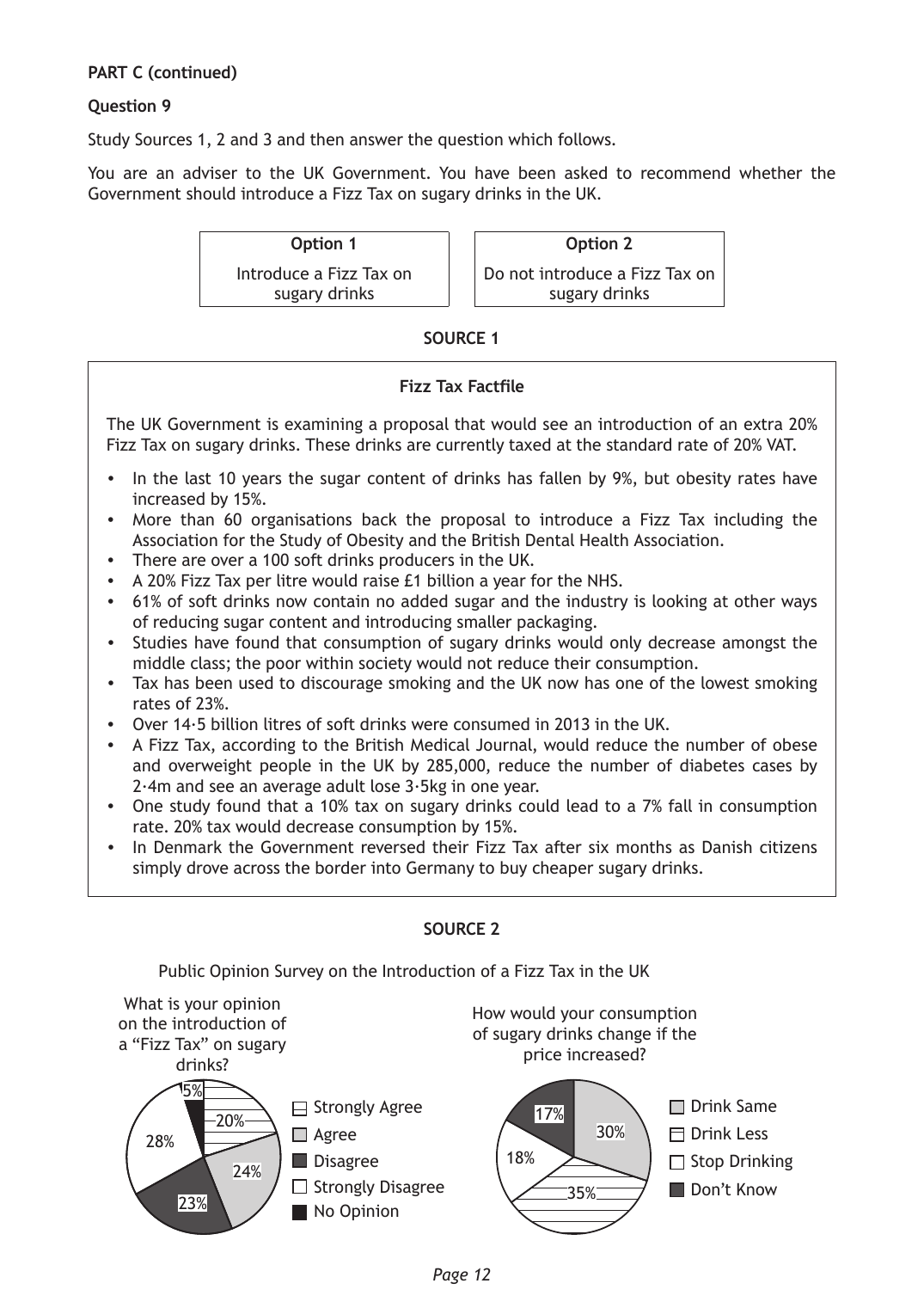
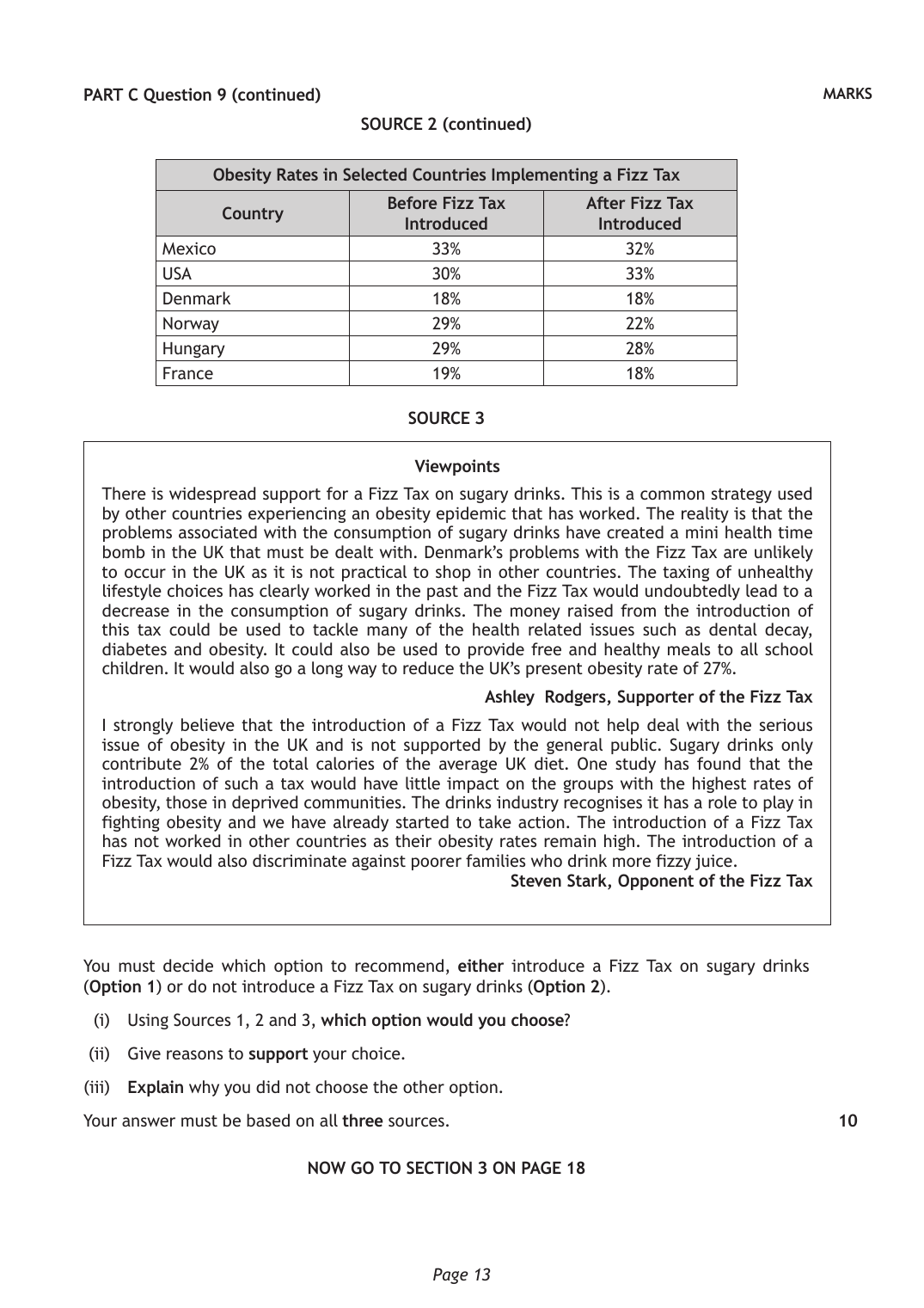
You are an adviser to the UK Government. You have been asked to recommend whether the Government should introduce a Fizz Tax on sugary drinks in the UK.

Option 1

Introduce a Fizz Tax on sugary drinks

Option 2

Do not introduce a Fizz Tax on sugary drinks

You must decide which option to recommend, either introduce a Fizz Tax on sugary drinks (Option 1) or do not introduce a Fizz Tax on sugary drinks (Option 2).

(i) Using Sources 1, 2 and 3, which option would you choose?

(ii) Give reasons to support your choice.

(iii) Explain why you did not choose the other option.

Your answer must be based on all three sources.

Sources (Source 1, Source 2, Source 3)

Source page 1 for this questionSource page 2 for this question
📝 Structure template — how to structure your answer

Decision making · A source-based skills question

WFQ (words from the question)

  1. I chose insert option name.
  2. Evidence to support this is in insert source which says/shows “insert evidence”.✓ 1 mark per piece of evidence (up to 8)
  3. This is further supported by evidence in insert source which says/shows “insert evidence”. (Repeat until you have 8 pieces of evidence = 8 marks.)
  4. Rebuttal: I rejected insert option name because insert source says/shows “insert evidence”.✓ needed for full marks

How it's marked

  • Up to 3 marks for a developed justification; credit highly where you link evidence between sources.
  • For full marks you must justify your decision AND explain why you rejected the other option.
  • Maximum 8 marks if you only deal with one option.
  • Aim for around 8 pieces of evidence to build up the marks.
  • Don’t forget the rebuttal — say why you rejected the other option.
✓ Reveal marking scheme
Max 10 marks

These are possible/exemplar answers from the marking instructions — other valid points can also gain marks.

How marks are awarded
  • The candidate is required to evaluate a limited range of sources, in order to make and justify a decision/recommendation. The candidate must also explain why they have rejected the other option.
  • In order to achieve full marks candidates must say why they did not choose the other option. An answer which deals with only one option should be awarded a maximum of 8 marks.

Option 1: Introduce a Fizz Tax on sugary drinks

  1. The Government should introduce a Fizz Tax as Ashley Rodgers states that there is wide spread support for a Fizz Tax on sugary drinks. This is supported by the Factfile which states that more than 60 organisations back the proposal, including the Study of Obesity and the British Dental Health Association. This is further supported by Source 1 when it states according to the British Medical Journal, a Fizz Tax, would reduce the number of diabetes cases by 2.4m and see an average adult lose 3.5kg in one year. [3 Marks – detailed evidence linked from Sources 1& 3]

Option 1 — Credit reference to aspects of the following

  1. A 20p Fizz Tax per litre would raise £1 billion a year for the NHS (S1)
  2. Tax has been used to discourage smoking and the UK now has one of the lowest smoking rates of 23% (S1)
  3. One study found that a 10% tax on sugary drinks could lead to a 7% consumption rate. 20% tax would decrease consumption by 15% (S1)
  4. 35% of people said they would drink less sugary drinks if the price increased and 18% said they would stop drinking fizzy drinks (S2)
  5. A Fizz Tax has worked in Norway, obesity has decreased from 29% to 22% (S2)
  6. Sugary Drinks creating a 'mini health time bomb'(S3)

Reasons for rejecting the other option (Option 1 chosen)

  1. I rejected option 2, not to introduce a fizz Tax, because Source 3 shows that the taxing of unhealthy lifestyle choices has clearly worked in the past so we must introduce the tax. [1 mark awarded for use of one piece of information with no linking. Do not credit if marks have already been awarded for this point]

Option 2: Do not introduce a Fizz Tax on sugary drinks

  1. The Government should not introduce a Fizz Tax on sugary drinks as 61% of soft drinks now contain no added sugar and the industry is looking at other ways of reducing sugar. [1 mark – evidence drawn from Source 1]
  2. The Government should not introduce a Fizz Tax on sugary drinks as one study has found that the introduction of such a tax would have little impact on the groups with the highest rates of obesity, those in deprived communities and this is supported as studies have found that consumption on sugary drinks would only decrease amongst the middle class: the poor within society would not reduce their consumption. [2 marks – evidence linked from Sources 1&3]

Option 2 — Credit reference to aspects of the following

  1. In the last 10 years the sugar content of drinks has fallen by 9%, but obesity rate have increased by 15% (S1)
  2. In Denmark the Government reversed their Fizz Tax six months later as Danish citizens simply crossed the border to buy cheaper sugary drinks elsewhere. (S1) linked to source 2 showing obesity in Denmark stay the same at 18%.
  3. Fizz Tax not supported by the public as Public Opinion poll – 51% either disagree or strongly disagree (S2)
  4. Drinks industry already started to take action (S3)
  5. Sugary drinks only account for 2% of the total calories of the average UK diet (S3)

Reasons for rejecting the other option (Option 2 chosen)

  1. I rejected the option to introduce the Fizz Tax as Ashley Roger states this is a common strategy used by other countries experiencing an obesity epidemic that has worked however source 2 highlights that before the fizz tax was introduced in the USA obesity rates were 30%, yet they increased to 33% after the fizz tax was introduced, which is evidence that it in fact does not work. [3 marks – evidence drawn from two sources, with evaluative comment]
Decision making10 marks2016Q12⏳ Older formatSocial Issues in the United Kingdom

Study Sources 1, 2 and 3 and then answer the question which follows.

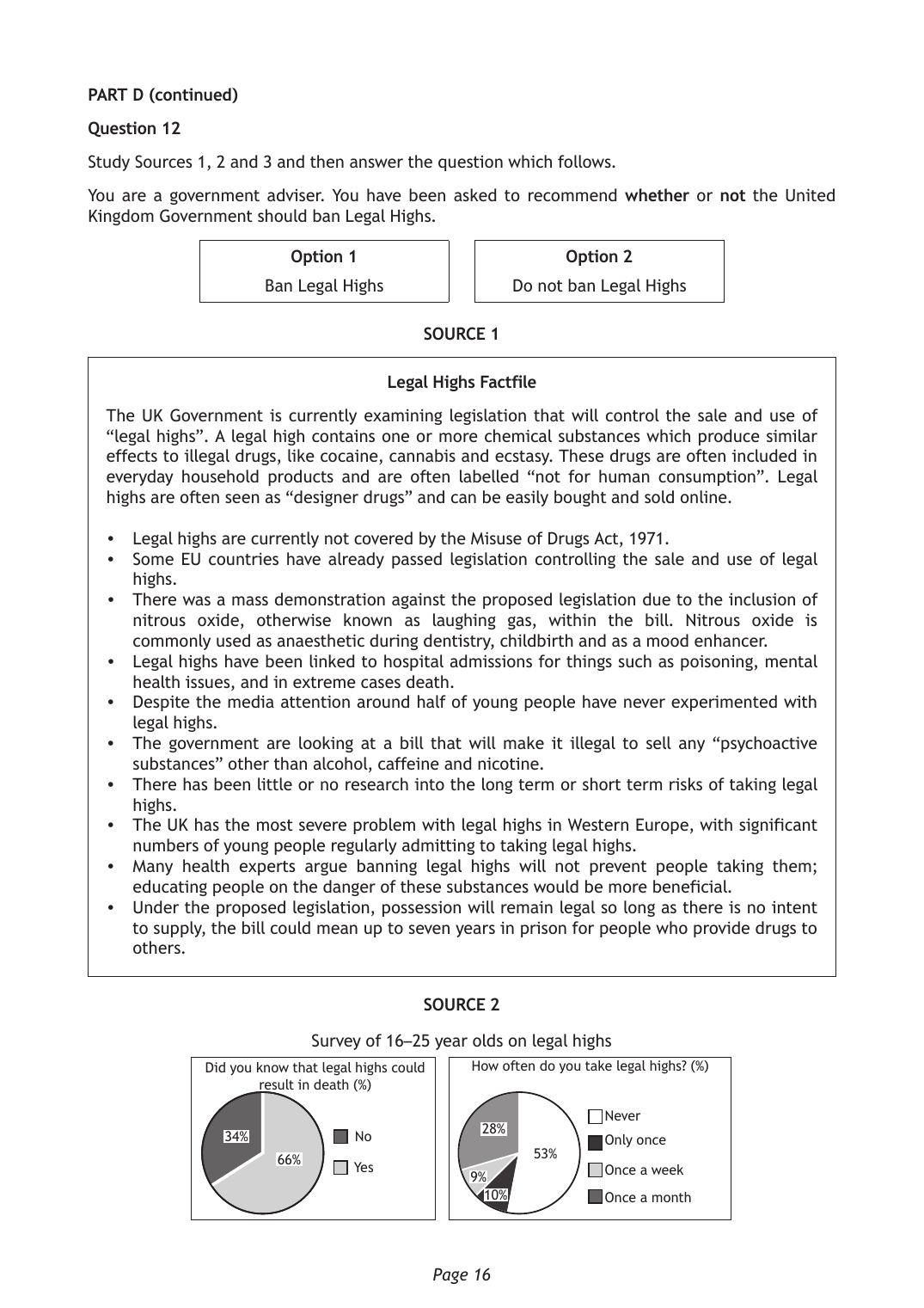
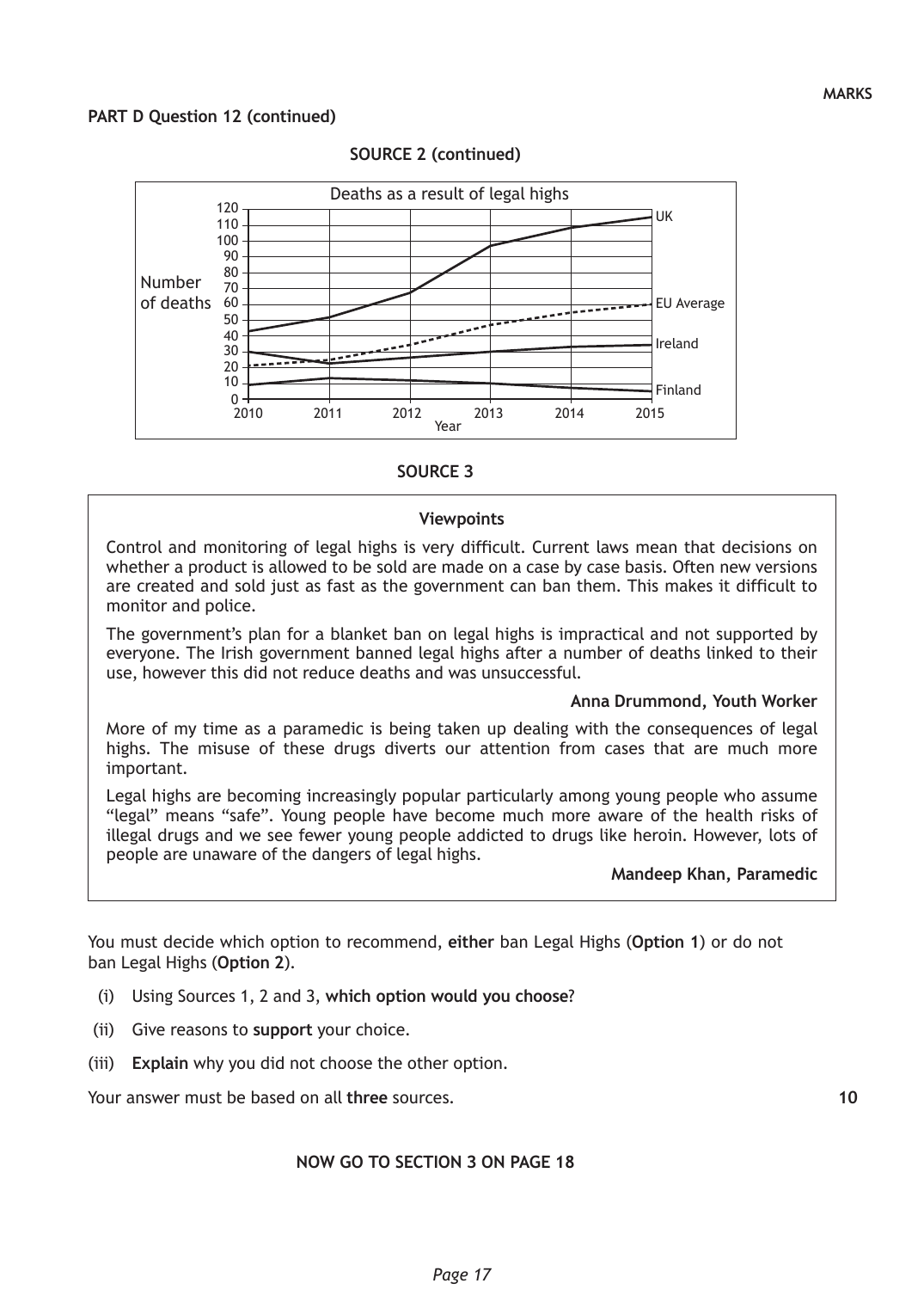
You are a government adviser. You have been asked to recommend whether or not the United Kingdom Government should ban Legal Highs.

Option 1

Ban Legal Highs

Option 2

Do not ban Legal Highs

You must decide which option to recommend, either ban Legal Highs (Option 1) or do not ban Legal Highs (Option 2).

(i) Using Sources 1, 2 and 3, which option would you choose?

(ii) Give reasons to support your choice.

(iii) Explain why you did not choose the other option.

Your answer must be based on all three sources.

Sources (Source 1, Source 2, Source 3)

Source page 1 for this questionSource page 2 for this question
📝 Structure template — how to structure your answer

Decision making · A source-based skills question

WFQ (words from the question)

  1. I chose insert option name.
  2. Evidence to support this is in insert source which says/shows “insert evidence”.✓ 1 mark per piece of evidence (up to 8)
  3. This is further supported by evidence in insert source which says/shows “insert evidence”. (Repeat until you have 8 pieces of evidence = 8 marks.)
  4. Rebuttal: I rejected insert option name because insert source says/shows “insert evidence”.✓ needed for full marks

How it's marked

  • Up to 3 marks for a developed justification; credit highly where you link evidence between sources.
  • For full marks you must justify your decision AND explain why you rejected the other option.
  • Maximum 8 marks if you only deal with one option.
  • Aim for around 8 pieces of evidence to build up the marks.
  • Don’t forget the rebuttal — say why you rejected the other option.
✓ Reveal marking scheme
Max 10 marks

These are possible/exemplar answers from the marking instructions — other valid points can also gain marks.

How marks are awarded
  • The candidate is required to evaluate a limited range of sources, in order to make and justify a decision/recommendation. The candidate must also explain why they have rejected the other option.
  • In order to achieve full marks candidates must say why they did not choose the other option. An answer which deals with only one option should be awarded a maximum of 8 marks.

Option 1: Ban Legal Highs

  1. The Government should ban Legal Highs as legal highs have been linked to hospital admissions for things such as poisoning, mental health issues, and in extreme cases death. [1 mark—evidence drawn from Source 1]
  2. The Government should ban Legal Highs as legal highs have been linked to hospital admissions for things such as poisoning, mental health issues, and in extreme cases death. This is backed up in Source 2 which shows that there has been an increase in deaths as a result of legal highs. [2 marks—evidence linked from Source 1 and Source 2]
  3. The Government should ban Legal Highs as legal highs have been linked to hospital admissions for things such as poisoning, mental health issues, and in extreme cases death. This is backed up in Source 2 which shows that there has been an increase in deaths as a result of legal highs. The increase in deaths has gone from just over 40 to almost 120, which is almost triple the number. [3 marks—evidence linked from Source 1 and 2 with evaluative comment]

Option 1 — Credit reference to aspects of the following

  1. These drugs are often included in everyday household products and are often labelled not for human consumption (S1)
  2. Mandeep Khan states that "more of my time as a paramedic is being taken up dealing with the consequences of legal highs. The misuse of these drugs diverts our attention from cases that are much more important.

Reasons for rejecting the other option (Option 1 chosen)

  1. I rejected Option 2 as although source 2 states 66% of young people know that legal highs could result in death source 1 highlights that the UK has the most severe problem with legal highs in Western Europe, with significant numbers of young people regularly admitting to taking legal highs [2 marks – evidence linked from source 1 & 2]

Option 2: Do not ban Legal Highs

  1. The Government should not ban Legal Highs as in a recent survey, the majority (53%) of 16-25 year olds stated that they had never taken legal highs with a further 10% only ever having taken them once (S2). This is supported by Source 1 when it states that despite media attention around half of young people have never experimented with legal highs. [2 marks—evidence linked from Source 1 and Source 2]

Option 2 — Credit reference to aspects of the following

  1. Control and monitoring of Legal Highs is very difficult (S3)
  2. Often new versions are created and sold just as fast as the government can ban them (S3)
  3. There has been little or no research into the long term or short term risks of taking Legal Highs (S1)

Reasons for rejecting the other option (Option 2 chosen)

  1. I rejected Option 1 as although Mandeep Khan states that lots of people are unaware of the dangers of legal highs source 2 highlights that 66% of young people know that legal highs result in death. [2 marks—evidence linked from Source 2 and 3]
Source: 2016 N5 History · X749/75/11 · Q12Question paper (PDF, p.17) ↗Marking instructions (PDF, p.20) ↗