Every question from the 2019 paper. Refine by section, topic or question type.
View
Showing 41 of 41 questions
Describe, in detail4 marks2019Q1Democracy in Scotland
The Scottish Parliament has responsibility for devolved matters.
Describe, in detail, two devolved matters the Scottish Parliament has responsibility for.
WFQ = words from the question — reuse in every point.
📝 Structure template — how to structure your answer▾
Describe, in detail · A knowledge (KU) question · use PEE
Remember PEE
•Point — make your point
•Explanation — develop it
•Example — a specific, recent example
WFQ (words from the question)
One words from the question is insert point.✓ 1 mark — Point
This means that … (explain your point).✓ 1 mark — Explanation
For example, … (give a specific, recent example).✓ 1 mark — Example
Then repeat with a second point — two developed points are needed for full marks.
How it's marked
1 mark for an accurate but undeveloped point (P).
+1 mark for developing/explaining it (E).
+1 mark for a specific example (E). Up to 3 marks per description; two descriptions needed for full marks.
💡The example is where learners most often drop the mark — always add “For example, …”.
✓ Reveal marking scheme▾
Max 4 marks
These are possible/exemplar answers from the marking instructions — other valid points can also gain marks.
How marks are awarded
Award up to 3 marks for a single description, depending on quality, level of detail, relevance, accuracy and exemplification.
Two descriptions are necessary for full marks.
Possible approaches to answering the question
The Scottish Parliament is responsible for the matter of education. (1 mark — accurate but undeveloped point)
The Scottish Parliament is responsible for the matter of education. MSPs can discuss and make changes to the education system in Scotland. (2 marks — accurate point with development)
The Scottish Parliament is responsible for the matter of education. MSPs can discuss and make changes to the education system in Scotland. For example, the Scottish Parliament Education and Skills committee is currently investigating how successful Curriculum for Excellence has been. (3 marks — accurate point with development and exemplification)
Credit reference to aspects of the following
devolved matters such as agriculture, forestry and fisheries
Describe, in detail4 marks2019 specimenQ1⏳ Older formatDemocracy in Scotland
Groups which try to influence the Scottish Government: Pressure Groups; Trades Unions; The Media.
Choose one of the groups above. Describe, in detail, two ways in which the group you have chosen tries to influence the Scottish Government.
WFQ = words from the question — reuse in every point.
📝 Structure template — how to structure your answer▾
Describe, in detail · A knowledge (KU) question · use PEE
Remember PEE
•Point — make your point
•Explanation — develop it
•Example — a specific, recent example
WFQ (words from the question)
One words from the question is insert point.✓ 1 mark — Point
This means that … (explain your point).✓ 1 mark — Explanation
For example, … (give a specific, recent example).✓ 1 mark — Example
Then repeat with a second point — two developed points are needed for full marks.
How it's marked
1 mark for an accurate but undeveloped point (P).
+1 mark for developing/explaining it (E).
+1 mark for a specific example (E). Up to 3 marks per description; two descriptions needed for full marks.
💡The example is where learners most often drop the mark — always add “For example, …”.
✓ Reveal marking scheme▾
Max 4 marks
These are possible/exemplar answers from the marking instructions — other valid points can also gain marks.
How marks are awarded
Award up to three marks for a single description, depending on quality, level of detail, relevance, accuracy and exemplification. At least two descriptions are necessary for full marks.
Possible approaches to answering the question:
Pressure groups try to influence the Scottish Government by having a demonstration, lobbying, petitions and getting media attention. [2 marks awarded in total—list type answer]
Trades Unions can try to influence the Government by going on strike, for example NHS doctors have threatened industrial action. [2 marks for a single point plus relevant example]
Newspapers can try to influence the Government by printing stories that are very critical of the Government. Bad publicity can make the Government unpopular, for example when the Daily Record started a campaign against organised crime hoping that the Scottish Government and courts would clamp down. [3 marks for a developed point with exemplification]
Credit reference to aspects of the following: Pressure Groups
Demonstrations/protest, eg recent protests by the SDL and UAF outside the Scottish Parliament.
Petitions—including e-petitions and submissions to the petitions committee.
Actions to attract media attention, eg campaign for safer cycle routes using celebrities such as Chris Hoy in a mass cycle ride through Edinburgh.
Lobbying—contacting elected members of the parliament in order to try to gain their support. This can be done by pressure groups themselves or they may employ advisors, ie professional lobbyists.
Direct action—disruptive and often illegal forms of protest, eg the Faslane peace camp.
Trades Unions
Industrial action such as strikes, work to rule, overtime bans. This may be especially effective in the public sector, eg proposed action by NHS doctors.
Demonstrations/protest—recent demonstrations organised by teaching unions.
Actions to attract media attention, eg prison officers protesting outside their prisons.
The Media
Newspapers supporting/opposing campaigns by pressure groups, eg recent highlighting of new medical tests introduced for disability benefits.
Newspapers supporting/opposing a particular political party during election campaigns, eg the changing support of the Sun newspaper in recent elections.
Newspapers highlighting what they see as Government incompetence/achievements, eg coverage of debate over continuation of universal benefits.
Broadcast media strictly controlled by legislation so cannot attempt to influence the Government.
Describe, in detail6 marks2019Q2Democracy in Scotland
Individuals have rights in a democracy.
Describe, in detail, two rights individuals have in a democracy.
WFQ = words from the question — reuse in every point.
📝 Structure template — how to structure your answer▾
Describe, in detail · A knowledge (KU) question · use PEE
Remember PEE
•Point — make your point
•Explanation — develop it
•Example — a specific, recent example
WFQ (words from the question)
One words from the question is insert point.✓ 1 mark — Point
This means that … (explain your point).✓ 1 mark — Explanation
For example, … (give a specific, recent example).✓ 1 mark — Example
Then repeat with a second point — two developed points are needed for full marks.
How it's marked
1 mark for an accurate but undeveloped point (P).
+1 mark for developing/explaining it (E).
+1 mark for a specific example (E). Up to 3 marks per description; two descriptions needed for full marks.
💡The example is where learners most often drop the mark — always add “For example, …”.
✓ Reveal marking scheme▾
Max 6 marks
These are possible/exemplar answers from the marking instructions — other valid points can also gain marks.
How marks are awarded
Award up to 3 marks for a single description, depending on quality, level of detail, relevance, accuracy and exemplification.
Two descriptions are necessary for full marks.
Possible approaches to answering the question
Individuals in Scotland have the right to protest. (1 mark — accurate but undeveloped point)
Individuals in Scotland have the right to protest. They can hold demonstrations against laws they disagree with. (2 marks — accurate point with development)
Individuals in Scotland have the right to protest. They can hold demonstrations against laws they disagree with. For example, people who disagreed with the Offensive Behaviour at Football Act, such as the pressure group Fans Against Criminalisation, held marches and demonstrations in Glasgow as part of their protests against this law. (3 marks — accurate point with development and exemplification)
Credit reference to aspects of the following
the right to a fair trial
the right to privacy
the right to vote
the right to education and healthcare
the right to join a pressure group
the right to join a political party
the right to protest
the right to lobby a representative
freedom of expression
freedom of religion or conscience
freedom of assembly
freedom from torture, inhuman or degrading treatment and slavery.
Explain, in detail8 marks2019 specimenQ2⏳ Older formatDemocracy in Scotland
The Additional Member System (AMS), used to elect the Scottish Parliament, has both advantages and disadvantages.
Explain, in detail, the advantages and disadvantages of the Additional Member System (AMS) which is used to elect the Scottish Parliament.
WFQ = words from the question — reuse in every point.
📝 Structure template — how to structure your answer▾
Explain, in detail · A knowledge (KU) question · use PEE (+ analysis)
Remember PEE
•Point — give your reason
•Explanation — “this means that…”
•Example — a specific, recent example
WFQ (words from the question)
One reason words from the question is insert point.✓ 1 mark — Point
This means that … (explain the reason).✓ 1 mark — Explanation
For example, … (give a specific, recent example).✓ 1 mark — Example
This is important because … (analysis — how it links to other factors).✓ 1 mark — Analysis
Then repeat with a second reason — a maximum of two explanations are credited.
How it's marked
1 mark for an accurate but undeveloped reason (P).
+1 for explanation (E), +1 for a specific example (E), +1 for analysis. Up to 4 marks per explanation.
A maximum of two explanations are credited.
💡Build each reason: Point → Explanation → Example → Analysis.
✓ Reveal marking scheme▾
Max 8 marks
These are possible/exemplar answers from the marking instructions — other valid points can also gain marks.
How marks are awarded
Award up to four marks for a single explanation, depending on quality, level of detail, relevance, accuracy, exemplification and answers which show the interaction of various factors.
Candidates who only explain either advantages or disadvantages should be awarded a maximum of six marks.
Possible approaches to answering the question:
An advantage of the additional member system is that it is a fairly proportional system. [1 mark]
An advantage of AMS is that it provides better representation as it gives voters a choice of MSP to consult. [2 marks—developed point]
An advantage of AMS is that it provides better representation as it gives voters a choice of MSP to consult. In any constituency you have a constituency and list MSPs. [3 marks—well developed point]
An advantage of AMS is that it is a system where voters have two votes. One vote uses the first past the post system so you have a directly elected MSP for the constituency and the other vote uses the list system to elect regional MSPs. This means AMS provides the advantages of both systems. [4 marks—developed points with some detail and analysis]
Credit reference to aspects of the following: Advantages
More proportional—Scottish elections have had a closer correlation between votes and seats.
Retains elements of FPTP so some direct representation—voters in every constituency know who to contact.
Greater choice—each voter can contact a number of MSPs due to the regional list element.
Smaller parties can be successful, eg Greens in Scottish Parliament.
Disadvantages
Too many representatives—129 MSPs is seen by many as a “top heavy” system.
Representatives to parliament elected under two different systems thus creating almost a “two tier” system of MSPs.
System more complex than FPTP so may more difficult for many voters to understand.
Retention of FPTP element still allows some parties to dominate disproportionately, eg SNP dominating this ballot.
Explain, in detail6 marks2019Q3Democracy in Scotland
Political parties use the media during election campaigns in Scotland.
Explain, in detail, two reasons why political parties use the media during election campaigns in Scotland.
WFQ = words from the question — reuse in every point.
📝 Structure template — how to structure your answer▾
Explain, in detail · A knowledge (KU) question · use PEE (+ analysis)
Remember PEE
•Point — give your reason
•Explanation — “this means that…”
•Example — a specific, recent example
WFQ (words from the question)
One reason words from the question is insert point.✓ 1 mark — Point
This means that … (explain the reason).✓ 1 mark — Explanation
For example, … (give a specific, recent example).✓ 1 mark — Example
This is important because … (analysis — how it links to other factors).✓ 1 mark — Analysis
Then repeat with a second reason — a maximum of two explanations are credited.
How it's marked
1 mark for an accurate but undeveloped reason (P).
+1 for explanation (E), +1 for a specific example (E), +1 for analysis. Up to 4 marks per explanation.
A maximum of two explanations are credited.
💡Build each reason: Point → Explanation → Example → Analysis.
✓ Reveal marking scheme▾
Max 6 marks
These are possible/exemplar answers from the marking instructions — other valid points can also gain marks.
How marks are awarded
Award up to 4 marks for a single explanation depending on quality, level of detail, relevance, accuracy, exemplification and answers which show the interaction of various factors.
A maximum of two explanations should be credited.
Possible approaches to answering the question
Political parties use the media during election campaigns in Scotland to gain support. (1 mark — accurate but undeveloped point)
Political parties use the media during election campaigns in Scotland to gain support. They hope this will give them a better chance of winning the election. (2 marks — accurate point with development)
Political parties use the media during election campaigns in Scotland to gain support. They hope this will give them a better chance of winning the election. For example, during an election campaign, Scottish Labour may use social media such as YouTube to promote their policies by posting short video clips. (3 marks — accurate point with development and exemplification)
Political parties use the media during election campaigns in Scotland to gain support. They hope this will give them a better chance of winning the election. For example, during an election campaign, Scottish Labour may use social media such as YouTube to promote their policies by posting short video clips. This method appeared to be successful for the Labour Party during the 2017 general election as many younger voters who voted Labour said they were influenced by social media. (4 marks — accurate point with development, exemplification and analysis)
Credit reference to aspects of the following
engage with younger voters via social media platforms
use of 'attack' advertising to discredit opposition
create publicity for the campaign message via soundbites
Party Election Broadcasts (PEBs) promote manifesto pledges to voters
printed press allegiance supports campaign at expense of other parties
mobilise grassroot supporters via social media to organise local campaigns
deliver campaign messages to those unable to be reached through traditional methods, such as canvassing, to attempt to increase turnout.
Conclusions10 marks2019Q7Democracy in Scotland and the UK
Study Sources 1, 2 and 3 and then answer the question which follows.
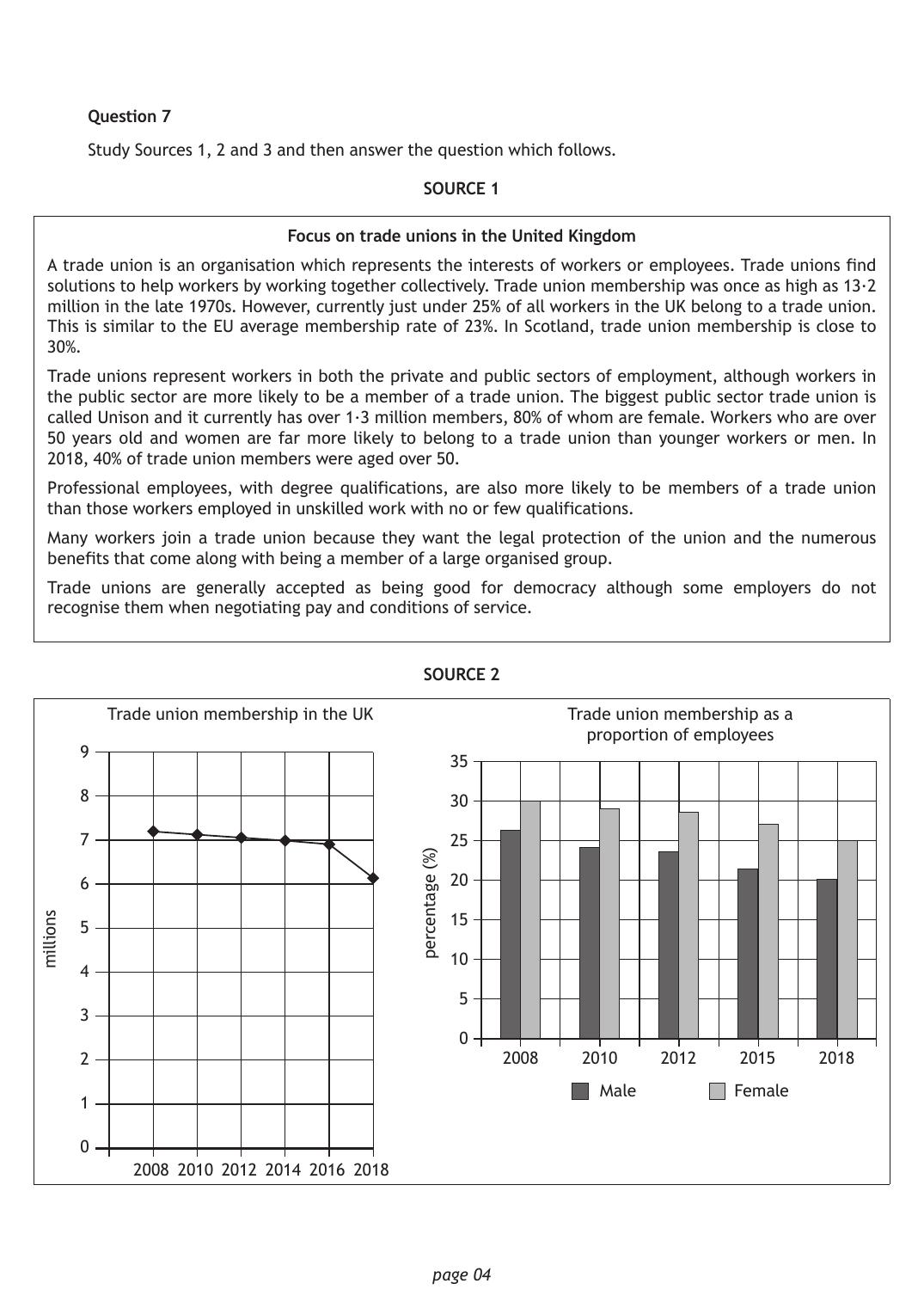
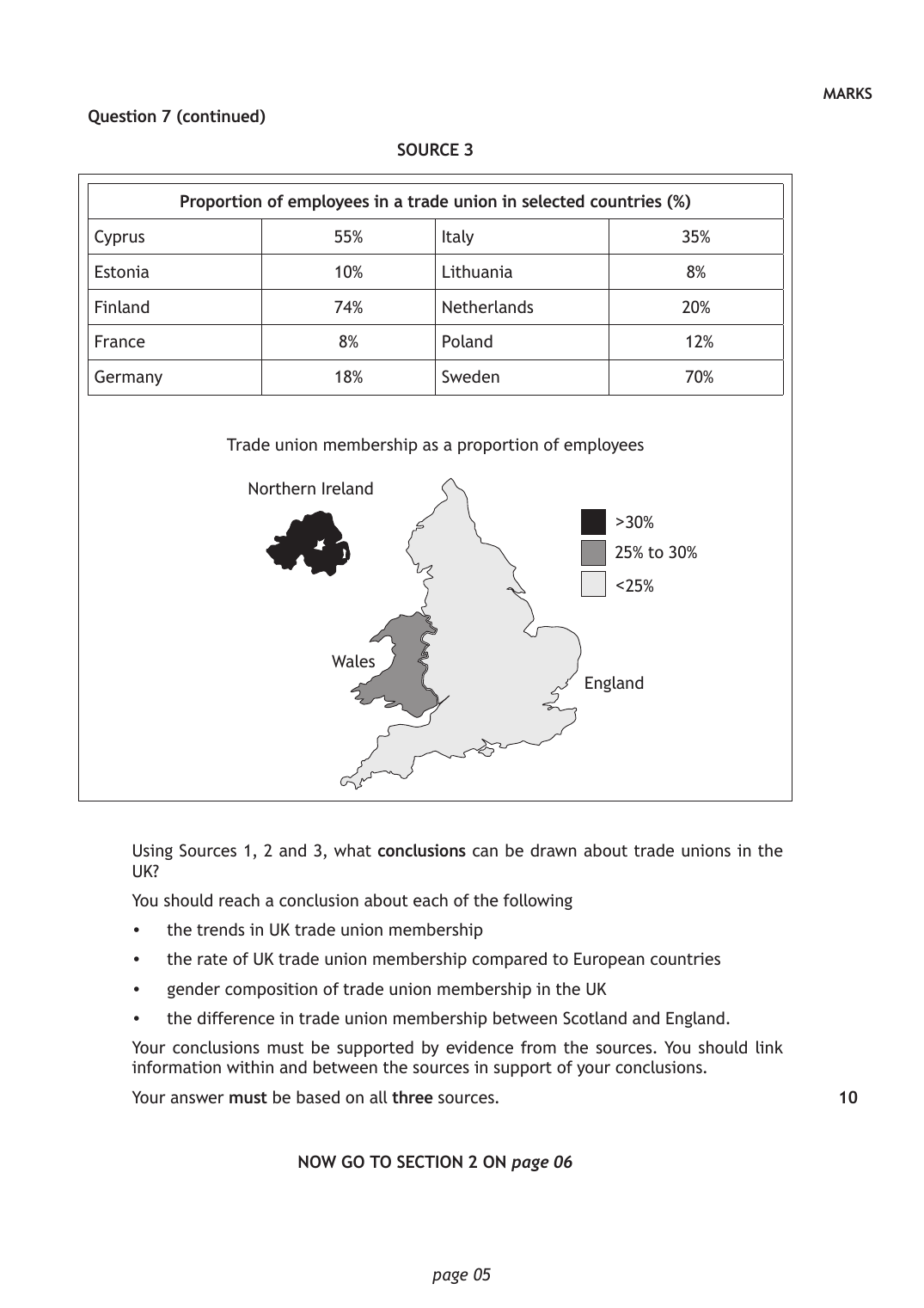
Using Sources 1, 2 and 3, what conclusions can be drawn about trade unions in the UK?
You should reach a conclusion about each of the following
the trends in UK trade union membership
the rate of UK trade union membership compared to European countries
gender composition of trade union membership in the UK
the difference in trade union membership between Scotland and England.
Your conclusions must be supported by evidence from the sources. You should link information within and between the sources in support of your conclusions.
Your answer must be based on all three sources.
Sources (Source 1, Source 2, Source 3)
📝 Structure template — how to structure your answer▾
Conclusions · A source-based skills question
WFQ (words from the question)
For EACH bullet point in the question, write the bullet point as a subheading, then:
One conclusion that can be made about insert bullet point is insert valid conclusion.✓ 1 mark — valid conclusion
Evidence to support this is shown in insert source which says/shows “insert evidence”.✓ 1 mark — evidence
This clearly shows / strongly suggests insert valid conclusion — evaluative language earns the 3rd mark.✓ 1 mark — evaluative language
How it's marked
Conclusion + one piece of evidence = 2 marks. That is all you need for two of the three marks.
The 3rd mark does NOT come from a second piece of evidence linked to the same point — it comes from using evaluative terminology (e.g. “this clearly shows”, “the strongest evidence is”, “significantly”, “overwhelmingly”).
Comparison bullets (e.g. the UK compared with another country): you must give evidence about BOTH sides — but two pieces of evidence together still earn only ONE evidence mark, not two. You can still earn the 3rd mark with evaluative language, exactly as normal.
Up to 3 marks per bullet point; four conclusions (one per bullet point) are needed for full marks (10).
💡Tip: turn each bullet point into a question (e.g. “What is…?”, “What are…?”, “Which…?”, “How…?”) — the answer you give is your conclusion.
💡Conclusion + evidence = 2 marks. For the 3rd mark add evaluative language — a second quote linked to the same point does NOT earn it.
💡For a comparison bullet you must back BOTH sides with evidence — but that is still only one evidence mark, not two. The 3rd mark still comes from evaluative language.
✓ Reveal marking scheme▾
Max 10 marks
These are possible/exemplar answers from the marking instructions — other valid points can also gain marks.
How marks are awarded
The candidate is required to use a limited range of sources and draw valid conclusions from them, with supporting evidence.
Candidates should draw conclusions using the headings/bullet points in the question.
Candidates should be highly credited if they draw conclusions which show interaction between the sources.
For full marks, four developed conclusions must be given.
THE TRENDS IN UK TRADE UNION MEMBERSHIP
Conclusion: Trade union membership in the UK has decreased. (1 mark — valid conclusion)
Conclusion: Trade union membership in the UK has decreased. Evidence: In Source 2 it shows that in 2008, trade union membership was just over 7 million but by 2018 it had fallen to just over 6 million. (2 marks — conclusion and evidence from one source)
Conclusion: Trade union membership in the UK has decreased. Evidence: In Source 2 it shows that in 2008 trade union membership was just over 7 million but by 2018 it had fallen to just over 6 million. This can be linked to Source 1 that states that trade union membership was once as high as 13·2 million, meaning that membership has more than halved in total since the late 1970s. (3 marks — conclusion and evidence from two sources with evaluative terminology)
THE RATE OF UK TRADE UNION MEMBERSHIP COMPARED TO EUROPEAN COUNTRIES
Conclusion: Trade union membership in the UK is higher than many other European countries. (1 mark — valid conclusion)
Conclusion: Trade union membership in the UK is higher than many other European countries. Evidence: In Source 1 it shows that just under 25% of all workers in the UK are members of trade unions. According to Source 3, this is higher than many other European countries such as Germany, Poland, France and Lithuania. (2 marks — conclusion and evidence from two sources)
Conclusion: Trade union membership in the UK is higher than many other European countries. Evidence: In Source 1 it shows that just under 25% of all workers in the UK are members of trade unions. According to Source 3, this is higher than many other European countries such as Germany, France and Lithuania. France has only 8% of employees in trade unions, this is around 17% lower than the UK which is a significant difference. (3 marks — conclusion and evidence from two sources with evaluative terminology)
GENDER COMPOSITION OF TRADE UNION MEMBERSHIP IN THE UK
Conclusion: Women are more likely than men to belong to a trade union in the UK. (1 mark — valid conclusion)
Conclusion: Women are more likely than men to belong to a trade union in the UK. Evidence: In Source 1 it states that women are more likely to belong to a trade union then men and in some trade unions, such as Unison, women account for the majority of members. (2 marks — conclusion and evidence from one source)
Conclusion: Women are more likely than men to belong to a trade union in the UK. Evidence: In Source 1 it states that women are more likely to belong to a trade union then men and in some trade unions, such as Unison, women account for the majority of members. This can be supported by Source 2 that shows female membership in the last ten years is consistently higher than male membership. For example, in 2018, 25% of women belonged to a trade union which was 5% higher than the rate for male membership. (3 marks — conclusion and information from two sources with evaluative terminology)
THE DIFFERENCE IN TRADE UNION MEMBERSHIP BETWEEN SCOTLAND AND ENGLAND
Conclusion: Trade union membership is higher in Scotland than in England. (1 mark — valid conclusion)
Conclusion: Trade union membership is higher in Scotland than in England. Evidence: Source 1 states trade union membership in Scotland is close to 30% but Source 3 shows England's trade union membership rate is less than 25%. (2 marks — conclusion and evidence from two sources)
Conclusion: Trade union membership is higher in Scotland than in England. Evidence: Source 1 states trade union membership in Scotland is close to 30% but Source 3 shows England's trade union membership rate is less than 25%. This shows that employees in England are less likely to belong to a trade union than employees in Scotland. (3 marks — conclusion and information from two sources with evaluative terminology)
Conclusions8 marks2019 specimenQ3⏳ Older formatDemocracy in Scotland and the United Kingdom
Study Sources 1, 2 and 3 below, then attempt the question which follows.
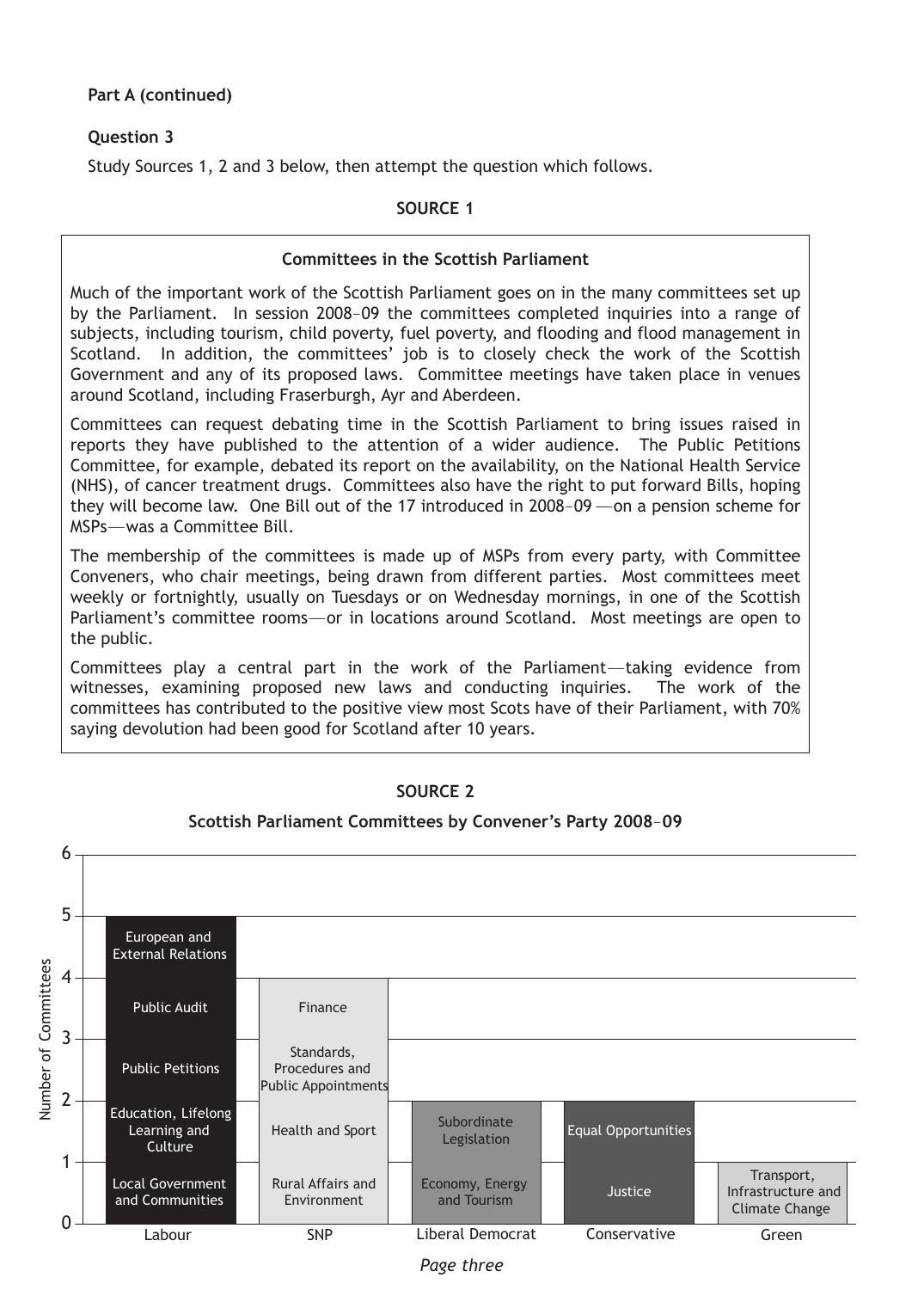
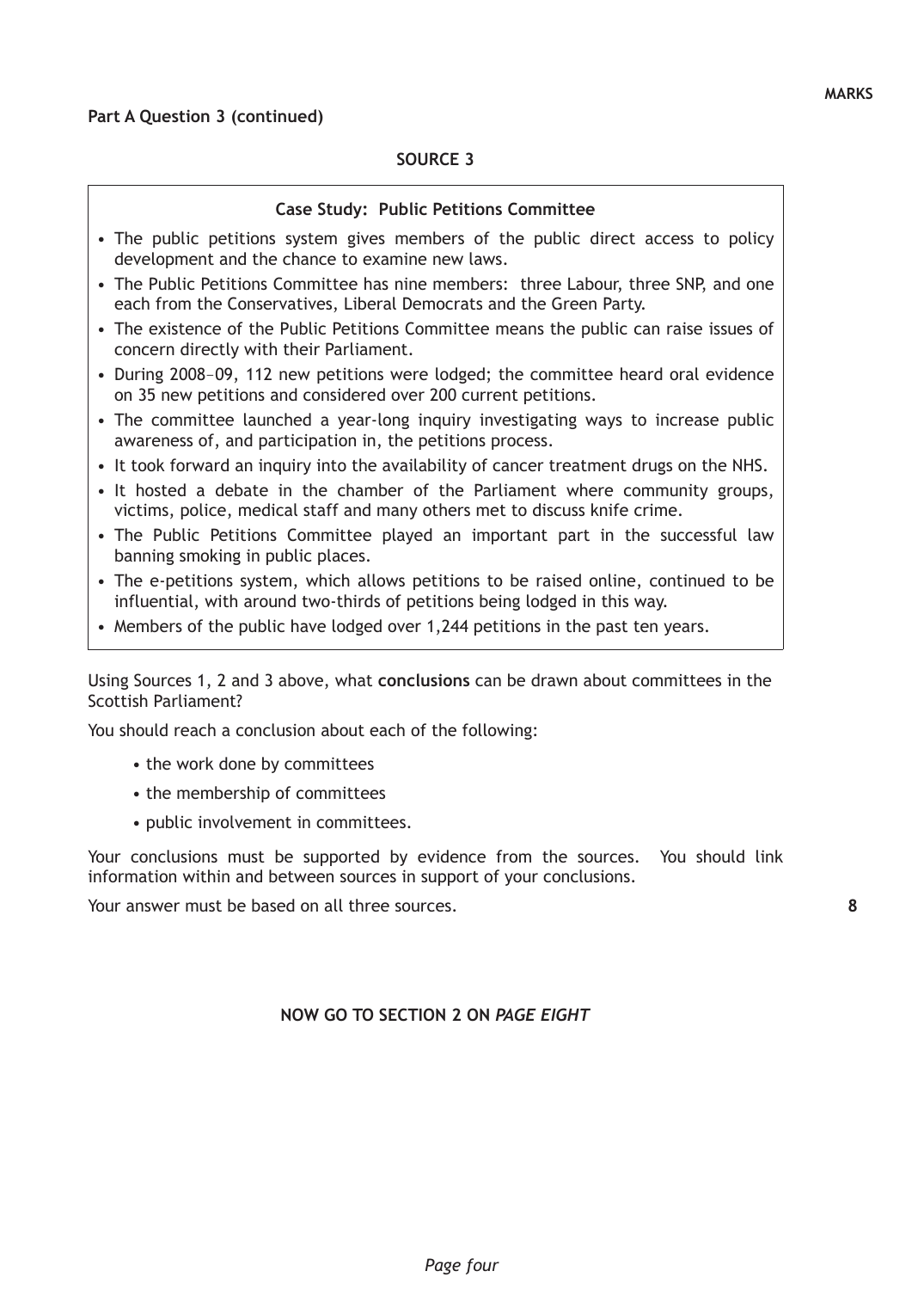
Using Sources 1, 2 and 3 above, what conclusions can be drawn about committees in the Scottish Parliament?
You should reach a conclusion about each of the following:
the work done by committees
the membership of committees
public involvement in committees.
Your conclusions must be supported by evidence from the sources. You should link information within and between sources in support of your conclusions.
Your answer must be based on all three sources.
Sources (Source 1, Source 2, Source 3)
📝 Structure template — how to structure your answer▾
Conclusions · A source-based skills question
WFQ (words from the question)
For EACH bullet point in the question, write the bullet point as a subheading, then:
One conclusion that can be made about insert bullet point is insert valid conclusion.✓ 1 mark — valid conclusion
Evidence to support this is shown in insert source which says/shows “insert evidence”.✓ 1 mark — evidence
This clearly shows / strongly suggests insert valid conclusion — evaluative language earns the 3rd mark.✓ 1 mark — evaluative language
How it's marked
Conclusion + one piece of evidence = 2 marks. That is all you need for two of the three marks.
The 3rd mark does NOT come from a second piece of evidence linked to the same point — it comes from using evaluative terminology (e.g. “this clearly shows”, “the strongest evidence is”, “significantly”, “overwhelmingly”).
Comparison bullets (e.g. the UK compared with another country): you must give evidence about BOTH sides — but two pieces of evidence together still earn only ONE evidence mark, not two. You can still earn the 3rd mark with evaluative language, exactly as normal.
Up to 3 marks per bullet point; four conclusions (one per bullet point) are needed for full marks (10).
💡Tip: turn each bullet point into a question (e.g. “What is…?”, “What are…?”, “Which…?”, “How…?”) — the answer you give is your conclusion.
💡Conclusion + evidence = 2 marks. For the 3rd mark add evaluative language — a second quote linked to the same point does NOT earn it.
💡For a comparison bullet you must back BOTH sides with evidence — but that is still only one evidence mark, not two. The 3rd mark still comes from evaluative language.
✓ Reveal marking scheme▾
Max 8 marks
These are possible/exemplar answers from the marking instructions — other valid points can also gain marks.
How marks are awarded
The candidate is required to use a limited range of sources and draw valid conclusions from them, with supporting evidence.
Candidates should draw conclusions using the headings/bullet points in the question.
Candidates should be highly credited if they draw conclusions which show interaction between the sources. Answers which merely repeat the source material without making judgements or drawing conclusions should be awarded zero marks.
For full marks, three developed conclusions must be given.
The work done by committees
Much of the important work of the Parliament is done in committees (Source 1). Committees on public audit, finance, justice etc (Source 2). Hosted debates on knife crime (Source 3). [1 mark awarded overall—no conclusion reached or judgement made. A series of relevant points arranged under a correct heading.]
Much of the important work of the Parliament done in committees (Source 1).
Completed inquiries into a range of subjects (Source 1).
Role of scrutinising the work of the Government and legislation (Source 1) link to paragraph 4 (Source 1).
Can request debating time (Source 1) link with (Source 3) debate on cancer treatment drugs.
Can introduce legislation—but only one in 2008–09 (Source 1).
Source 2 indicates the range of areas of interest of Committees, eg Finance, Public Petitions, Justice (Source 2).
2008-09 Public Petition Committee—112 new petitions lodged; considered over 200 petitions (Source 3).
Inquiry into availability of cancer treatment drugs (Source 3) link with (Source 1).
Hosted debates on knife crime (Source 3).
Possible conclusion—committees do a lot of work and play an important role in the work of the Scottish Parliament.
The membership of committees
The membership of the committees is made up of MSPs from every party. This is supported by evidence from Source 3 which says The Public Petitions Committee has 9 members; Labour 3, SNP 3, and one each from the Conservatives, Liberal Democrats and the Green Party. [2 marks. Conclusion given but taken from Source 1—supported by accurate and relevant evidence from Source 3.]
MSPs from every party are members of the committees (Source 1).
Committee Convenors, who chair meetings, drawn from different parties (Source 1) link with Source 2.
Conveners drawn from Conservative, Labour, SNP, Liberal Democrats and Greens (Source 2).
The Public Petitions Committee has 9 members; Labour 3, SNP 3, and one each from the Conservatives, Liberal Democrats and the Green Party (Source 3).
Possible conclusion—all parties play a role in the Committees.
Public involvement in committees
Members of the public are able to get involved in politics through the committee system. [original conclusion] This conclusion is supported by evidence from Source 1 which says that committee meetings have been held around Scotland in places such as Fraserburgh, Ayr and Aberdeen. This is further supported in Source 3 which says that the Public Petitions Committee system gives members of the public direct access to policy development and also that members of the public have lodged over 1,244 petitions in the last 10 years. [3 marks awarded]
Committee meetings have taken place in venues around Scotland, including Fraserburgh, Ayr and Aberdeen (Source 1).
Most committees meet weekly or fortnightly in one of the Scottish Parliament’s committee rooms—or in locations around Scotland (Source 1).
Most meetings are open to the public (Source 1).
The public petitions system provides members of the public with direct access to the policy development and scrutiny process (Source 3).
The existence of the Public Petitions Committee means that petitioners can raise issues of concern directly with their Parliament (Source 3).
The committee launched a year-long inquiry investigating ways to increase public awareness of, and participation in, the petitions process (Source 3).
The e-petitions system, which allows petitions to be raised online, continued to be influential, with around two-thirds of petitions being lodged in this form (Source 3).
1,244 petitions have been lodged by members of the public over 10 years (Source 3).
Possible conclusion—the committees are open to the public and the public can participate in a variety of ways.
Conclusions8 marks2019 specimenQ3⏳ Older formatDemocracy in Scotland and the United Kingdom
Study Sources 1, 2 and 3 below, then attempt the question which follows.
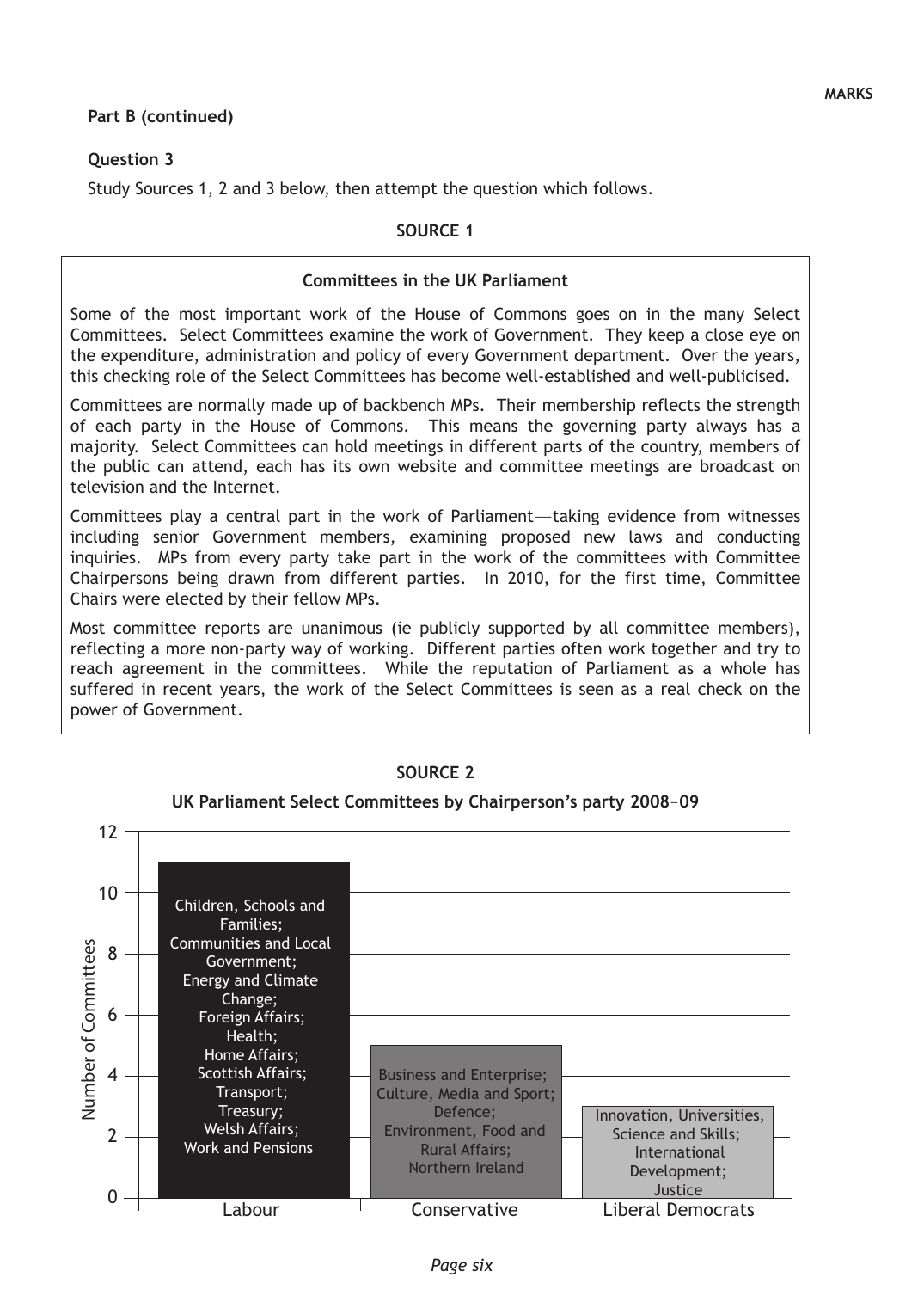
Using Sources 1, 2 and 3 above, what conclusions can be drawn about committees in the UK Parliament?
You should reach a conclusion about each of the following:
the work done by committees
the membership of committees
public involvement in committees.
Your conclusions must be supported by evidence from the sources. You should link information within and between sources in support of your conclusions.
Sources (Source 1, Source 2, Source 3)
📝 Structure template — how to structure your answer▾
Conclusions · A source-based skills question
WFQ (words from the question)
For EACH bullet point in the question, write the bullet point as a subheading, then:
One conclusion that can be made about insert bullet point is insert valid conclusion.✓ 1 mark — valid conclusion
Evidence to support this is shown in insert source which says/shows “insert evidence”.✓ 1 mark — evidence
This clearly shows / strongly suggests insert valid conclusion — evaluative language earns the 3rd mark.✓ 1 mark — evaluative language
How it's marked
Conclusion + one piece of evidence = 2 marks. That is all you need for two of the three marks.
The 3rd mark does NOT come from a second piece of evidence linked to the same point — it comes from using evaluative terminology (e.g. “this clearly shows”, “the strongest evidence is”, “significantly”, “overwhelmingly”).
Comparison bullets (e.g. the UK compared with another country): you must give evidence about BOTH sides — but two pieces of evidence together still earn only ONE evidence mark, not two. You can still earn the 3rd mark with evaluative language, exactly as normal.
Up to 3 marks per bullet point; four conclusions (one per bullet point) are needed for full marks (10).
💡Tip: turn each bullet point into a question (e.g. “What is…?”, “What are…?”, “Which…?”, “How…?”) — the answer you give is your conclusion.
💡Conclusion + evidence = 2 marks. For the 3rd mark add evaluative language — a second quote linked to the same point does NOT earn it.
💡For a comparison bullet you must back BOTH sides with evidence — but that is still only one evidence mark, not two. The 3rd mark still comes from evaluative language.
✓ Reveal marking scheme▾
Max 8 marks
These are possible/exemplar answers from the marking instructions — other valid points can also gain marks.
How marks are awarded
The candidate is required to use a limited range of sources and draw valid conclusions from them, with supporting evidence.
Candidates should draw conclusions using the headings/bullet points in the question.
Candidates should be highly credited if they draw conclusions which show interaction between the sources. Answers which merely repeat the source material without making judgements or drawing conclusions should be awarded zero marks.
For full marks, three developed conclusions must be given.
The work done by committees
Much of the important work of the Parliament done in select committees (Source 1). There are Select Committees on lots of issues (Source 2). Select Committees have the power to investigate what they want. (Source 3). [1 mark awarded overall—no conclusion reached or judgement made. A series of relevant points arranged under a correct heading.]
Some of the most important work of Parliament goes on in the many Select Committees (Source 1).
Role is to “examine the expenditure, administration and policy of the principal Government departments” (Source 1).
Over the years, the scrutiny role of the Select Committees has become well-established and well-publicised (Source 1).
Committees play a central part in the work of the Parliament—taking evidence from witnesses including senior Government members, scrutinising legislation and conducting inquiries (Source 1).
Source 2 indicates the range of areas of interest of Committees, eg Defence, Foreign Affairs, Treasury (Source 2).
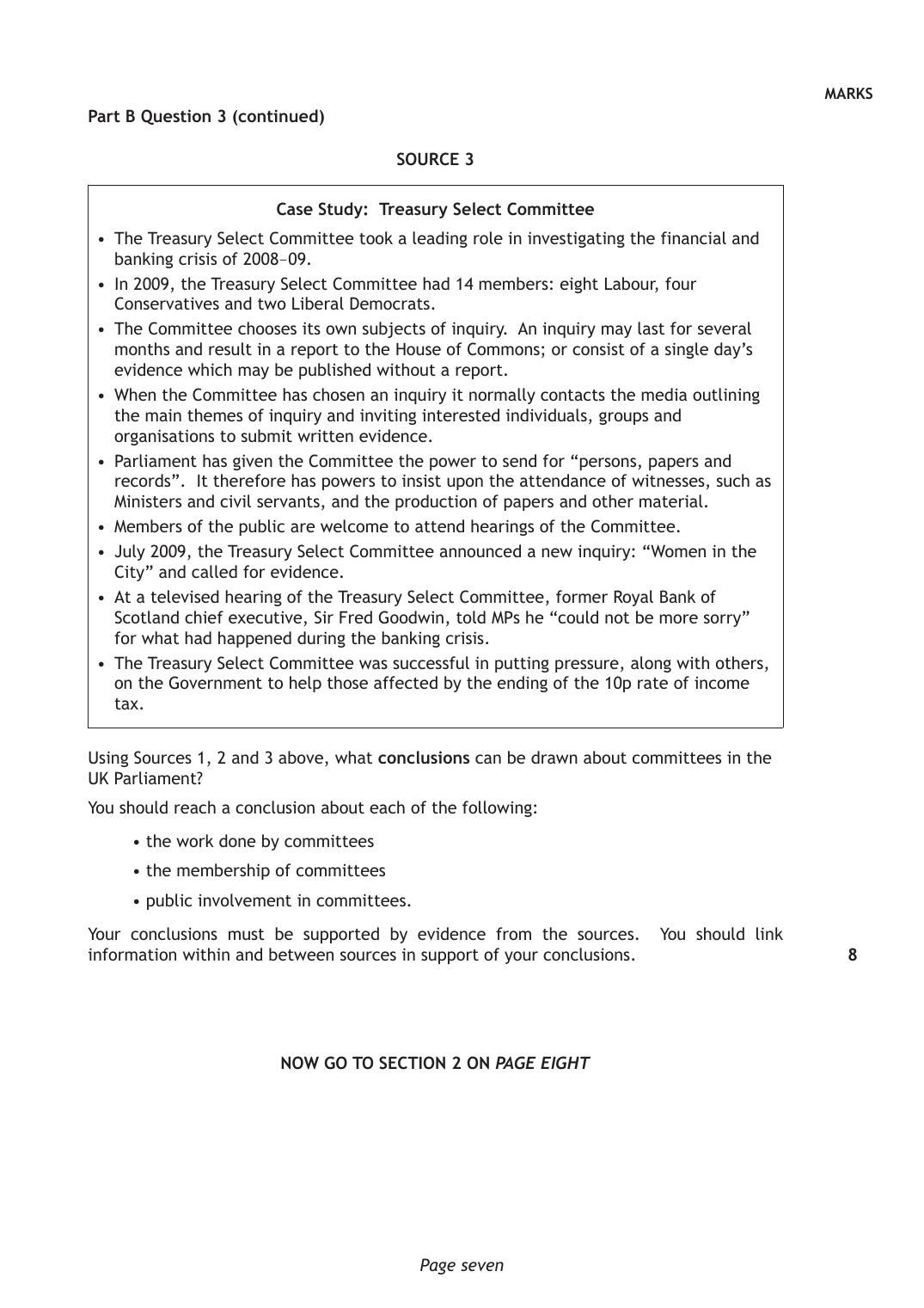
The Treasury Select Committee took a leading role in investigating the financial and banking crisis of 2008–09 (Source 3).
The Committee chooses its own subjects of inquiry.
Parliament has given the Committee the power to send for “persons, papers and records”. It therefore has powers to insist upon the attendance of witnesses, such as ministers and civil servants, and the production of papers and other material (Source 3).
Possible conclusion—Committees do a lot of work and play an important role in the work of the UK Parliament.
The membership of committees
The membership of the committees is made up of backbench MPs from every party. This is supported by evidence from Source 3 which says The Treasury Select Committee has 8 Labour members and two Liberal democrats. [2 marks. Conclusion given but taken from Source 1—supported by accurate and relevant evidence from Source 3.]
Committees normally consist of backbench members (Source 1).
Membership reflects the composition of the parties in the House of Commons as a whole. This means the governing party always has a majority (Source 1).
Most committee reports are unanimous, reflecting a more non-party way of working. Different parties often work together and try to reach agreement in the committees (Source 1).
MPs from every party take part in the work of the committees with Committee Chairs being drawn from different parties (Source 1).
Chairs drawn from three parties, ie Labour, Conservative and Liberal Democrats (Source 2).
The Treasury Select Committee has 14 members; Labour 8, Conservatives 4, Liberal Democrats 2 (Source 3).
Possible conclusion—Committees are made up of all parties although governing party (Labour in 2008–09) has biggest role.
Public involvement in committees
Members of the public have several opportunities to get involved in politics through the select committee system. [original conclusion] This conclusion is supported by evidence from Source 1 which says that committee meetings have been held in different parts of the country with the public attending. The public are welcome to attend and can also feel involved through television coverage, internet broadcast and the website. The public have been involved in recent Select Committee investigations, eg Fred Goodwin and the 10p tax issue. (Source 3)
Select Committees can hold meetings in different parts of the country (Source 1).
Members of the public can attend (Source 1).
Each has its own website and committee meetings are broadcast on television and the Internet (Source 1).
Members of the public are welcome to attend hearings of the committee (Source 3).
At a televised hearing of the Treasury Select Committee, former Royal Bank of Scotland chief executive Sir Fred Goodwin told MPs he “could not be more sorry” for what had happened during the banking crisis (Source 3).
Possible conclusion—public does have some access to work of committees.
Describe, in detail4 marks2019 specimenQ1⏳ Older formatDemocracy in the United Kingdom
Groups which try to influence the United Kingdom Government: Pressure Groups; Trades Unions; The Media.
Choose one of the groups above. Describe, in detail, two ways in which the group you have chosen tries to influence the UK Government.
WFQ = words from the question — reuse in every point.
📝 Structure template — how to structure your answer▾
Describe, in detail · A knowledge (KU) question · use PEE
Remember PEE
•Point — make your point
•Explanation — develop it
•Example — a specific, recent example
WFQ (words from the question)
One words from the question is insert point.✓ 1 mark — Point
This means that … (explain your point).✓ 1 mark — Explanation
For example, … (give a specific, recent example).✓ 1 mark — Example
Then repeat with a second point — two developed points are needed for full marks.
How it's marked
1 mark for an accurate but undeveloped point (P).
+1 mark for developing/explaining it (E).
+1 mark for a specific example (E). Up to 3 marks per description; two descriptions needed for full marks.
💡The example is where learners most often drop the mark — always add “For example, …”.
✓ Reveal marking scheme▾
Max 4 marks
These are possible/exemplar answers from the marking instructions — other valid points can also gain marks.
How marks are awarded
Award up to three marks for a single description, depending on quality, level of detail, relevance, accuracy and exemplification. At least two descriptions are necessary for full marks.
Possible approaches to answering the question:
Pressure groups try to influence the UK Government by having a demonstration. [1 mark for an accurate but undeveloped point]
Trades Unions can try to influence the Government by going on strike, for example NHS doctors have threatened industrial action. [2 marks for a single point plus relevant example]
Newspapers can try to influence the Government by printing stories that are very critical of the Government. Bad publicity can make the Government unpopular, for example when some newspapers criticised the Government for trying to bring in the ‘pasty tax’ and the Government changed their mind. [3 marks for a developed point with exemplification]
Credit reference to aspects of the following: Pressure Groups
Demonstrations/protest, eg recent protests outside the House of Commons concerning student fees.
Petitions—including e-petitions.
Actions to attract media attention, eg Greenpeace campaign against whaling.
Lobbying—contacting elected members of the parliament in order to try to gain their support. This can be done by pressure groups themselves or they may employ advisors, ie professional lobbyists. Also mass lobbying.
Direct action—disruptive and often illegal forms of protest, eg the Faslane peace camp, hunt saboteurs, anti-abortion groups.
Trades Unions
Industrial action such as strikes, work to rule, overtime bans. This may be especially effective in the public sector, eg strike action by NHS doctors.
Demonstrations/protest—recent demonstrations organised by teaching unions.
Actions to attract media attention, eg blockades of petrol depots.
The Media
Newspapers supporting/opposing campaigns by pressure groups, eg support of some newspapers for a referendum over Europe.
Newspapers supporting/opposing a particular political party during election campaigns, eg the traditional Labour versus Tory split in the press.
Newspapers highlighting what they see as Government incompetence/achievements, eg Chief Whip incident with police officers.
Broadcast media strictly controlled by legislation so cannot attempt to influence the Government.
Explain, in detail8 marks2019 specimenQ2⏳ Older formatDemocracy in the United Kingdom
The First Past the Post system (FPTP), used to elect the United Kingdom Parliament, has both advantages and disadvantages.
Explain, in detail, the advantages and disadvantages of the First Past the Post system (FPTP) which is used to elect the United Kingdom Parliament.
WFQ = words from the question — reuse in every point.
📝 Structure template — how to structure your answer▾
Explain, in detail · A knowledge (KU) question · use PEE (+ analysis)
Remember PEE
•Point — give your reason
•Explanation — “this means that…”
•Example — a specific, recent example
WFQ (words from the question)
One reason words from the question is insert point.✓ 1 mark — Point
This means that … (explain the reason).✓ 1 mark — Explanation
For example, … (give a specific, recent example).✓ 1 mark — Example
This is important because … (analysis — how it links to other factors).✓ 1 mark — Analysis
Then repeat with a second reason — a maximum of two explanations are credited.
How it's marked
1 mark for an accurate but undeveloped reason (P).
+1 for explanation (E), +1 for a specific example (E), +1 for analysis. Up to 4 marks per explanation.
A maximum of two explanations are credited.
💡Build each reason: Point → Explanation → Example → Analysis.
✓ Reveal marking scheme▾
Max 8 marks
These are possible/exemplar answers from the marking instructions — other valid points can also gain marks.
How marks are awarded
Award up to four marks for a single explanation, depending on quality, level of detail, relevance, accuracy, exemplification and answers which show the interaction of various factors.
Candidates who only explain either advantages or disadvantages should be awarded a maximum of six marks.
Possible approaches to answering the question:
An advantage of FPTP is that it is easy for voters to understand. [1 mark]
An advantage of the first past the post system is that it provides a clear winner in each constituency as a simple majority is all that is needed. [2 marks—developed point]
A disadvantage of FPTP is that many voters in safe seats feel that their vote is worthless. For example, a Labour supporter in a safe Conservative constituency may not bother voting as Labour have very little chance of winning in that seat. [3 marks—well developed point]
A disadvantage of FPTP is that in safe constituencies the parties have a lot of power in choosing the MP. For example, in a safe Labour seat like Kirkcaldy and Cowdenbeath (Labour majority 23,000) it may not matter who the local Labour party chooses as their candidate as the party has such a large majority. Many voters always vote for the same party. This suggests that local party activists effectively choose the MP and not local voters. Marginal constituencies actually provide voters with more power, eg Edinburgh South which has a Labour majority of 300. [4 marks—developed points with some detail, analysis and exemplification]
Credit reference to aspects of the following: Advantages
Straightforward system means voters not confused which may make voters feel part of the democratic process and encourage participation.
Directly elected representative—one per constituency. MPs can be held directly accountable by constituents.
Usually a quick result is achieved which avoids the uncertainty of some PR systems.
Extremist parties such as the BNP have very little chance of gaining representation.
Disadvantage
Not proportional so many voters feel their votes are wasted, eg Labour supporter in a safe Conservative seat.
Encourages electorate to vote tactically. This adversely affects the democratic nature of the process.
Many MPs elected on a minority of the vote, ie winner takes all.
Possible for party to form majority government on minority of the popular vote.
Describe, in detail4 marks2019Q4Democracy in the United Kingdom
The UK Parliament has responsibility for reserved matters.
Describe, in detail, two reserved matters the UK Parliament has responsibility for.
WFQ = words from the question — reuse in every point.
📝 Structure template — how to structure your answer▾
Describe, in detail · A knowledge (KU) question · use PEE
Remember PEE
•Point — make your point
•Explanation — develop it
•Example — a specific, recent example
WFQ (words from the question)
One words from the question is insert point.✓ 1 mark — Point
This means that … (explain your point).✓ 1 mark — Explanation
For example, … (give a specific, recent example).✓ 1 mark — Example
Then repeat with a second point — two developed points are needed for full marks.
How it's marked
1 mark for an accurate but undeveloped point (P).
+1 mark for developing/explaining it (E).
+1 mark for a specific example (E). Up to 3 marks per description; two descriptions needed for full marks.
💡The example is where learners most often drop the mark — always add “For example, …”.
✓ Reveal marking scheme▾
Max 4 marks
These are possible/exemplar answers from the marking instructions — other valid points can also gain marks.
How marks are awarded
Award up to 3 marks for a single description, depending on quality, level of detail, relevance, accuracy and exemplification.
Two descriptions are necessary for full marks.
Possible approaches to answering the question
The UK Parliament is responsible for the matter of defence. (1 mark — accurate but undeveloped point)
The UK Parliament is responsible for the matter of defence. This means that the UK Parliament makes decisions about how best to protect the UK against terrorist attacks. (2 marks — accurate point with development)
The UK Parliament is responsible for the matter of defence. This means that the UK Parliament makes decisions about how best to protect the UK against terrorist attacks. For example, the UK Parliament passed the 2015 Counter Terrorism and Security Act which prevents individuals travelling abroad to engage in terrorist activities. (3 marks — accurate point with development and exemplification)
Describe, in detail6 marks2019Q5Democracy in the United Kingdom
Individuals have rights in a democracy.
Describe, in detail, two rights individuals have in a democracy.
WFQ = words from the question — reuse in every point.
📝 Structure template — how to structure your answer▾
Describe, in detail · A knowledge (KU) question · use PEE
Remember PEE
•Point — make your point
•Explanation — develop it
•Example — a specific, recent example
WFQ (words from the question)
One words from the question is insert point.✓ 1 mark — Point
This means that … (explain your point).✓ 1 mark — Explanation
For example, … (give a specific, recent example).✓ 1 mark — Example
Then repeat with a second point — two developed points are needed for full marks.
How it's marked
1 mark for an accurate but undeveloped point (P).
+1 mark for developing/explaining it (E).
+1 mark for a specific example (E). Up to 3 marks per description; two descriptions needed for full marks.
💡The example is where learners most often drop the mark — always add “For example, …”.
✓ Reveal marking scheme▾
Max 6 marks
These are possible/exemplar answers from the marking instructions — other valid points can also gain marks.
How marks are awarded
Award up to 3 marks for a single description, depending on quality, level of detail, relevance, accuracy and exemplification.
Two descriptions are necessary for full marks.
Possible approaches to answering the question
Individuals have the right to vote in a democracy. (1 mark — accurate but undeveloped point)
Individuals have the right to vote in a democracy. Individuals can vote in elections or referendums. (2 marks — accurate point with development)
Individuals have the right to vote in a democracy. Individuals can vote in elections or referendums. For example, 32 million individuals voted in the 2017 general election. (3 marks — accurate point with development and exemplification)
Credit reference to aspects of the following
the right to a fair trial
the right to privacy
the right to vote
the right to education and healthcare
the right to join a pressure group
the right to join a political party
the right to protest
the right to lobby a representative
freedom of expression
freedom of religion or conscience
freedom of assembly
freedom from torture, inhuman or degrading treatment and slavery.
Explain, in detail6 marks2019Q6Democracy in the United Kingdom
Political parties use the media during election campaigns in the UK.
Explain, in detail, two reasons why political parties use the media during election campaigns in the UK.
WFQ = words from the question — reuse in every point.
📝 Structure template — how to structure your answer▾
Explain, in detail · A knowledge (KU) question · use PEE (+ analysis)
Remember PEE
•Point — give your reason
•Explanation — “this means that…”
•Example — a specific, recent example
WFQ (words from the question)
One reason words from the question is insert point.✓ 1 mark — Point
This means that … (explain the reason).✓ 1 mark — Explanation
For example, … (give a specific, recent example).✓ 1 mark — Example
This is important because … (analysis — how it links to other factors).✓ 1 mark — Analysis
Then repeat with a second reason — a maximum of two explanations are credited.
How it's marked
1 mark for an accurate but undeveloped reason (P).
+1 for explanation (E), +1 for a specific example (E), +1 for analysis. Up to 4 marks per explanation.
A maximum of two explanations are credited.
💡Build each reason: Point → Explanation → Example → Analysis.
✓ Reveal marking scheme▾
Max 6 marks
These are possible/exemplar answers from the marking instructions — other valid points can also gain marks.
How marks are awarded
Award up to 4 marks for a single explanation depending on quality, level of detail, relevance, accuracy, exemplification and answers which show the interaction of various factors.
A maximum of two explanations should be credited.
Possible approaches to answering the question
Political parties use the media during election campaigns because it allows the party to spread their election message. (1 mark — accurate but undeveloped point)
Political parties use the media during election campaigns because it allows the party to spread their election message. Using traditional media and social media allows political parties to reach millions of voters to tell them about their manifesto promises. (2 marks — accurate point with development)
Political parties use the media during election campaigns because it allows the party to spread their election message. Using traditional media and social media allows political parties to reach millions of voters to tell them about their manifesto promises. For example, the BBC leaders' TV debate during the 2017 general election campaign was watched by an average of 3·5 million viewers. (3 marks — accurate point with development and exemplification)
Political parties use the media during election campaigns because it allows the party to spread their election message. Using traditional media and social media allows political parties to reach millions of voters to tell them about their manifesto promises. For example, the BBC leaders' TV debate during the 2017 general election campaign was watched by an average of 3·5 million viewers. The five leaders who took part debated issues such as health, education and Brexit with the aim of persuading voters to cast their vote in favour of their party. (4 marks — accurate point with development, exemplification and analysis)
Credit reference to aspects of the following
engage with younger voters via social media platforms
use of 'attack' advertising to discredit opposition
create publicity for the campaign message via soundbites
Party Election Broadcasts (PEBs) promote manifesto pledges to voters
printed press allegiance supports campaign at expense of other parties
mobilise grassroot supporters via social media to organise local campaigns
deliver campaign messages to those unable to be reached through traditional methods, such as canvassing, to attempt to increase turnout.
Study Sources 1, 2 and 3 below, then attempt the question which follows.
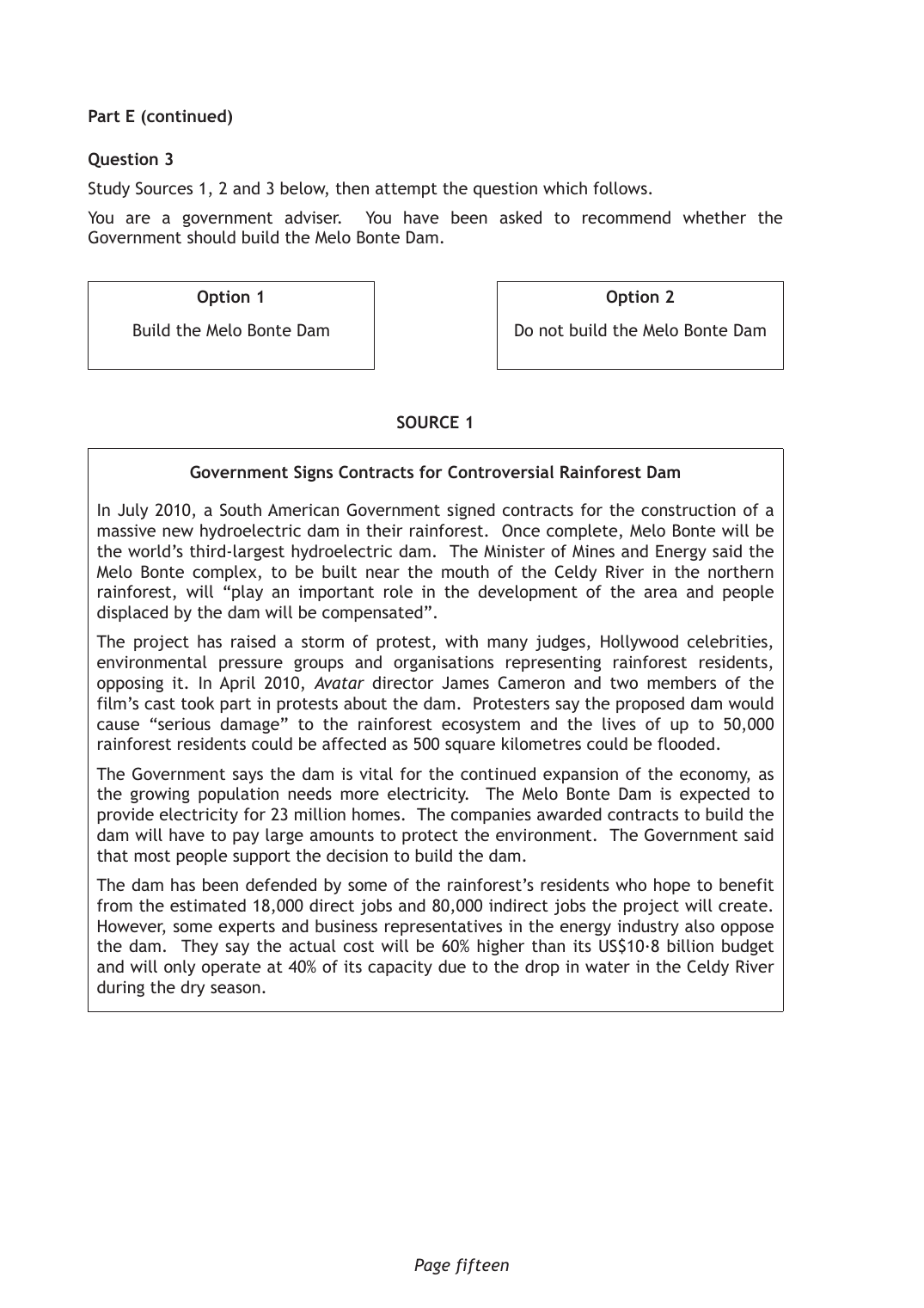
You are a government adviser. You have been asked to recommend whether the Government should build the Melo Bonte Dam.
Option 1
Build the Melo Bonte Dam
Option 2
Do not build the Melo Bonte Dam
You must decide which option to recommend, either build the Melo Bonte Dam (Option 1) or do not build the Melo Bonte Dam (Option 2).
(i) Using Sources 1, 2 and 3 above and opposite, which option would you choose?
(ii) Give reasons to support your choice.
(iii) Explain why you did not choose the other option.
Your answer must be based on all three sources.
Sources (Source 1, Source 2, Source 3)
📝 Structure template — how to structure your answer▾
Decision making · A source-based skills question
WFQ (words from the question)
I chose insert option name.
Evidence to support this is in insert source which says/shows “insert evidence”.✓ 1 mark per piece of evidence (up to 8)
This is further supported by evidence in insert source which says/shows “insert evidence”. (Repeat until you have 8 pieces of evidence = 8 marks.)
Rebuttal: I rejected insert option name because insert source says/shows “insert evidence”.✓ needed for full marks
How it's marked
Up to 3 marks for a developed justification; credit highly where you link evidence between sources.
For full marks you must justify your decision AND explain why you rejected the other option.
Maximum 8 marks if you only deal with one option.
💡Aim for around 8 pieces of evidence to build up the marks.
💡Don’t forget the rebuttal — say why you rejected the other option.
✓ Reveal marking scheme▾
Max 10 marks
These are possible/exemplar answers from the marking instructions — other valid points can also gain marks.
How marks are awarded
The candidate is required to evaluate a limited range of sources, in order to make and justify a decision/recommendation. The candidate must also explain why they have rejected the other option.
In order to achieve full marks candidates must say why they did not choose the other option. An answer which deals with only one option should be awarded a maximum of 8 marks.
Option 1: Build the Melo Bonte Dam
The Government should build the Melo Bonte Dam as it is vital for the continued expansion of the economy, as the growing population needs more electricity. [1 mark—evidence drawn from Source 1]
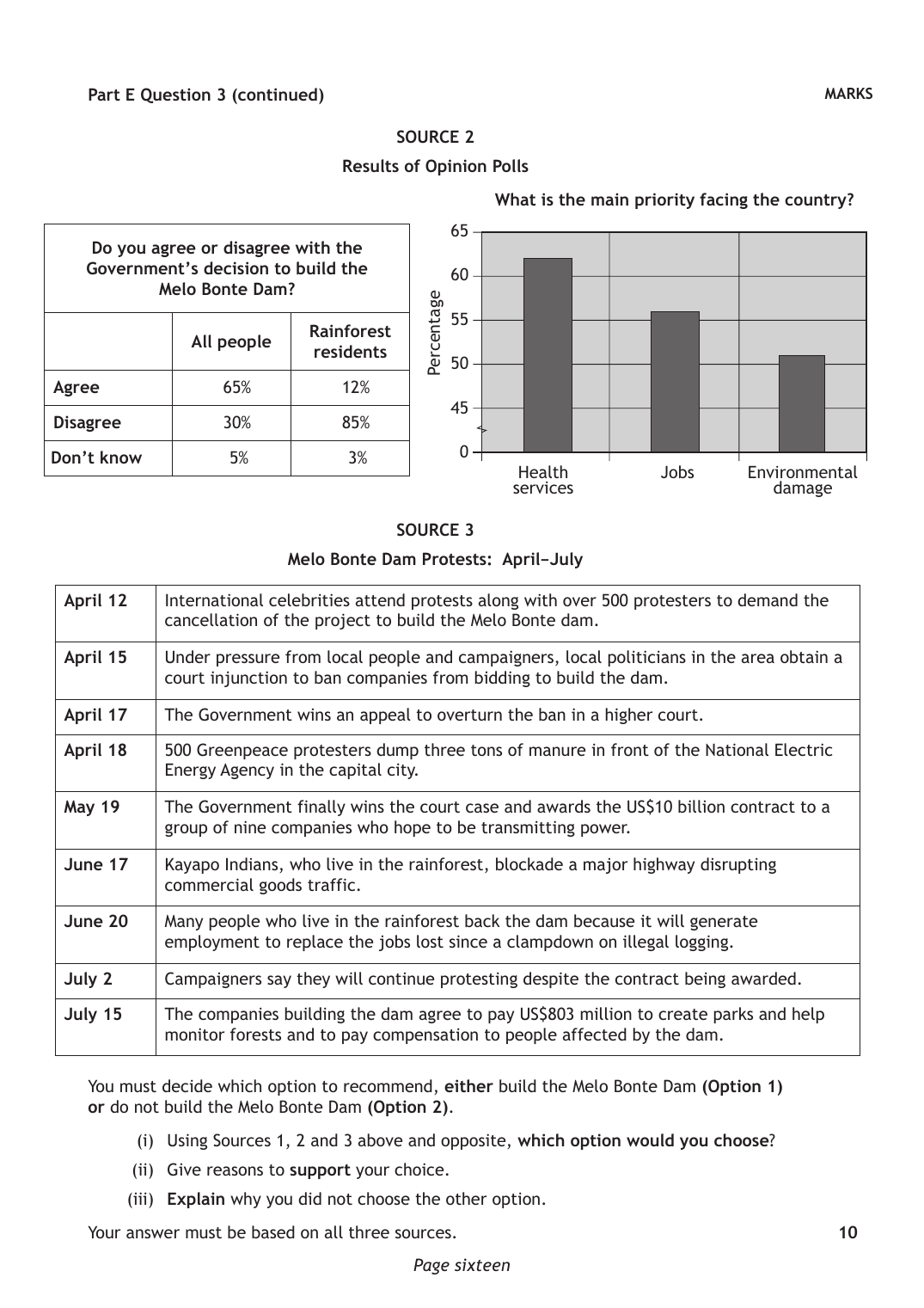
The Government should build the Melo Bonte Dam as it is vital for the continued expansion of the economy, as Source 1 says that most people support the decision to build the dam and this is backed up by the opinion poll in Source 2 which shows 65% of all people agree with the decision to build the dam. [2 marks—evidence linked from Source 1 and Source 2]
The Minister of Mines and Energy said the Melo Bonte complex, to be built near the mouth of the Celdy River in the rainforest, will “play an important role in the development” of the area and people displaced by the dam “will be compensated.” (Source 1).
The Government says the dam is vital for the continued expansion of the economy as the country needs more electricity (Source 1).
The dam has been defended by some in the local population who hope to benefit from the estimated 18,000 direct jobs and 80,000 indirect jobs the Government says the project would create. (Source 1)
The Melo Bonte Dam is expected to provide electricity to 23 million homes. (Source 1)
The Government said that most people support the decision to build the dam (Source 1).
65% of the population agreed with the Government’s decision to build the Melo Bonte Dam (Source 2).
June 20, Many indigenous people back the dam because it will generate employment to replace the jobs lost since a clamp down on illegal logging (Source 3).
July 15, The companies building the dam agree to pay US$803 million to create parks and help monitor forests and to pay compensation to people affected by the dam (Source 3).
Reasons for rejecting other option.
I rejected the option to not build the dam as although protesters say the dam could cause serious damage to the rainforest and the lives of up to 50,000 rainforest residents could be affected, Source 3 says the companies building the dam agree to pay US$803 million to create parks and help monitor forests and to pay compensation to people affected by the dam. [2 marks]
Option 2: Do not build the Melo Bonte Dam
The Government should not build the Melo Bonte Dam as protesters say the proposed dam would cause serious damage to the rainforest and the lives of up to 50,000 rainforest residents could be affected (Source 1). In an opinion poll only 12% of rainforest residents agreed and a large majority of 85% said they disagreed with the decision to build the dam. [3 marks—evidence linked from Source 1 (1 mark) with detailed use of evidence from Source 2 demonstrating evaluative terminology (2 marks)].
The project has raised a storm of protest, with judges, Hollywood celebrities, environmental pressure groups and local people in opposition (Source 1).
In April 2010, Avatar director James Cameron and two members of the film’s cast, took part in protests. (Source 1)
Protesters say the proposed dam would cause “serious damage” to the rainforest ecosystem, and the lives of up to 50,000 people could be affected as 500 square kilometres could be flooded (Source 1).
Some experts and business representatives in the energy industry also oppose the dam. They say the actual cost will be 60% higher than its US$10.8 billion budget and will only operate at 40% of its installed capacity, due to the drop in water in the Celdy River during the dry season (Source 1).
In an opinion poll 85% of rainforest residents disagreed with the Government’s decision to build the Melo Bonte Dam (Source 2).
Over half of people think that environmental damage is the main priority facing the country (Source 2).
62% of people think the health service is the main priority facing the country. (Source 2)
April 12, international celebrities attend protests with over 500 protesters to demand the cancellation of the project to build the Melo Bonte Dam (Source 3).
April 15, under pressure from local people and campaigners, local politicians obtain a court injunction to ban companies bidding to build the dam (Source 3).
July 2, Campaigners say they will continue protesting despite the contract being awarded (Source 3).
Reasons for rejecting other option.
I rejected the option to build the dam as there have been a storm of protests from Hollywood celebrities and environmental pressure groups and organisations representing rainforest residents. [1 mark awarded for use of one piece of information from Source 1 with no linking. Do not credit if marks already awarded for this point.]
Study Sources 1, 2 and 3 below, then attempt the question which follows.
You are an adviser to the European Union (EU). You have been asked to recommend whether Country A or Country B should be allowed to join the EU.
Option 1
Allow Country “A” to join the EU
Option 2
Allow Country “B” to join the EU
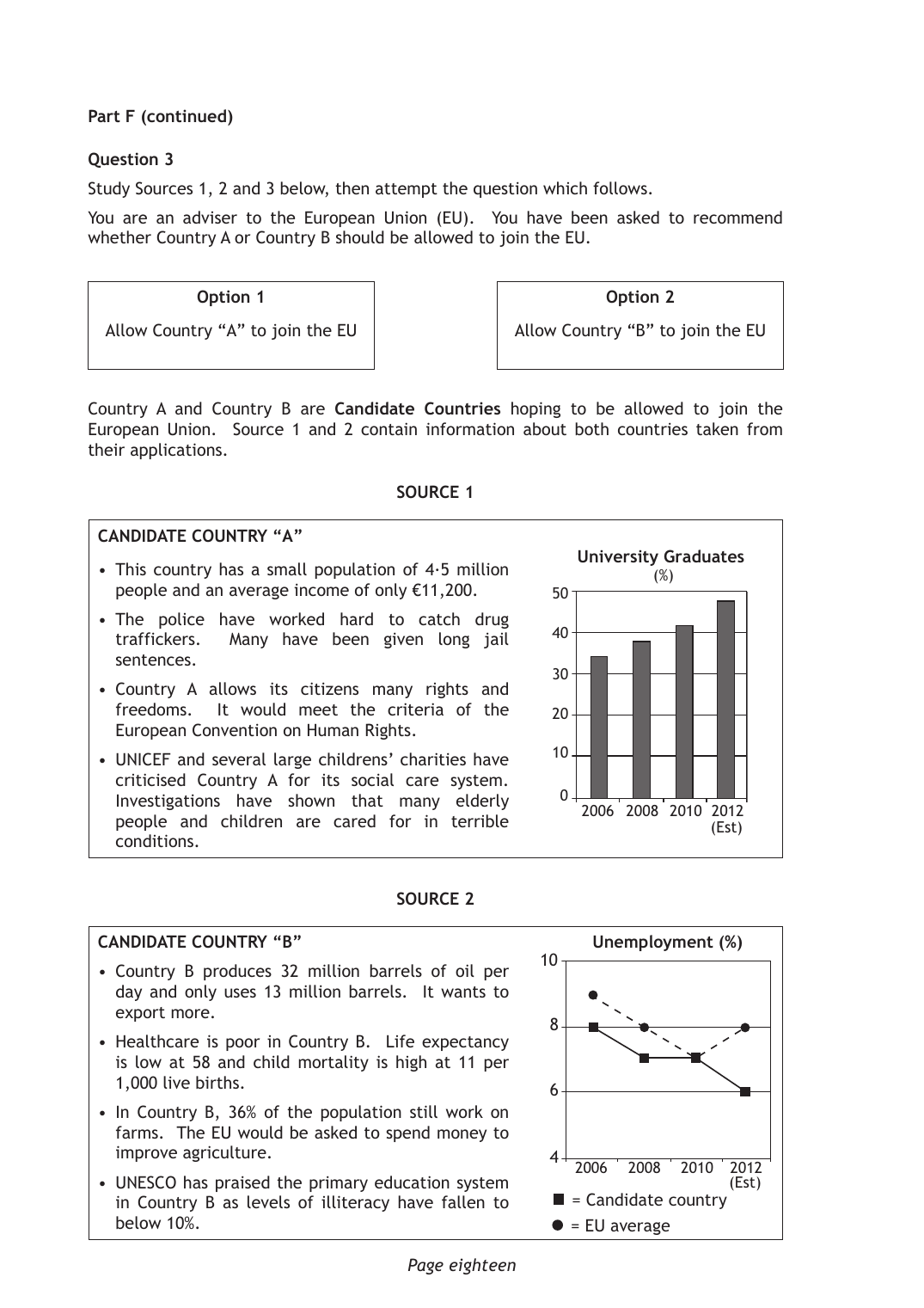
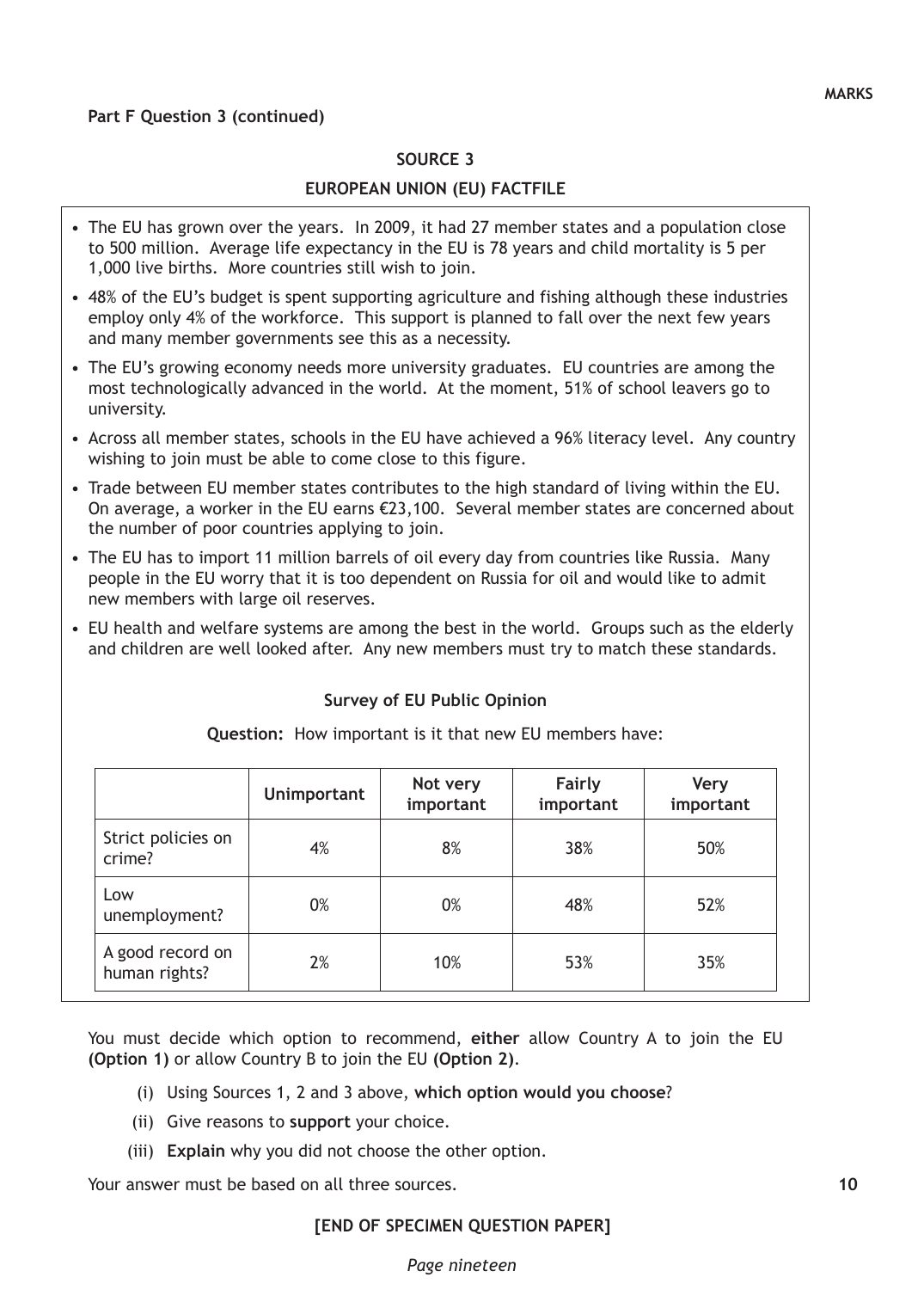
Country A and Country B are Candidate Countries hoping to be allowed to join the European Union. Source 1 and 2 contain information about both countries taken from their applications.
You must decide which option to recommend, either allow Country A to join the EU (Option 1) or allow Country B to join the EU (Option 2).
(i) Using Sources 1, 2 and 3 above, which option would you choose?
(ii) Give reasons to support your choice.
(iii) Explain why you did not choose the other option.
Your answer must be based on all three sources.
Sources (Source 1, Source 2, Source 3)
📝 Structure template — how to structure your answer▾
Decision making · A source-based skills question
WFQ (words from the question)
I chose insert option name.
Evidence to support this is in insert source which says/shows “insert evidence”.✓ 1 mark per piece of evidence (up to 8)
This is further supported by evidence in insert source which says/shows “insert evidence”. (Repeat until you have 8 pieces of evidence = 8 marks.)
Rebuttal: I rejected insert option name because insert source says/shows “insert evidence”.✓ needed for full marks
How it's marked
Up to 3 marks for a developed justification; credit highly where you link evidence between sources.
For full marks you must justify your decision AND explain why you rejected the other option.
Maximum 8 marks if you only deal with one option.
💡Aim for around 8 pieces of evidence to build up the marks.
💡Don’t forget the rebuttal — say why you rejected the other option.
✓ Reveal marking scheme▾
Max 10 marks
These are possible/exemplar answers from the marking instructions — other valid points can also gain marks.
How marks are awarded
The candidate is required to evaluate a limited range of sources, in order to make and justify a decision/recommendation. The candidate must also explain why they did not choose the other option.
In order to achieve full marks candidates must say why they did not choose the other option. An answer which deals with only one option should be awarded a maximum of 8 marks.
For option 1: Country A
Country A should be allowed to join the EU as many drug dealers have been sent to prison. [1 mark—one piece of evidence from one source]
I rejected the second option (allowing country B to join) as over one third (36%) of its population still work in agriculture. This is nine times the level in the EU (4%) which would not allow the EU to reduce its huge expenditure on agriculture which stands at almost half of the entire budget (48%). Many of the EU members see a drop in this 48% as essential. [3 marks—accurate information from two sources with some evaluative comment]
Country A’s police have done well in clamping down on drug trafficking. According to the EU opinion survey, 88% of Europeans saw this as fairly important or very important.
88% of respondents in the survey also saw a good human rights record as fairly or very important. Country A would meet the criteria for the ECHR.
University entrants in Country A have been growing in number and are getting close to the EU average of 51%. The EU’s economy needs more university graduates.
Against option 1: Country A
Several member states have become concerned about the number of poor countries who are applying to join the EU. Country A’s average income (11,200) is less than half of the EU average (23,100).
The EU takes good care of vulnerable groups, like children. Country A would struggle to meet these standards as shown in a recent UNICEF investigation, which criticized it for “terrible conditions”.
For option 2: Country B
Country B should be allowed to join the EU as it produces 32 million barrels of oil and the EU doesn’t want to rely on Russia. [2 marks—evidence linked from Source 1 and Source 2]
I rejected country A as its average income is €11,200. In the EU it is €23,100. [2 marks awarded for use of two pieces of evidence from different sources. Do not credit if marks already awarded for this point in justification of choice.]
Country B is self-sufficient in oil and is already producing 19 million barrels per day more than it uses. EU dependence on Russia would be reduced. This would be good as many would like to admit countries with oil reserves.
100% in the survey said that low unemployment was fairly important or very important. The graph shows that Country B’s unemployment rate is consistently less than the EU average.
Country B has been praised for reducing illiteracy rates to below 10%. This is coming close to the levels achieved by schools in the EU.
Against option 2: Country B
Country B has a huge agricultural industry. Over one third of workers are employed in this sector. This would make it difficult to reduce the EU’s agriculture budget, which the member states see as necessary.
Country B has poor health care. Life expectancy is twenty years below the EU average and infant mortality rate is more than double.
Study Sources 1, 2 and 3 and then answer the question which follows.
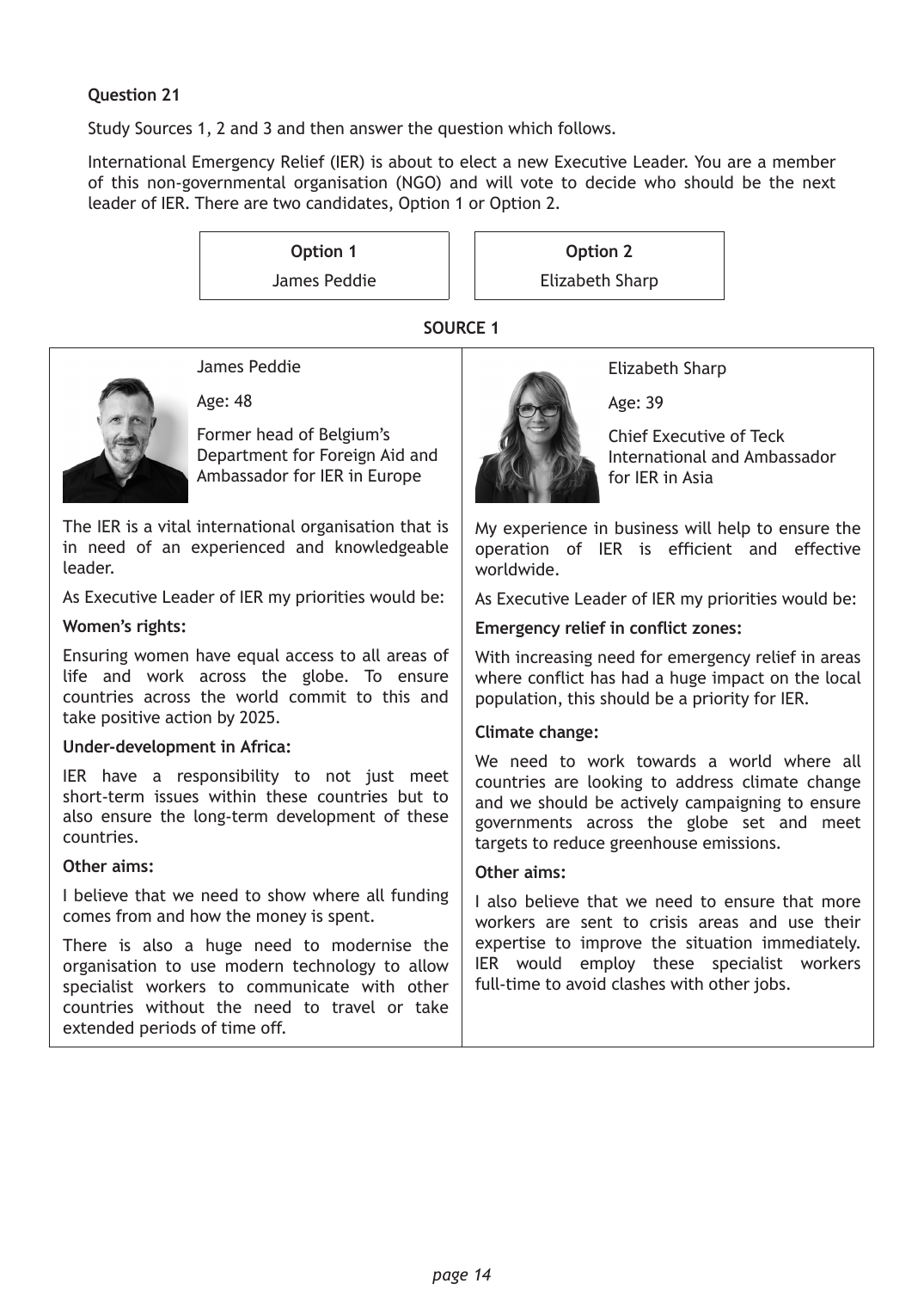
International Emergency Relief (IER) is about to elect a new Executive Leader. You are a member of this non-governmental organisation (NGO) and will vote to decide who should be the next leader of IER. There are two candidates, Option 1 or Option 2.
Option 1
James Peddie
Option 2
Elizabeth Sharp
You must decide which option to recommend, either James Peddie (Option 1) or Elizabeth Sharp (Option 2).
(i) Using Sources 1, 2 and 3, which option would you choose?
(ii) Give reasons to support your choice.
(iii) Explain why you did not choose the other option.
Your answer must be based on all three sources.
Sources (Source 1, Source 2, Source 3)
📝 Structure template — how to structure your answer▾
Decision making · A source-based skills question
WFQ (words from the question)
I chose insert option name.
Evidence to support this is in insert source which says/shows “insert evidence”.✓ 1 mark per piece of evidence (up to 8)
This is further supported by evidence in insert source which says/shows “insert evidence”. (Repeat until you have 8 pieces of evidence = 8 marks.)
Rebuttal: I rejected insert option name because insert source says/shows “insert evidence”.✓ needed for full marks
How it's marked
Up to 3 marks for a developed justification; credit highly where you link evidence between sources.
For full marks you must justify your decision AND explain why you rejected the other option.
Maximum 8 marks if you only deal with one option.
💡Aim for around 8 pieces of evidence to build up the marks.
💡Don’t forget the rebuttal — say why you rejected the other option.
✓ Reveal marking scheme▾
Max 10 marks
These are possible/exemplar answers from the marking instructions — other valid points can also gain marks.
How marks are awarded
The candidate is required to evaluate a limited range of sources, in order to justify a decision/recommendation.
The candidate must also explain why they have rejected the other option.
In order to achieve full marks candidates must say why they did not choose the other option. An answer which deals with only one option should be awarded a maximum of 8 marks.
Option 1: elect James Peddie
IER should select James Peddie as he says in Source 1 'we need to show where all funding comes from and how the money is spent'. (1 mark — evidence drawn from Source 1)
IER should select James Peddie as he says in Source 1 'we need to show where all funding comes from and how the money is spent'. This is backed up in Source 3 from the Daily News when it says 'A number of international NGOs have been named and shamed for not declaring how they have spent money raised and governments are calling on leaders to change practice or face penalties'. (2 marks — evidence linked from Source 1 and Source 3)
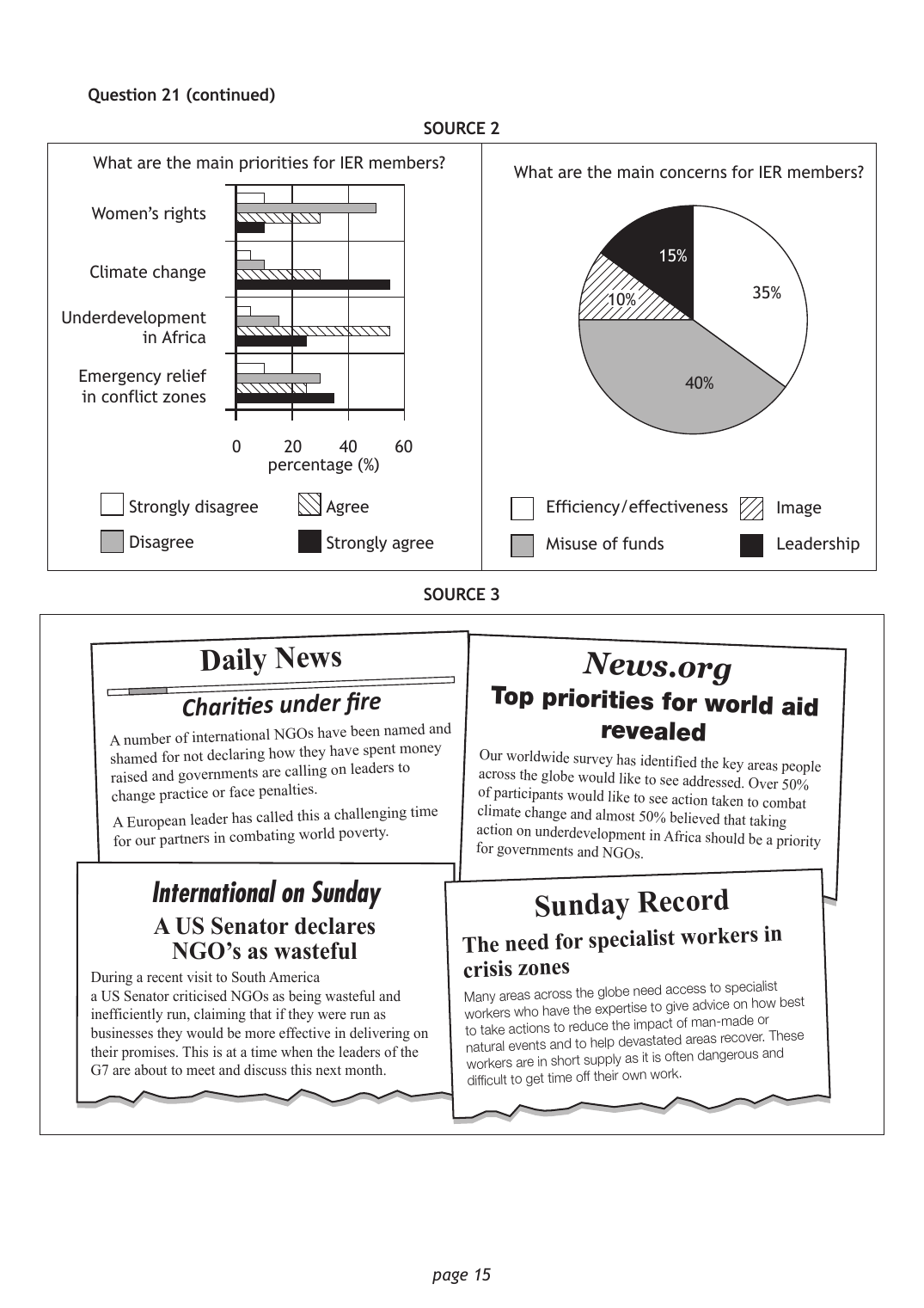
IER should select James Peddie as he says in Source 1 'we need to show where all funding comes from and how the money is spent'. This is backed up in Source 3 from the Daily News when it says 'A number of international NGOs have been named and shamed for not declaring how they have spent money raised and governments are calling on leaders to change practice or face penalties' and Source 2 which shows that the misuse of funds is the main concern for IER members. (3 marks — evidence linked from all three Sources)
Credit reference to aspects of the following (Option 1)
under-development in Africa: James Peddie says that IER have a responsibility to not just meet short-term issues within these countries but to also ensure the long-term development of these countries (Source 1) and over 50% believe that underdevelopment in Africa should be a priority for governments and NGOs (Source 3)
specialist workers are in short supply as it is often dangerous and difficult to get time off their own work (Source 3) and there is also a huge need to modernise the organisation to use modern technology to allow specialist workers to communicate with other countries without the need to travel or take extended periods of time off (Source 1)
the IER is a vital international organisation that is in need of an experienced and knowledgeable leader (Source 1) and James Peddie is 'Former head of Belgium's Department for Foreign Aid and Ambassador for IER in Europe'. (Source 1)
Reasons for rejecting the other option (Option 1 chosen)
I rejected option 2, Elizabeth Sharp, as she said she would prioritise emergency relief in conflict zones (Source 1) but more IER members agreed that underdevelopment in Africa should be a priority. (Source 2) (2 marks — evidence linked from Source 1 and Source 2)
Option 2: elect Elizabeth Sharp
IER should select Elizabeth Sharp as she says 'My experience in business will help to ensure the operation of IER is efficient and effective worldwide'. (1 mark — evidence drawn from Source 1)
IER should select Elizabeth Sharp as she says 'My experience in business will help to ensure the operation of IER is efficient and effective worldwide'. This is supported in Source 3 when the news article says 'A US Senator criticised NGOs as being wasteful and inefficiently run, claiming that if they were run as businesses they would be more effective in delivering on their promises'. (2 marks — evidence linked from Source 1 and Source 3)
IER should select Elizabeth Sharp as she says 'My experience in business will help to ensure the operation of IER is efficient and effective worldwide'. This is supported in Source 3 when the news article says 'A US Senator has criticised NGOs as being wasteful and inefficiently run, claiming that if they were run as businesses they would be more effective in delivering on their promises'. This is further shown in the pie chart in Source 2 as 35% of members are concerned about efficiency/effectiveness. (3 marks — evidence linked from all three Sources)
Credit reference to aspects of the following (Option 2)
many areas across the globe need access to specialist workers who have the expertise to give advice on how best to take actions to reduce the impact of man-made or natural events and to help areas devastated recover (Source 3) and we need to ensure that more workers are sent to crisis areas and use their expertise to improve the situation immediately. IER would employ these specialist workers full-time to avoid clashes with other jobs (Source 1)
emergency relief in conflict zones: with increasing need for emergency relief in areas where conflict has had a huge impact on the local population, this should be a priority for IER (Source 1) and a majority of people said they agreed or strongly agreed that emergency relief in conflict zones should be a priority. (Source 2)
Reasons for rejecting the other option (Option 2 chosen)
I rejected option 1 because James Peddie says 'Women's Rights: Ensuring women have equal access to all areas of life and work across the globe' should be a priority but Source 2 shows that this has the highest number of people disagreeing in comparison to the other priorities. (2 marks — evidence linked from Source 1 and Source 2)
International conflicts and issues have an impact on people directly involved.
Describe, in detail, two ways an international conflict or issue that you have studied has an impact on people directly involved. In your answer you must state the world issue or conflict you have studied.
WFQ = words from the question — reuse in every point.
📝 Structure template — how to structure your answer▾
Describe, in detail · A knowledge (KU) question · use PEE
Remember PEE
•Point — make your point
•Explanation — develop it
•Example — a specific, recent example
WFQ (words from the question)
One words from the question is insert point.✓ 1 mark — Point
This means that … (explain your point).✓ 1 mark — Explanation
For example, … (give a specific, recent example).✓ 1 mark — Example
Then repeat with a second point — two developed points are needed for full marks.
How it's marked
1 mark for an accurate but undeveloped point (P).
+1 mark for developing/explaining it (E).
+1 mark for a specific example (E). Up to 3 marks per description; two descriptions needed for full marks.
💡The example is where learners most often drop the mark — always add “For example, …”.
✓ Reveal marking scheme▾
Max 4 marks
These are possible/exemplar answers from the marking instructions — other valid points can also gain marks.
How marks are awarded
Award up to 3 marks for a single description, depending on quality, level of detail, relevance, accuracy and exemplification.
Two descriptions are necessary for full marks.
Possible approaches to answering the question — CONFLICT — SYRIA
Conflict can cause people to flee their homes through fear of being killed. (1 mark — accurate but undeveloped point)
Conflict can cause people to flee their homes through fear of being killed and they may become refugees in other countries. (2 marks — accurate point with development)
Conflict can cause people to flee their homes through fear of being killed and they may become refugees in other countries. Many people have fled Syria through fear of ISIS and have migrated to Europe, for example to Greece. (3 marks — accurate point with development and exemplification)
Credit reference to aspects of the following — Terrorism
loss of life
financial impact due to lack of tourism
tighter security, for example airport checks
increase in hate crimes.
Credit reference to aspects of the following — Development
International organisations have been successful in tackling many international conflicts and issues.
Explain, in detail, two reasons why attempts by international organisations to tackle the conflict or issue you have studied have been successful. In your answer you must state the world issue or conflict you have studied.
WFQ = words from the question — reuse in every point.
📝 Structure template — how to structure your answer▾
Explain, in detail · A knowledge (KU) question · use PEE (+ analysis)
Remember PEE
•Point — give your reason
•Explanation — “this means that…”
•Example — a specific, recent example
WFQ (words from the question)
One reason words from the question is insert point.✓ 1 mark — Point
This means that … (explain the reason).✓ 1 mark — Explanation
For example, … (give a specific, recent example).✓ 1 mark — Example
This is important because … (analysis — how it links to other factors).✓ 1 mark — Analysis
Then repeat with a second reason — a maximum of two explanations are credited.
How it's marked
1 mark for an accurate but undeveloped reason (P).
+1 for explanation (E), +1 for a specific example (E), +1 for analysis. Up to 4 marks per explanation.
A maximum of two explanations are credited.
💡Build each reason: Point → Explanation → Example → Analysis.
✓ Reveal marking scheme▾
Max 6 marks
These are possible/exemplar answers from the marking instructions — other valid points can also gain marks.
How marks are awarded
Award up to 4 marks for a single explanation depending on quality, level of detail, relevance, accuracy, exemplification and answers which show the interaction of various factors.
A maximum of two explanations should be credited.
Possible approaches to answering the question — ISSUE — UNDERDEVELOPMENT IN AFRICA
The UN has been successful because it has many specialised agencies. (1 mark — accurate but undeveloped point)
The UN has been successful because it has many specialised agencies. These agencies can focus on individual problems and provide aid to certain countries. (2 marks — accurate point with development)
The UN has been successful because it has many specialised agencies. These agencies can focus on individual problems and provide aid to certain countries. For example, UNICEF has provided malaria nets to Tanzania to tackle ill health. (3 marks — accurate point with development and exemplification)
Credit reference to aspects of the following — UN
Security Council actions
sanctions
peacekeeping
role of humanitarian agencies
willingness of member states to co-operate.
Credit reference to aspects of the following — NATO
strong military power
use of airstrikes
co-operation of member states.
Credit reference to aspects of the following — NGOs
There are many political causes of international conflicts or issues.
Explain, in detail, two political causes of an international conflict or issue you have studied. In your answer you should state the world issue or conflict you have studied.
WFQ = words from the question — reuse in every point.
📝 Structure template — how to structure your answer▾
Explain, in detail · A knowledge (KU) question · use PEE (+ analysis)
Remember PEE
•Point — give your reason
•Explanation — “this means that…”
•Example — a specific, recent example
WFQ (words from the question)
One reason words from the question is insert point.✓ 1 mark — Point
This means that … (explain the reason).✓ 1 mark — Explanation
For example, … (give a specific, recent example).✓ 1 mark — Example
This is important because … (analysis — how it links to other factors).✓ 1 mark — Analysis
Then repeat with a second reason — a maximum of two explanations are credited.
How it's marked
1 mark for an accurate but undeveloped reason (P).
+1 for explanation (E), +1 for a specific example (E), +1 for analysis. Up to 4 marks per explanation.
A maximum of two explanations are credited.
💡Build each reason: Point → Explanation → Example → Analysis.
✓ Reveal marking scheme▾
Max 6 marks
These are possible/exemplar answers from the marking instructions — other valid points can also gain marks.
How marks are awarded
Award up to 4 marks for a single explanation depending on quality, level of detail, relevance, accuracy, exemplification and answers which show the interaction of various factors.
A maximum of two explanations should be credited.
Possible approaches to answering the question — ISSUE — UNDERDEVELOPMENT IN AFRICA
Many African countries are underdeveloped because of corrupt governments. (1 mark — accurate but undeveloped point)
Many African countries are underdeveloped because of corrupt governments. They spend money on weapons rather than feeding their own people. (2 marks — accurate point with development)
Many African countries are underdeveloped because of corrupt governments. They misspend money rather than feeding their own people. For example, the leader of Equatorial Guinea has allowed his son to spend millions of dollars of state funds on his lavish lifestyle. (3 marks — accurate point with development and exemplification)
Credit reference to aspects of the following — Terrorism
nationalism
revenge
religion.
Credit reference to aspects of the following — Development
Describe, in detail4 marks2019 specimenQ1⏳ Older formatWorld Issues
International organisations which try to resolve international issues and problems: United Nations Organisation; NATO; World Bank; European Union; African Union; Charities and other NGOs.
Describe, in detail, two ways in which international organisations try to resolve an international issue or problem you have studied.
WFQ = words from the question — reuse in every point.
📝 Structure template — how to structure your answer▾
Describe, in detail · A knowledge (KU) question · use PEE
Remember PEE
•Point — make your point
•Explanation — develop it
•Example — a specific, recent example
WFQ (words from the question)
One words from the question is insert point.✓ 1 mark — Point
This means that … (explain your point).✓ 1 mark — Explanation
For example, … (give a specific, recent example).✓ 1 mark — Example
Then repeat with a second point — two developed points are needed for full marks.
How it's marked
1 mark for an accurate but undeveloped point (P).
+1 mark for developing/explaining it (E).
+1 mark for a specific example (E). Up to 3 marks per description; two descriptions needed for full marks.
💡The example is where learners most often drop the mark — always add “For example, …”.
✓ Reveal marking scheme▾
Max 4 marks
These are possible/exemplar answers from the marking instructions — other valid points can also gain marks.
How marks are awarded
Award up to three marks for a single description, depending on quality, level of detail, relevance, accuracy and exemplification. At least two descriptions are necessary for full marks.
Answers may focus on any world issue and candidates will be expected to provide examples relevant to that issue.
Answers which do not make specific reference to a relevant world issue should be awarded a maximum of 2 marks.
Possible approaches to answering the question:
The World Bank gives loans to countries. [1 mark—accurate but undeveloped point]
The African Union try to help stop conflicts between countries in Africa by holding peace talks with their leaders. [2 marks—accurate point with development]
The United Nations has tried to help refugees in many poor areas in the world. Recently, they have been providing emergency medicines, shelters and clean water to people in the “Horn of Africa” as they suffered a very serious drought. Many people walked hundreds of miles to refugee camps just to get basic food and clean water. [3 marks—accurate point with development and exemplification]
Credit reference to aspects of the following: United Nations Organisation. The United Nations responds to international problems largely through its “Specialised Agencies”. UNICEF
Agency involved in helping meet the specific needs of children.
Oral Rehydration Therapy across Africa.
Campaign in southern Africa to prevent AIDS transmission from mothers to children—setting up clinics, school visits and poster/TV campaigns.
Campaign to help child soldiers in Sudan—‘de-mob’ camps.
Building and equipping of clinics across Africa such as recently in Congo.
Campaign to increase the number of blood donors in Ethiopia. This also includes training and education programmes.
Ongoing vaccination programmes against polio across Sub-Saharan Africa.
Donation of ICT equipment to African health ministries to help coordinate healthcare and use of health resources.
Supporting charity campaigns to donate old spectacles to Africa.
WHO
Agency involved in helping meet African health needs.
Research into Africa’s killer diseases such as AIDS and malaria.
UNESCO
Agency involved in helping meet African education, cultural and science needs.
Setting up world heritage sites to protect African heritage.
Teacher training in Sub-Saharan Africa (TTISSA) campaign.
The LIFE campaign—Literacy Initiative for Empowerment.
The school in a suitcase campaign. All the equipment to run a classroom anywhere, in one bag.
EDUCAIDS—campaign to improve AIDS education across Africa.
Education for all by 2015. UNESCO’s major campaign to try to meet the Millennium Development goals.
FAO
Agency mainly concerned with the production of food in Africa and in helping develop agricultural efficiency.
Recent campaign against high food prices.
Help for small farmers to increase production, eg emergency rice programme in west Africa.
Campaigns to protect vulnerable crops against virus and disease, eg cassava.
Campaigns to educate farmers on the use of fertilizers and farm machinery.
Funding of research into GM seeds and other “bio-agriculture”.
WFP
Prepare reports which help National Governments and NGOs understand more clearly what the problems are with food security, nutrition, health and education within a country.
Reduce hunger and under-nutrition everywhere.
Save lives and protect livelihoods in emergencies by getting food to where it is most needed and quickly. The WFP does this by launching appeals to the international community for funds and food aid.
The WFP relies entirely on voluntary contributions to finance its operations.
Restore and rebuild lives after emergencies.
The Security Council
The UN Security Council is a small body of fifteen member states (Five permanent members and 10 non-permanent members, elected for two year term). Ambassadors from the fifteen countries can meet at short notice in response to global security issues. They discuss these matters and can pass resolutions which can include military intervention, sanctions, peace keeping missions, mediation etc.
NATO
NATO has tried to respond to terrorism (9/11 attacks, London underground bombings, Madrid bombings, Glasgow airport attack) by launching operations in Afghanistan and Iraq as part of the “War on Terror”. Also involvement in Libya.
NATO’s Defence Against Terrorism Programme established in 2004. NATO has responded to attempts by countries such as Iran to build nuclear weapons by introducing sanctions on trade etc, with the cooperation of the UN Security Council. There have also been diplomatic discussions to further reduce and possibly eliminate entire classes of nuclear weapons.
NATO has an international naval force patrolling piracy “hotspots” especially off the coast of north-east Africa.
Developing new missile defence systems to protect NATO countries.
Cyber security—A major cyber-attack on Estonia, a NATO member, in 2007 by Russian hackers. China “hijacking” 15 per cent of the world’s internet traffic in 2010. More training in cyber defence for NATO members. Better early warning systems to protect NATO members from cyber-attack.
World Bank
The World Bank is an international financial institution that provides loans to developing countries for capital programs.
The World Bank funds projects aimed at tackling poverty, increase foreign investment in poor countries, increase international trade etc.
Haiti was helped to rebuild housing and infrastructure, ICT training has been provided in many African countries, banks in countries such as Nepal have been supported through the worldwide recession.
Loans have been provided across the world to support education, medicine and clean water projects.
European Union
Co-operation between member states, eg Irish financial crisis or Greek financial bailout. Attempts to create international economic stability.
Regional aid bringing investment and jobs, eg infrastructure into places likes the Highlands and Islands helping inequalities across the Union.
Freedom of movement also helps to solve inequality. Regional aid benefits Europe’s poorer nations.
Attempts through the CFP and CAP to safeguard food supplies and to conserve fish stocks.
The EU tries to promote peace and security and has become involved in areas outside Europe in recent year. In 2004, Eufor took over peace keeping in Bosnia-Herzegovina providing over 6,000 troops. The European Defence Force (EDF) has also been involved in the Democratic Republic of Congo, Georgia, Indonesia, Sudan and Palestine. Most recently the EU was involved in Libya.
Humanitarian aid is given (eg Libya) in partnership with the UN and other NGOs. It assists refugees, treats the injured, prevents human rights abuses and meets other basic needs.
The EU tries to create jobs and prosperity across its member states through the European Single Currency.
African Union
Organisation of African countries which aims to promote and improve peace and security, improve the socio/economic lives of Africans and promote democracy and human rights.
The AU has been central to the fight against AIDS. They have supported education programmes as well as funding treatment centres and training specialist staff.
The AU tried to help negotiate a peaceful settlement to the Libyan civil war in 2011. The AU has been involved in “conflict resolution” during several African wars.
AU troops have been active as peacekeepers and as combatants in Somalia, fighting against al-Shabab.
The AU has captured, detained and tried suspected war criminals from various African conflicts.
Charities and other NGOs
Expect reference to charities such as Oxfam, Save the Children, The Red Cross etc.
Medical aid, nurses, doctors, medicines.
Food aid, provided during times of crisis such as drought or civil war.
Emergency relief during refugee crisis, eg food, clean water, vaccinations, shelter, other medical treatments.
Explain, in detail6 marks2019 specimenQ2⏳ Older formatWorld Issues
International issues and problems have many causes.
Explain, in detail, the causes of an international issue or problem you have studied.
WFQ = words from the question — reuse in every point.
📝 Structure template — how to structure your answer▾
Explain, in detail · A knowledge (KU) question · use PEE (+ analysis)
Remember PEE
•Point — give your reason
•Explanation — “this means that…”
•Example — a specific, recent example
WFQ (words from the question)
One reason words from the question is insert point.✓ 1 mark — Point
This means that … (explain the reason).✓ 1 mark — Explanation
For example, … (give a specific, recent example).✓ 1 mark — Example
This is important because … (analysis — how it links to other factors).✓ 1 mark — Analysis
Then repeat with a second reason — a maximum of two explanations are credited.
How it's marked
1 mark for an accurate but undeveloped reason (P).
+1 for explanation (E), +1 for a specific example (E), +1 for analysis. Up to 4 marks per explanation.
A maximum of two explanations are credited.
💡Build each reason: Point → Explanation → Example → Analysis.
✓ Reveal marking scheme▾
Max 6 marks
These are possible/exemplar answers from the marking instructions — other valid points can also gain marks.
How marks are awarded
Award up to four marks for a single explanation, depending on quality, level of detail, relevance, accuracy, exemplification and answers which show the interaction of various factors.
Answers may focus on any world issue and candidates will be expected to provide examples relevant to that issue.
Answers which do not make specific reference to a relevant world issue should be awarded a maximum of 4 marks.
Possible approaches to answering the question:
Poverty has caused a lot of illegal immigration. [1 mark—accurate but undeveloped point]
Many people have been forced to leave their homes and become refugees in Africa, due to a serious famine and civil war. [2 marks—accurate point with development]
Many ships have been hijacked by pirates in the Indian Ocean. Many of these pirates have come from Somalia where there is no real government and people are desperately poor. Tourist yachts are seen as an easy target and several British tourists have been kidnapped and held for ransom. [3 marks—accurate point with development and exemplification]
Terrorism is a major problem, caused by feelings of injustice among some groups. In the last ten years some extremists have become so angry at the USA’s domination of the world that they have targeted their buildings and citizens. Several US officials were recently killed in Libya. Al Qaeda is an organisation that has vowed to attack the USA and its allies (such as the UK) as they claim they are “anti-Muslim”. Other terrorist organisations exist, including extremists in Northern Ireland who still oppose British government in Ulster. [4 marks—relevant, accurate point with development, analysis and exemplification]
Credit reference to aspects of the following: Poverty
war
unfair trade
poor education
poor health
lack of foreign investment
few natural economic resources
War
land dispute
religious dispute
ideological disputes
historical disputes
expansion ambitions of governments
Piracy
poverty
break down of law and order in certain parts of Africa
Disease (HIV/AIDS is likely but not the only acceptable context)
poor health education
traditional communities suspicious of modern medical practices
little availability of drugs/treatments/trained staff
World powers can have a military influence on other countries.
Describe, in detail, two ways the world power you have studied can have a military influence on other countries. In your answer you must state the world power you have studied.
WFQ = words from the question — reuse in every point.
📝 Structure template — how to structure your answer▾
Describe, in detail · A knowledge (KU) question · use PEE
Remember PEE
•Point — make your point
•Explanation — develop it
•Example — a specific, recent example
WFQ (words from the question)
One words from the question is insert point.✓ 1 mark — Point
This means that … (explain your point).✓ 1 mark — Explanation
For example, … (give a specific, recent example).✓ 1 mark — Example
Then repeat with a second point — two developed points are needed for full marks.
How it's marked
1 mark for an accurate but undeveloped point (P).
+1 mark for developing/explaining it (E).
+1 mark for a specific example (E). Up to 3 marks per description; two descriptions needed for full marks.
💡The example is where learners most often drop the mark — always add “For example, …”.
✓ Reveal marking scheme▾
Max 4 marks
These are possible/exemplar answers from the marking instructions — other valid points can also gain marks.
How marks are awarded
Award up to 3 marks for a single description, depending on quality, level of detail, relevance, accuracy and exemplification.
Two descriptions are necessary for full marks.
Possible approaches to answering the question — Russia
Russia has had military influence by supporting the Assad regime in the Syrian conflict. (1 mark — accurate but undeveloped point)
Russia has had military influence by supporting the Assad regime in the Syrian conflict. Russia carried out airstrikes against militant groups opposed to the Syrian government. (2 marks — accurate point with development)
Possible approaches to answering the question — USA
America has military bases across the world in order to support their allies against any threat. (1 mark — accurate but undeveloped point)
America has military bases across the world in order to support their allies against any threat. These bases ensure a rapid response to any perceived threat, for example from Russia. (2 marks — accurate point with development)
America has military bases across the world in order to support their allies against any threat. These bases ensure a rapid response to any perceived threat, for example from Russia. In 2018, the Trump Administration had plans to build-up military infrastructure in Europe to deter Russian aggression. (3 marks — accurate point with development and exemplification)
Social and economic issues are experienced by some people.
Explain, in detail, two reasons why some people experience social and economic issues. In your answer you must state the world power you have studied.
WFQ = words from the question — reuse in every point.
📝 Structure template — how to structure your answer▾
Explain, in detail · A knowledge (KU) question · use PEE (+ analysis)
Remember PEE
•Point — give your reason
•Explanation — “this means that…”
•Example — a specific, recent example
WFQ (words from the question)
One reason words from the question is insert point.✓ 1 mark — Point
This means that … (explain the reason).✓ 1 mark — Explanation
For example, … (give a specific, recent example).✓ 1 mark — Example
This is important because … (analysis — how it links to other factors).✓ 1 mark — Analysis
Then repeat with a second reason — a maximum of two explanations are credited.
How it's marked
1 mark for an accurate but undeveloped reason (P).
+1 for explanation (E), +1 for a specific example (E), +1 for analysis. Up to 4 marks per explanation.
A maximum of two explanations are credited.
💡Build each reason: Point → Explanation → Example → Analysis.
✓ Reveal marking scheme▾
Max 6 marks
These are possible/exemplar answers from the marking instructions — other valid points can also gain marks.
How marks are awarded
Award up to 4 marks for a single explanation depending on quality, level of detail, relevance, accuracy, exemplification and answers which show the interaction of various factors.
A maximum of two explanations should be credited.
Possible approaches to answering the question — USA
One reason why some people are more likely to experience social inequalities is discrimination. (1 mark — accurate but undeveloped point)
One reason why some people are more likely to experience social inequalities is discrimination. Blacks are often paid less than white workers even when they do the same job. (2 marks — accurate point with development)
One reason why some people are more likely to experience social inequalities is discrimination. Blacks are often paid less than white workers even when they do the same job. For example, in the USA, the pay gap is approximately 30%. (3 marks — accurate point with development and exemplification)
Possible approaches to answering the question — China
One reason why some people are more likely to experience social and economic inequalities is because they live in rural areas. (1 mark — accurate but undeveloped point)
One reason why some people are more likely to experience social and economic inequalities is because they live in rural areas. Those in the countryside make very little money from farming compared to factory workers in the cities. (2 marks — accurate point with development)
One reason why some people are more likely to experience social and economic inequalities is because they live in rural areas. Those in the countryside make very little money from farming compared to factory workers in the cities. Those in towns, especially in Special Economic Zones, earn three times more than those in the countryside. (3 marks — accurate point with development and exemplification)
Credit reference to aspects of the following
other forms of discrimination, for example sexism, racism
Some groups are more likely to participate in politics than others.
Explain, in detail, two reasons why some groups are more likely to participate in politics than others. In your answer you must state the world power you have studied.
WFQ = words from the question — reuse in every point.
📝 Structure template — how to structure your answer▾
Explain, in detail · A knowledge (KU) question · use PEE (+ analysis)
Remember PEE
•Point — give your reason
•Explanation — “this means that…”
•Example — a specific, recent example
WFQ (words from the question)
One reason words from the question is insert point.✓ 1 mark — Point
This means that … (explain the reason).✓ 1 mark — Explanation
For example, … (give a specific, recent example).✓ 1 mark — Example
This is important because … (analysis — how it links to other factors).✓ 1 mark — Analysis
Then repeat with a second reason — a maximum of two explanations are credited.
How it's marked
1 mark for an accurate but undeveloped reason (P).
+1 for explanation (E), +1 for a specific example (E), +1 for analysis. Up to 4 marks per explanation.
A maximum of two explanations are credited.
💡Build each reason: Point → Explanation → Example → Analysis.
✓ Reveal marking scheme▾
Max 6 marks
These are possible/exemplar answers from the marking instructions — other valid points can also gain marks.
How marks are awarded
Award up to 4 marks for a single explanation depending on quality, level of detail, relevance, accuracy, exemplification and answers which show the interaction of various factors.
A maximum of two explanations should be credited.
Possible approaches to answering the question — South Africa
Blacks are more likely to participate in politics to try and bring about a change. (1 mark — accurate but undeveloped point)
Blacks are more likely to participate in politics to try and bring about a change. They could join an interest group campaigning about an issue. (2 marks — accurate point with development)
Blacks are more likely to participate in politics to try and bring about a change. They could join an interest group campaigning about an issue. For example, Treatment Action Campaign. (3 marks — accurate point with development and exemplification)
Blacks are more likely to participate in politics to try and bring about a change. They could join an interest group campaigning about an issue. For example, Treatment Action Campaign. This group took the government to court to make sure pregnant women got HIV drugs. (4 marks — accurate point with development, exemplification and analysis)
Describe, in detail4 marks2019 specimenQ1⏳ Older formatWorld Powers
Citizens can participate in politics in many ways.
Describe, in detail, two ways in which citizens from a world power you have studied can participate in politics.
WFQ = words from the question — reuse in every point.
📝 Structure template — how to structure your answer▾
Describe, in detail · A knowledge (KU) question · use PEE
Remember PEE
•Point — make your point
•Explanation — develop it
•Example — a specific, recent example
WFQ (words from the question)
One words from the question is insert point.✓ 1 mark — Point
This means that … (explain your point).✓ 1 mark — Explanation
For example, … (give a specific, recent example).✓ 1 mark — Example
Then repeat with a second point — two developed points are needed for full marks.
How it's marked
1 mark for an accurate but undeveloped point (P).
+1 mark for developing/explaining it (E).
+1 mark for a specific example (E). Up to 3 marks per description; two descriptions needed for full marks.
💡The example is where learners most often drop the mark — always add “For example, …”.
✓ Reveal marking scheme▾
Max 4 marks
These are possible/exemplar answers from the marking instructions — other valid points can also gain marks.
How marks are awarded
Award up to three marks for a single description, depending on quality, level of detail, relevance, accuracy and exemplification. At least two descriptions are necessary for full marks.
Answers may focus on any one of the G20 countries and candidates will be expected to provide examples from that country.
Answers which do not make specific reference to a world power should be awarded a maximum of 2 marks.
Possible approaches to answering the question:
Citizens can participate in politics by joining a political party. [1 mark—accurate but undeveloped point]
People in Australia can participate in politics by voting in elections when they are 18 or over. [2 marks—accurate point with development]
American citizens can participate in politics by joining an interest group that they agree with (eg the National Rifle Association) and helping to campaign for certain laws. The NRA supports the right to own guns in the USA and citizens could take part in legal activities such as marches, rallies, petitions, letter writing to Senators etc. [3 marks—accurate point with development and exemplification]
Explain, in detail6 marks2019 specimenQ2⏳ Older formatWorld Powers
Social and economic inequalities exist in all world powers.
Explain, in detail, why social and economic inequalities exist in a world power you have studied.
WFQ = words from the question — reuse in every point.
📝 Structure template — how to structure your answer▾
Explain, in detail · A knowledge (KU) question · use PEE (+ analysis)
Remember PEE
•Point — give your reason
•Explanation — “this means that…”
•Example — a specific, recent example
WFQ (words from the question)
One reason words from the question is insert point.✓ 1 mark — Point
This means that … (explain the reason).✓ 1 mark — Explanation
For example, … (give a specific, recent example).✓ 1 mark — Example
This is important because … (analysis — how it links to other factors).✓ 1 mark — Analysis
Then repeat with a second reason — a maximum of two explanations are credited.
How it's marked
1 mark for an accurate but undeveloped reason (P).
+1 for explanation (E), +1 for a specific example (E), +1 for analysis. Up to 4 marks per explanation.
A maximum of two explanations are credited.
💡Build each reason: Point → Explanation → Example → Analysis.
✓ Reveal marking scheme▾
Max 6 marks
These are possible/exemplar answers from the marking instructions — other valid points can also gain marks.
How marks are awarded
Award up to four marks for a single explanation, depending on quality, level of detail, relevance, accuracy, exemplification and answers which show the interaction of various factors.
Answers may focus on any one of the G20 countries and candidates will be expected to provide examples from that country.
Answers which do not make specific reference to a world power should be awarded a maximum of 4 marks.
Credit answers which explain social inequalities, economic inequalities or a combination of the two.
Possible approaches to answering the question:
Inequality exists in the USA as some people do badly at school. [1 mark—accurate but undeveloped point]
In China, some people in rural areas still rely on traditional methods of healthcare, unlike the modern methods and equipment in the towns. [2 marks—accurate point with development]
In Canada, some people are very wealthy while others have low incomes. Canada is a capitalist country and so people who succeed in business can become very wealthy. Other groups who may have poor qualifications may be stuck in low paid jobs or be reliant on benefits. [3 marks—accurate point with development and exemplification]
Many people in India live in very poor housing conditions. Indian cities have grown rapidly in recent years as India is one of the fastest growing economies in the world. Many people live in poorly constructed shanty towns or slums which are unsafe and unhealthy. Although some Indians are very rich, most are poor and work in unskilled jobs and so can only afford to live in these poor areas. People who live in these slums are more likely to suffer ill-health, be the victims of crime and experience lack of success in education. This means that housing inequalities will continue. [4 marks—relevant, accurate point with development, analysis and exemplification]
Describe, in detail4 marks2019Q11Crime and the law
Biological factors can cause crime.
Describe, in detail, two biological factors that can cause crime.
WFQ = words from the question — reuse in every point.
📝 Structure template — how to structure your answer▾
Describe, in detail · A knowledge (KU) question · use PEE
Remember PEE
•Point — make your point
•Explanation — develop it
•Example — a specific, recent example
WFQ (words from the question)
One words from the question is insert point.✓ 1 mark — Point
This means that … (explain your point).✓ 1 mark — Explanation
For example, … (give a specific, recent example).✓ 1 mark — Example
Then repeat with a second point — two developed points are needed for full marks.
How it's marked
1 mark for an accurate but undeveloped point (P).
+1 mark for developing/explaining it (E).
+1 mark for a specific example (E). Up to 3 marks per description; two descriptions needed for full marks.
💡The example is where learners most often drop the mark — always add “For example, …”.
✓ Reveal marking scheme▾
Max 4 marks
These are possible/exemplar answers from the marking instructions — other valid points can also gain marks.
How marks are awarded
Award up to 3 marks for a single description, depending on quality, level of detail, relevance, accuracy and exemplification.
Two descriptions are necessary for full marks.
Possible approaches to answering the question
Some people believe that criminals are 'born evil'. (1 mark — accurate but undeveloped point)
Some people believe that criminals are 'born evil' and that they are physiologically distinct from non-criminals. (2 marks — accurate point with development)
Some people believe that criminals are 'born evil' and that they are physiologically distinct from non-criminals. For example, they would argue that criminals have no choice, it is 'nature' and they have no control over it. (3 marks — accurate point with development and exemplification)
Credit reference to aspects of the following
nature versus nurture
bio-chemical conditions such as hormone imbalance
warrior gene (MAOA)
neuro-physical conditions such as learning difficulties
Describe, in detail6 marks2019Q12Crime and the law
Crime is a problem in Scotland and the UK.
Describe, in detail, two ways that highlight that crime in Scotland and/or the UK is a problem.
WFQ = words from the question — reuse in every point.
📝 Structure template — how to structure your answer▾
Describe, in detail · A knowledge (KU) question · use PEE
Remember PEE
•Point — make your point
•Explanation — develop it
•Example — a specific, recent example
WFQ (words from the question)
One words from the question is insert point.✓ 1 mark — Point
This means that … (explain your point).✓ 1 mark — Explanation
For example, … (give a specific, recent example).✓ 1 mark — Example
Then repeat with a second point — two developed points are needed for full marks.
How it's marked
1 mark for an accurate but undeveloped point (P).
+1 mark for developing/explaining it (E).
+1 mark for a specific example (E). Up to 3 marks per description; two descriptions needed for full marks.
💡The example is where learners most often drop the mark — always add “For example, …”.
✓ Reveal marking scheme▾
Max 6 marks
These are possible/exemplar answers from the marking instructions — other valid points can also gain marks.
How marks are awarded
Award up to 3 marks for a single description, depending on quality, level of detail, relevance, accuracy and exemplification.
Two descriptions are necessary for full marks.
Possible approaches to answering the question
One way that highlights that crime is a problem in the UK is the increase in knife crime. (1 mark — accurate but undeveloped point)
One way that highlights that crime is a problem in the UK is the increase in knife crime. In September 2018 knife crime had risen to the highest level in England and Wales since 2010. (2 marks — accurate point with development)
One way that highlights that crime is a problem in the UK is the increase in knife crime. In September 2018 knife crime had risen to the highest level in England and Wales since 2010. Of those convicted of knife crime 36% were given a prison sentence. (3 marks — accurate point with development and exemplification)
Explain, in detail8 marks2019Q13(a)Crime and the law
The criminal courts in Scotland are effective in tackling crime.
Explain, in detail, why the criminal courts in Scotland are effective in tackling crime. You should give a maximum of three reasons in your answer.
WFQ = words from the question — reuse in every point.
📝 Structure template — how to structure your answer▾
Explain, in detail · A knowledge (KU) question · use PEE (+ analysis)
Remember PEE
•Point — give your reason
•Explanation — “this means that…”
•Example — a specific, recent example
WFQ (words from the question)
One reason words from the question is insert point.✓ 1 mark — Point
This means that … (explain the reason).✓ 1 mark — Explanation
For example, … (give a specific, recent example).✓ 1 mark — Example
This is important because … (analysis — how it links to other factors).✓ 1 mark — Analysis
Then repeat with a second reason — a maximum of two explanations are credited.
How it's marked
1 mark for an accurate but undeveloped reason (P).
+1 for explanation (E), +1 for a specific example (E), +1 for analysis. Up to 4 marks per explanation.
A maximum of two explanations are credited.
💡Build each reason: Point → Explanation → Example → Analysis.
✓ Reveal marking scheme▾
Max 8 marks
These are possible/exemplar answers from the marking instructions — other valid points can also gain marks.
How marks are awarded
Award up to 4 marks for a single explanation, depending on quality, level of detail, relevance, accuracy, exemplification and answers which show the interaction of various factors.
A maximum of three explanations should be credited.
Possible approaches to answering the question
The criminal courts in Scotland are effective because they have the power to imprison people. (1 mark — accurate but undeveloped point)
The criminal courts in Scotland are effective because they have the power to imprison people. The three different types of courts have different sentencing powers. (2 marks — accurate point with development)
The criminal courts in Scotland are effective because they have the power to imprison people. The three different types of courts have different sentencing powers. For example, the High Court of Justiciary can impose an unlimited fine and a life sentence in comparison to the JP court which has lesser powers. This is effective as people who commit serious crimes are suitably punished. (4 marks — accurate point with development, exemplification and analysis)
Credit reference to aspects of the following
deterrence
protecting the public
rehabilitation for example, Drug Treatment and Testing Orders
prevention, for example Restriction of Liberty Order — tagging/curfews
Explain, in detail8 marks2019Q13(b)Crime and the law
The government's responses to tackling crime are ineffective.
Explain, in detail, why the government's responses to tackling crime have been ineffective. You should give a maximum of three reasons in your answer.
WFQ = words from the question — reuse in every point.
📝 Structure template — how to structure your answer▾
Explain, in detail · A knowledge (KU) question · use PEE (+ analysis)
Remember PEE
•Point — give your reason
•Explanation — “this means that…”
•Example — a specific, recent example
WFQ (words from the question)
One reason words from the question is insert point.✓ 1 mark — Point
This means that … (explain the reason).✓ 1 mark — Explanation
For example, … (give a specific, recent example).✓ 1 mark — Example
This is important because … (analysis — how it links to other factors).✓ 1 mark — Analysis
Then repeat with a second reason — a maximum of two explanations are credited.
How it's marked
1 mark for an accurate but undeveloped reason (P).
+1 for explanation (E), +1 for a specific example (E), +1 for analysis. Up to 4 marks per explanation.
A maximum of two explanations are credited.
💡Build each reason: Point → Explanation → Example → Analysis.
✓ Reveal marking scheme▾
Max 8 marks
These are possible/exemplar answers from the marking instructions — other valid points can also gain marks.
How marks are awarded
Award up to 4 marks for a single explanation, depending on quality, level of detail, relevance, accuracy, exemplification and answers which show the interaction of various factors.
A maximum of three explanations should be credited.
Possible approaches to answering the question
The Scottish Government have introduced the Caledonian System to help tackle domestic abuse and yet domestic abuse still occurs. (1 mark — accurate but undeveloped point)
The Scottish Government have introduced the Caledonian System to help tackle domestic abuse and yet domestic abuse still occurs. The Caledonian System works with men who have been convicted of domestic abuse. (2 marks — accurate point with development)
The Scottish Government have introduced the Caledonian System to help tackle domestic abuse and yet domestic abuse still occurs. The Caledonian System works with men who have been convicted of domestic abuse. Despite this, 51,104 domestic abuse incidents were reported to police forces across Scotland 2015–2016. The government committed £245 million to tackle domestic abuse in 2015–2016 yet between 2016–2017 domestic abuse incidents had risen to 58,810. (4 marks — accurate point with development, exemplification and analysis)
Credit reference to aspects of the following
Government response of fewer short-term prison sentences — short-term prison sentences are still high — reoffending rates remain high
mentors in violence prevention programme — violent crime has increased
building Safer Communities Programme — not successful for all communities
removal of Drug Courts
alcohol related initiatives — alcohol related crime remains high
London knife crime strategy has been unsuccessful — increase in knife crime.
Describe, in detail6 marks2019 specimenQ1⏳ Older formatCrime and the Law
The police in the UK try to reduce crime levels.
Describe, in detail, at least two ways in which the police try to reduce crime levels.
WFQ = words from the question — reuse in every point.
📝 Structure template — how to structure your answer▾
Describe, in detail · A knowledge (KU) question · use PEE
Remember PEE
•Point — make your point
•Explanation — develop it
•Example — a specific, recent example
WFQ (words from the question)
One words from the question is insert point.✓ 1 mark — Point
This means that … (explain your point).✓ 1 mark — Explanation
For example, … (give a specific, recent example).✓ 1 mark — Example
Then repeat with a second point — two developed points are needed for full marks.
How it's marked
1 mark for an accurate but undeveloped point (P).
+1 mark for developing/explaining it (E).
+1 mark for a specific example (E). Up to 3 marks per description; two descriptions needed for full marks.
💡The example is where learners most often drop the mark — always add “For example, …”.
✓ Reveal marking scheme▾
Max 6 marks
These are possible/exemplar answers from the marking instructions — other valid points can also gain marks.
How marks are awarded
Award up to three marks for a single description, depending on quality, level of detail, relevance, accuracy and exemplification. At least two descriptions are necessary for full marks.
Possible approaches to answering the question:
The police try to reduce crime by arresting suspects. [1 mark—accurate but undeveloped point]
The police try to reduce crime levels by promoting crime prevention campaigns such as “Neighbourhood Watch”. [2 marks—accurate point with development]
The police try to reduce crime levels by working in the community. They visit schools to talk to pupils and some schools have “campus” officers who try to get to know pupils and steer them clear of trouble. In my school many pupils attend regular “Blue Light” discos organised by the local police officers. [3 marks—accurate point with development and exemplification]
Credit reference to aspects of the following:
Maintain law and order by having foot patrol officers “on the beat”.
Detect crimes, eg carry out investigations, interview witnesses, process evidence. Role of CID.
Explain, in detail6 marks2019 specimenQ2⏳ Older formatCrime and the Law
There are many reasons why people commit crime.
Explain, in detail, why some people commit crime.
WFQ = words from the question — reuse in every point.
📝 Structure template — how to structure your answer▾
Explain, in detail · A knowledge (KU) question · use PEE (+ analysis)
Remember PEE
•Point — give your reason
•Explanation — “this means that…”
•Example — a specific, recent example
WFQ (words from the question)
One reason words from the question is insert point.✓ 1 mark — Point
This means that … (explain the reason).✓ 1 mark — Explanation
For example, … (give a specific, recent example).✓ 1 mark — Example
This is important because … (analysis — how it links to other factors).✓ 1 mark — Analysis
Then repeat with a second reason — a maximum of two explanations are credited.
How it's marked
1 mark for an accurate but undeveloped reason (P).
+1 for explanation (E), +1 for a specific example (E), +1 for analysis. Up to 4 marks per explanation.
A maximum of two explanations are credited.
💡Build each reason: Point → Explanation → Example → Analysis.
✓ Reveal marking scheme▾
Max 6 marks
These are possible/exemplar answers from the marking instructions — other valid points can also gain marks.
How marks are awarded
Award up to four marks for a single explanation, depending on quality, level of detail, relevance, accuracy, exemplification and answers which show the interaction of various factors.
Possible approaches to answering the question:
Some people commit crime because they are bored. [1 mark—accurate but undeveloped point]
Some people commit crime because they are addicted to drugs and steal things to pay for these. [2 marks—accurate point with development]
Some people commit crime because they are influenced by those around them. Peer pressure is very important especially amongst young people who feel excluded from society. Some young people can be encouraged into drug taking and crime just for the “thrill”. [3 marks—accurate point with development and exemplification]
People commit crime for numerous reasons. Many offenders come from deprived areas and feel a sense of hopelessness about their future. However, “white collar crime” seems to be motivated by greed. Many very rich people in the financial industries have been guilty of theft and fraud despite the fact that they appear to have everything they need. Many see “white collar crime” as inevitable as people are bound to be tempted by the huge sums of money that they manage. A recent example of “white collar crime” was the scandal over MPs’ expenses. [4 marks—relevant, accurate point with development, analysis and exemplification]
Credit reference to aspects of the following:
Family background, criminal behaviour within family.
There are several consequences of inequality on communities.
Describe, in detail, two consequences social and economic inequality can have on communities.
WFQ = words from the question — reuse in every point.
📝 Structure template — how to structure your answer▾
Describe, in detail · A knowledge (KU) question · use PEE
Remember PEE
•Point — make your point
•Explanation — develop it
•Example — a specific, recent example
WFQ (words from the question)
One words from the question is insert point.✓ 1 mark — Point
This means that … (explain your point).✓ 1 mark — Explanation
For example, … (give a specific, recent example).✓ 1 mark — Example
Then repeat with a second point — two developed points are needed for full marks.
How it's marked
1 mark for an accurate but undeveloped point (P).
+1 mark for developing/explaining it (E).
+1 mark for a specific example (E). Up to 3 marks per description; two descriptions needed for full marks.
💡The example is where learners most often drop the mark — always add “For example, …”.
✓ Reveal marking scheme▾
Max 4 marks
These are possible/exemplar answers from the marking instructions — other valid points can also gain marks.
How marks are awarded
Award up to 3 marks for a single description, depending on quality, level of detail, relevance, accuracy and exemplification.
Two descriptions are necessary for full marks.
Possible approaches to answering the question
When there is a lot of poverty in a community then it might lead to people leaving the area. (1 mark — accurate but undeveloped point)
When there is a lot of poverty in a community then it might lead to people leaving the area. People will have to move to find work and this means that there will be less people paying their council tax. (2 marks — accurate point with development)
When there is a lot of poverty in a community then it might lead to people leaving the area. People will have to move to find work and this means that there will be less people paying their council tax. This then means that it will be difficult for councils to provide services like libraries, swimming pools and schools. (3 marks — accurate point with development and exemplification)
Credit reference to aspects of the following
businesses leave
lower educational attainment
higher crime rates, for example vandalism and anti-social behaviour
unemployment
house prices go down
rates of social exclusion increase which has an impact on health services.
Describe, in detail, two ways that highlight that inequality in Scotland and/or the UK is a problem.
WFQ = words from the question — reuse in every point.
📝 Structure template — how to structure your answer▾
Describe, in detail · A knowledge (KU) question · use PEE
Remember PEE
•Point — make your point
•Explanation — develop it
•Example — a specific, recent example
WFQ (words from the question)
One words from the question is insert point.✓ 1 mark — Point
This means that … (explain your point).✓ 1 mark — Explanation
For example, … (give a specific, recent example).✓ 1 mark — Example
Then repeat with a second point — two developed points are needed for full marks.
How it's marked
1 mark for an accurate but undeveloped point (P).
+1 mark for developing/explaining it (E).
+1 mark for a specific example (E). Up to 3 marks per description; two descriptions needed for full marks.
💡The example is where learners most often drop the mark — always add “For example, …”.
✓ Reveal marking scheme▾
Max 6 marks
These are possible/exemplar answers from the marking instructions — other valid points can also gain marks.
How marks are awarded
Award up to 3 marks for a single description, depending on quality, level of detail, relevance, accuracy and exemplification.
Two descriptions are necessary for full marks.
Possible approaches to answering the question
One way that highlights that inequality is a problem in the UK is child poverty. (1 mark — accurate but undeveloped point)
One way that highlights that inequality is a problem in the UK is child poverty. In March 2018 it was estimated that over 4 million children in the UK lived in poverty. (2 marks — accurate point with development)
One way that highlights that inequality is a problem in the UK is child poverty. In March 2018 it was estimated that over 4 million children in the UK lived in poverty. The Child Poverty Action Group suggests that this is due to benefit cuts and reduction in tax credits. (3 marks — accurate point with development and exemplification)
Explain, in detail8 marks2019Q10(a)Social inequality
The private sector has a role to play in tackling social and economic inequality.
Explain, in detail, why the private sector has been successful in tackling social and economic inequality. You should give a maximum of three reasons in your answer.
WFQ = words from the question — reuse in every point.
📝 Structure template — how to structure your answer▾
Explain, in detail · A knowledge (KU) question · use PEE (+ analysis)
Remember PEE
•Point — give your reason
•Explanation — “this means that…”
•Example — a specific, recent example
WFQ (words from the question)
One reason words from the question is insert point.✓ 1 mark — Point
This means that … (explain the reason).✓ 1 mark — Explanation
For example, … (give a specific, recent example).✓ 1 mark — Example
This is important because … (analysis — how it links to other factors).✓ 1 mark — Analysis
Then repeat with a second reason — a maximum of two explanations are credited.
How it's marked
1 mark for an accurate but undeveloped reason (P).
+1 for explanation (E), +1 for a specific example (E), +1 for analysis. Up to 4 marks per explanation.
A maximum of two explanations are credited.
💡Build each reason: Point → Explanation → Example → Analysis.
✓ Reveal marking scheme▾
Max 8 marks
These are possible/exemplar answers from the marking instructions — other valid points can also gain marks.
How marks are awarded
Award up to 4 marks for a single explanation, depending on quality, level of detail, relevance, accuracy, exemplification and answers which show the interaction of various factors.
A maximum of three explanations should be credited.
Possible approaches to answering the question
Private companies have tackled social and economic inequality by working in partnership with the Scottish Government to provide jobs. (1 mark — accurate but undeveloped point)
Private companies have tackled social and economic inequality by working in partnership with the Scottish Government to provide jobs and apprenticeships. Modern Apprenticeships are for people aged over 16 and helps them into paid employment. (2 marks — accurate point with development)
Private companies have tackled social and economic inequality by working in partnership with the Scottish Government to provide apprenticeships. Modern Apprenticeships are for people aged over 16 which helps them into paid employment and gives them training which could lead to further qualifications such as an SVQ in Business Administration or Joinery. This is seen as a very successful way of reducing the number of NEETs (Not in Employment Education or Training) and these are valued by employers when the apprentice is looking to further their career. (4 marks — accurate point with development, exemplification and analysis)
Credit reference to aspects of the following
more women on boards of private companies
affordable housing
private sector initiatives, for example Sainsbury's have a 'slow shopping' day
flexible working hours
non-discriminatory policies
financial incentives, for example childcare subsidy.
Explain, in detail8 marks2019Q10(b)Social inequality
Discrimination is one cause of social and economic inequality.
Explain, in detail, why discrimination can cause social and economic inequality for a group you have studied. You should give a maximum of three reasons in your answer.
WFQ = words from the question — reuse in every point.
📝 Structure template — how to structure your answer▾
Explain, in detail · A knowledge (KU) question · use PEE (+ analysis)
Remember PEE
•Point — give your reason
•Explanation — “this means that…”
•Example — a specific, recent example
WFQ (words from the question)
One reason words from the question is insert point.✓ 1 mark — Point
This means that … (explain the reason).✓ 1 mark — Explanation
For example, … (give a specific, recent example).✓ 1 mark — Example
This is important because … (analysis — how it links to other factors).✓ 1 mark — Analysis
Then repeat with a second reason — a maximum of two explanations are credited.
How it's marked
1 mark for an accurate but undeveloped reason (P).
+1 for explanation (E), +1 for a specific example (E), +1 for analysis. Up to 4 marks per explanation.
A maximum of two explanations are credited.
💡Build each reason: Point → Explanation → Example → Analysis.
✓ Reveal marking scheme▾
Max 8 marks
These are possible/exemplar answers from the marking instructions — other valid points can also gain marks.
How marks are awarded
Award up to 4 marks for a single explanation, depending on quality, level of detail, relevance, accuracy, exemplification and answers which show the interaction of various factors.
A maximum of three explanations should be credited.
Possible approaches to answering the question
Discrimination affects women because it means they are less likely to get promotion. (1 mark — accurate but undeveloped point)
Discrimination affects women because it means they are less likely to get promotion compared to men. This means that they are less likely to have high paying jobs. (2 marks — accurate point with development)
Discrimination affects women because it means they are less likely to get promotion compared to men. This means that they are less likely to have high paying jobs. This might be because employers are worried they may take time off to have children. Evidence has shown that mothers who return to work end up earning a third less than men and face a 'glass ceiling' when going for promotion. Although there are now more women on boards of FTSE 100 companies than in the past showing that there has been improvement. (4 marks — accurate point with development, exemplification and analysis)
Credit reference to aspects of the following — Women
more likely to take time out of career for children/be unemployed
more likely to live in poverty
can face harassment in the workplace, for example evidence of sexual harassment in parliament/film industry recently
less likely to stand as candidates in elections, poorer levels of political representation.
Credit reference to aspects of the following — Minority ethnic groups
a 'glass door' which leads to higher levels of unemployment
racist attitudes
harassment and intimidation
lower wage levels
under represented in many jobs and in politics
lack of role models
more likely to have poorer housing.
Credit reference to aspects of the following — Elderly
can face abuse/harassment/victimisation
unequal treatment in healthcare, for example rationing of care
ageism.
Credit reference to aspects of the following — Social class
Describe, in detail6 marks2019 specimenQ1⏳ Older formatSocial Inequality
Examples of some groups that face inequality: Ethnic minority groups; Elderly people; Unemployed people; Lone parent families; Disabled groups; Women.
Choose one group from above or another group you have studied. Describe, in detail, at least two ways in which the Government provides help for the group you have chosen.
WFQ = words from the question — reuse in every point.
📝 Structure template — how to structure your answer▾
Describe, in detail · A knowledge (KU) question · use PEE
Remember PEE
•Point — make your point
•Explanation — develop it
•Example — a specific, recent example
WFQ (words from the question)
One words from the question is insert point.✓ 1 mark — Point
This means that … (explain your point).✓ 1 mark — Explanation
For example, … (give a specific, recent example).✓ 1 mark — Example
Then repeat with a second point — two developed points are needed for full marks.
How it's marked
1 mark for an accurate but undeveloped point (P).
+1 mark for developing/explaining it (E).
+1 mark for a specific example (E). Up to 3 marks per description; two descriptions needed for full marks.
💡The example is where learners most often drop the mark — always add “For example, …”.
✓ Reveal marking scheme▾
Max 6 marks
These are possible/exemplar answers from the marking instructions — other valid points can also gain marks.
How marks are awarded
Award up to three marks for a single description, depending on quality, level of detail, relevance, accuracy and exemplification. At least two descriptions are necessary for full marks.
Possible approaches to answering the question:
The Government provides the pension for elderly people. [1 mark—accurate but undeveloped point]
The Government tries to help unemployed people by providing “Jobcentre plus” which gives them free interview advice. [2 marks—accurate point with development]
The Government has helped protect ethnic minority groups through the Equality Act (2010). This replaces various other laws against racism. These groups cannot be discriminated against in any walk of life, eg housing, employment, benefits, leisure, law and order. [3 marks—accurate point with development and exemplification]
Credit reference to aspects of the following: Ethnic minority groups
Protection from discrimination through various pieces of legislation now consolidated by the Equality Act (2010).
Support of various anti-racist campaigns, eg “One Scotland, Many Cultures”.
Various social benefits provided to all affected groups, eg Income Support, Housing Benefit. Welfare Reform Act introducing the Universal Benefit and reforming the Social Fund system.
Elderly people
Provision of the State retirement pension and introduction of new Workplace Pensions in 2012.
Various social benefits provided to all affected groups, eg Income Support, Housing Benefit. Welfare Reform Act which makes big changes to Disability Living Allowance.
Various free, universal benefits available to the elderly such as free personal care in Scotland and free bus travel.
Unemployed
Various services provided by Jobcentre plus such as “The Work Programme”, “Work Clubs”, “Enterprise Clubs” etc. Jobcentre plus also provides advice, job search facilities and access to benefits.
Provision of benefits including the new Universal Credit which aims to encourage claimants back into work. This will involve reform of the Employment and Support Allowance, Job Seekers Allowance etc.
Training/retraining opportunities through further education and organisations such as “Skills Development Scotland” providing schemes like Modern Apprenticeships and its website “My world of work”.
Lone parent families
Protection from discrimination through the Equality Act (2010).
Various social benefits provided to all affected groups, eg Income Support, Housing Benefit. Welfare Reform Act introducing the Universal Benefit which contains a childcare element replacing Child Tax Credit.
Free nursery places for three and four-year-olds, Sure Start Children’s Centres, Maternity Grants etc.
Disabled groups
Protection from discrimination through the Equality Act (2010), replacing various pieces of disability rights legislation.
Various social benefits provided to all affected groups, eg Income Support, Housing Benefit. Welfare Reform Act introducing the Universal Benefit which contains a Personal Independence payment.
Women
Protection from discrimination through the Equality Act (2010), replacing various pieces of legislation.
Various social benefits provided to all affected groups, eg Income Support, Housing Benefit. Welfare Reform Act introducing the Universal Benefit which will encourage claimants back into work.
Explain, in detail6 marks2019 specimenQ2⏳ Older formatSocial Inequality
Many people in the UK have good health while others do not.
Explain, in detail, why many people in the UK have good health while others do not.
WFQ = words from the question — reuse in every point.
📝 Structure template — how to structure your answer▾
Explain, in detail · A knowledge (KU) question · use PEE (+ analysis)
Remember PEE
•Point — give your reason
•Explanation — “this means that…”
•Example — a specific, recent example
WFQ (words from the question)
One reason words from the question is insert point.✓ 1 mark — Point
This means that … (explain the reason).✓ 1 mark — Explanation
For example, … (give a specific, recent example).✓ 1 mark — Example
This is important because … (analysis — how it links to other factors).✓ 1 mark — Analysis
Then repeat with a second reason — a maximum of two explanations are credited.
How it's marked
1 mark for an accurate but undeveloped reason (P).
+1 for explanation (E), +1 for a specific example (E), +1 for analysis. Up to 4 marks per explanation.
A maximum of two explanations are credited.
💡Build each reason: Point → Explanation → Example → Analysis.
✓ Reveal marking scheme▾
Max 6 marks
These are possible/exemplar answers from the marking instructions — other valid points can also gain marks.
How marks are awarded
Award up to four marks for a single explanation, depending on quality, level of detail, relevance, accuracy, exemplification and answers which show the interaction of various factors.
Credit answers which explain why people have good health or others do not have good health or a combination of the two approaches to explaining the issue.
Possible approaches to answering the question:
Some people have good health because they eat vegetables. [1 mark—accurate but undeveloped point]
Some people have good health because they take regular exercise which keeps their heart fit and strong. [2 marks—accurate point with development]
Some people have poor health as they may live in a poor quality house. If they have inadequate heating or their house is damp then conditions like asthma and bronchitis are more likely. [3 marks—accurate point with development and exemplification]
Some people have poor health due to the choices they make in the way they live their lives. Smokers are more likely to develop lung cancer, drinkers are more likely to damage their liver and those who abuse heroin are more likely to fall victim to HIV/AIDS. People choose to do these things but they are also linked to poverty, ie people who live in poverty are more likely to abuse themselves in these ways. This is shown by the fact that life expectancy in Scotland’s poorest areas is almost twenty years less than in its wealthiest areas. [4 marks—relevant, accurate point with development, analysis and exemplification]
Credit reference to aspects of the following:
Lifestyle factors—eg the effects of smoking, drink/alcohol abuse, lack of exercise.
Social and economic disadvantages—eg poor diet, effects of poverty.
Geography and environment—eg poor quality housing, limited access to local amenities, high levels of crime.
Age—The older you are the more likely you are to suffer poor health.
Gender—Women live longer than men but are more likely to suffer poor health.
Race—High incidence of heart attacks, strokes, depression etc amongst some ethnic minorities. Also more likely to suffer socio-economic disadvantage and therefore suffer ill health due to this.
Support or oppose8 marks2019 specimenQ3⏳ Older formatSocial Issues in the United Kingdom
Study Sources 1, 2 and 3 below, then attempt the question which follows.
Using Sources 1, 2 and 3 above explain why the view of Danny Wilson is selective in the use of facts.
“The homeless problem in Scotland is caused by a lack of available houses.” View of Danny Wilson.
You should give information that Danny Wilson has selected as it supports his view.
You should give information that Danny Wilson has not selected as it does not support his view.
Your answer must be based on all three sources.
Sources (Source 1, Source 2, Source 3)
📝 Structure template — how to structure your answer▾
Support or oppose · A source-based skills question
WFQ (words from the question)
I can support the view of insert name that “insert view” because Source 1 says “insert evidence”.✓ up to 3 marks
Source 2 also supports the view when it says “insert evidence”.✓ up to 3 marks
Source 3 also supports the view when it says “insert evidence”.✓ up to 3 marks
I can oppose the view of insert name that “insert view” because Source 1 says “insert evidence”.✓ up to 3 marks
Source 2 also opposes the view when it says “insert evidence”.✓ up to 3 marks
Source 3 also opposes the view when it says “insert evidence”.✓ up to 3 marks
How it's marked
Up to 3 marks for each developed point using accurate source evidence.
Maximum 6 marks if you only support OR only oppose.
For full marks you must use all sources and give evidence that supports AND opposes the view.
💡Do as many support / oppose points as you like (e.g. 8 support + 2 oppose)…
💡…but you MUST have evidence for BOTH support and oppose to reach full marks.
✓ Reveal marking scheme▾
Max 8 marks
These are possible/exemplar answers from the marking instructions — other valid points can also gain marks.
How marks are awarded
The candidate is required to evaluate a limited range of sources, detecting and explaining instances of exaggeration and/or selective use of facts, giving developed arguments.
In order to achieve full marks candidates must show evidence that has been selected as it supports the view and show evidence that has not been selected as it does not support the view. An answer which deals with only one side of the explanation should be awarded a maximum of 6 marks.
Option 1: Danny Wilson is not selective in his view “The homeless problem in Scotland is caused by a lack of available houses.”
Candidate should give information that Danny Wilson has selected because it supports his view.
Danny’s view is not selective as Source 1 shows that the number of new houses is down 38%. [1 mark—accurate use of Source 1 but minimal development]
Danny’s view is not selective as Source 1 shows that the number of new houses built in 2011/12 fell to a four-year-low of 15,900 which is not nearly enough to tackle the huge numbers who have been accepted as homeless—35,515 households according to Source 1. [2 marks—accurate and detailed use of statistics]
The “Right to Buy” policy has reduced the numbers of available homes by 80,411 [S2] which means fewer “decent homes for rental” [S1].
Only 7,847 council houses are empty [S1] which is not enough considering that over 35,000 households have been accepted as homeless by our local councils. [S1]
Councils are not building enough new houses, only 5,861 according to Source 2. This is partly due to the 45% cut in the Scottish Government’s housing budget [S1] which should be reversed [S3] if the problems are to be tackled.
Option 2: Danny Wilson is selective in his view “The homeless problem in Scotland is caused by a lack of available houses.”
Candidate should give information that Danny Wilson has not selected because it does not support his view.
Danny Wilson’s view is selective when he says ‘the homeless problem in Scotland is caused by a lack of available houses’ as source 3 shows that people are made homeless for a variety of reasons which have nothing to do with a shortage of available homes. These include release from prison or hospital, which accounts for 5% of the homeless. Although this is only one in twenty people, the situation has been made worse by massive Government cuts of 45% which has exaggerated the problem for vulnerable groups [S3] and not helped the charities like SACRO and APEX who have limited funding. [S1 and S3] [3 marks—accurate use of information from two sources with some evaluative terminology used regarding the statistic included, ie “only one in twenty” and “massive”]
Over 40% of homeless people are homeless because of reasons including being intimidated by anti-social (S1) or violent neighbours (S3). This accounts for 5% of the homeless and is not caused by a lack of housing.
Some people become homeless because they do not pay their rent or mortgage. This is a small figure (5%) but it is not caused by a lack of housing as there are 87,000 empty houses in Scotland and 7,847 empty council houses.
Danny is selective because a comparison of all types of empty houses (S1) (87,000) and the numbers who are homeless (35,515) show that there are more than enough available houses to meet demand.
Homelessness has fallen by 2,585 households since 2010–11, accompanied by a fall in new houses. If a shortage of houses was to blame then homelessness would have gone up.
Support or oppose8 marks2019 specimenQ3⏳ Older formatSocial Issues in the United Kingdom
Study Sources 1, 2 and 3 below, then attempt the question which follows.
Using Sources 1, 2 and 3 above explain why the view of Billy Mackenzie is selective in the use of facts.
Giving anyone caught carrying a knife a prison sentence is a good way to reduce knife crime. View of Billy Mackenzie.
You should give information that Billy Mackenzie has selected as it supports his view.
You should give information that Billy Mackenzie has not selected as it does not support his view.
Your answer must be based on all three sources.
Sources (Source 1, Source 2, Source 3)
📝 Structure template — how to structure your answer▾
Support or oppose · A source-based skills question
WFQ (words from the question)
I can support the view of insert name that “insert view” because Source 1 says “insert evidence”.✓ up to 3 marks
Source 2 also supports the view when it says “insert evidence”.✓ up to 3 marks
Source 3 also supports the view when it says “insert evidence”.✓ up to 3 marks
I can oppose the view of insert name that “insert view” because Source 1 says “insert evidence”.✓ up to 3 marks
Source 2 also opposes the view when it says “insert evidence”.✓ up to 3 marks
Source 3 also opposes the view when it says “insert evidence”.✓ up to 3 marks
How it's marked
Up to 3 marks for each developed point using accurate source evidence.
Maximum 6 marks if you only support OR only oppose.
For full marks you must use all sources and give evidence that supports AND opposes the view.
💡Do as many support / oppose points as you like (e.g. 8 support + 2 oppose)…
💡…but you MUST have evidence for BOTH support and oppose to reach full marks.
✓ Reveal marking scheme▾
Max 8 marks
These are possible/exemplar answers from the marking instructions — other valid points can also gain marks.
How marks are awarded
The candidate is required to evaluate a limited range of sources, detecting and explaining instances of exaggeration and/or selective use of facts, giving developed arguments.
In order to achieve full marks candidates must show evidence that has been selected as it supports the view and show evidence that has not been selected as it does not support the view. An answer which deals with only one side of the explanation should be awarded a maximum of 6 marks.
Option 1: Billy Mackenzie is not selective in his view, “Giving anyone caught carrying a knife a prison sentence is a good way to reduce knife crime.”
Candidate should give information that Billy Mackenzie has selected because it supports his view.
Billy’s view is not selective as Source 2 supports his view because the number of convictions for carrying a knife is higher in 2007/08 compared with 1998/99. [1 mark—accurate use of source 2 but minimal development]
Billy’s view is not selective as Source 2 supports his view because the number of convictions for carrying a knife has risen in most years from 1998/99 when it was about 7,000 until it reached a peak in 2006/07 at over 10,000. [2 marks—accurate and detailed use of statistics (Source 2) showing current system not working.]
Community groups have called on the Government to take action on deterring young people from carrying such weapons (Source 1) backed by “People are worried about crime.” (Source 3).
The number of people sent to prison for carrying a knife in public fell to a five-year-low in 2008 when only one in three offenders were jailed (Source 1) backed by rise in number of murders with knives at its peak (53%) (Source 2) showing current system not working.
1,200 offenders were sentenced for possession of a knife or offensive weapon between 2004 and 2009, but only 314 were given custodial terms (Source 1) backed by percentage of murders with knives rising from 37% in 2005 to 48% in 2007 and handling an offensive weapon rising from around 9,000 to 10,000 in Source 2.
In 2009, one in five people convicted of carrying a knife or offensive weapon in Edinburgh has previously been charged for a similar offence (Source 1) shows current sentences do not deter the carrying of knives. This is backed by 78% of Glasgow youths who said they would stop carrying a knife if they were given a prison sentence (Source 1)
Option 2: Billy Mackenzie is selective in his view, “Giving anyone caught carrying a knife a prison sentence is a good way to reduce knife crime.”
Candidate should give information that Billy Mackenzie has not selected because it does not support his view.
Billy Mackenzie’s view is being selective when it says ‘giving all people caught carrying a knife a prison sentence is a good way to reduce knife crime’ as only 30% of young people thought that introducing tougher sentences would reduce knife crime which is quite a small percentage and this is supported by Louise McKay who says that locking up people who carry knives is not the answer to tackling this problem. [3 marks—accurate use of information from two sources with some evaluative terminology used regarding the statistic included, ie ‘only’ and ‘quite a small percentage’]
Scottish Prisons reported that as a result of overcrowding, offenders were not serving their full sentence and were being released early (Source 1). This shows that introducing mandatory sentencing will only crowd prisons further.
30% of young people thought that introducing tougher sentences would reduce knife crime (Source 1) which is a minority backed by Source 3. “Locking up people is not the answer...”
53% of teens questioned thought that community sentences were an appropriate punishment for young people found carrying a knife. Backed by Source 3. “Community projects would help young people realise how much damage they can do to themselves and others by carrying a knife. ...” (Source 3).
Support or oppose10 marks2019Q14Social Issues in the United Kingdom
Study Sources 1, 2 and 3 and then answer the question which follows.
Using Sources 1, 2 and 3, give reasons to support and oppose the view of Ivy Jackson.
— View of Ivy Jackson: Enough support is being provided to reduce reoffending.
In your answer you must
give evidence from the sources that supports Ivy Jackson's view
and
give evidence from the sources that opposes Ivy Jackson's view.
Your answer must be based on all three sources.
Sources (Source 1, Source 2, Source 3)
📝 Structure template — how to structure your answer▾
Support or oppose · A source-based skills question
WFQ (words from the question)
I can support the view of insert name that “insert view” because Source 1 says “insert evidence”.✓ up to 3 marks
Source 2 also supports the view when it says “insert evidence”.✓ up to 3 marks
Source 3 also supports the view when it says “insert evidence”.✓ up to 3 marks
I can oppose the view of insert name that “insert view” because Source 1 says “insert evidence”.✓ up to 3 marks
Source 2 also opposes the view when it says “insert evidence”.✓ up to 3 marks
Source 3 also opposes the view when it says “insert evidence”.✓ up to 3 marks
How it's marked
Up to 3 marks for each developed point using accurate source evidence.
Maximum 6 marks if you only support OR only oppose.
For full marks you must use all sources and give evidence that supports AND opposes the view.
💡Do as many support / oppose points as you like (e.g. 8 support + 2 oppose)…
💡…but you MUST have evidence for BOTH support and oppose to reach full marks.
✓ Reveal marking scheme▾
Max 10 marks
These are possible/exemplar answers from the marking instructions — other valid points can also gain marks.
How marks are awarded
The candidate is required to evaluate a limited range of sources, to support and oppose a point of view.
In order to achieve full marks candidates must show evidence that supports the view and show evidence that does not support the view.
An answer which deals with only one side of the explanation should be awarded a maximum of 6 marks.
Evidence to support Ivy Jackson's view that enough support is being provided to reduce reoffending
Source 1 highlights that 'If used, the charities which offer support for released prisoners have excellent success rates at reducing reoffending'. (1 mark — accurate use of Source 1 but minimal development)
Source 1 highlights that 'If used, the charities which offer support for released prisoners have excellent success rates at reducing reoffending'. This is backed up in Source 2 where it states that '78% of offenders who receive this support successfully stay out of jail'. (2 marks — accurate use of Source 1 and Source 2 linking two pieces of evidence)
Source 1 highlights that 'If used, the charities which offer support for released prisoners have excellent success rates at reducing reoffending'. This is backed up in Source 2 where it states that '78% of offenders who receive this support successfully stay out of jail'. This shows that the majority of offenders who access available support are less likely to reoffend. (3 marks — accurate information linked from two sources with some evaluation of the information, that is 'this shows…')
Credit reference to aspects of the following (support)
they can provide advice and support as to how to access state benefits and also support ex-prisoners back into education and training, giving them a better chance at staying on the straight and narrow (Source 1)
one-to-one mentoring has been shown to turn people away from crime by helping them address practical or personal problems, such as relationship issues, accessing housing or healthcare, or finding training or work (Source 2)
supporting people to overcome these challenges can stop them offending in the future (Source 2)
Turn2Us is a charity which helps prisoners turn away from crime after release. They arranged a local advisor to meet with Lauren and create an action plan for her first few months after release. This ensured she knew what she was entitled to financially and supported her on her return to a local college (Source 3)
Lauren has had a successful return to society and has not reoffended in the first five years since her release. This is due to her success at accessing available support. (Source 3)
Evidence to oppose Ivy Jackson's view that enough support is being provided to reduce reoffending
Source 1 states that 'Some prisoners on release are receiving limited support and are struggling with problems, such as no accommodation and a lack of skills and resources to start again'. (1 mark — accurate use of Source 1 but minimal development)
Source 1 states that 'Some prisoners on release are receiving limited support and are struggling with problems, such as no accommodation and a lack of skills and resources to start again'. This is backed up in Source 3 where it states 'On his release Hamish was placed in a temporary bed and breakfast for the first two weeks…' (2 marks — accurate use of Source 1 and Source 3 linking two pieces of evidence)
Source 1 states that 'Some prisoners on release are receiving limited support and are struggling with problems, such as no accommodation and a lack of skills and resources to start again'. This is backed up in Source 3 where it states 'On his release Hamish was placed in a temporary bed and breakfast for the first two weeks…' Source 3 also highlights that 'He has since had no support for his mental health issues…' (3 marks — well developed point — accurate use of two sources)
Credit reference to aspects of the following (oppose)
some prisoners have even been handed tents on leaving prison to use as their accommodation. This can then lead them to reoffending in order to survive (Source 1)
charities are available to offer support for released prisoners however they rely on the prisoners contacting them directly. This can be difficult as many prisoners do not have access to mobile phones or the internet on their release (Source 1)
Hamish was advised to contact Step Together, however he had no access to the internet to do so (Source 3)
an issue with these support services provided by charities and the voluntary sector is that they rely on funding from the public (Source 1)
funding for these services has decreased from 10·7 million in 2015 to 8·4 million in 2017. (Source 2)